Printable habit tracker
| Habit | 1 | 2 | 3 | 4 | 5 | 6 | 7 | 8 | 9 | 10 | 11 | 12 | 13 | 14 | 15 | 16 | 17 | 18 | 19 | 20 | 21 | 22 | 23 | 24 | 25 | 26 | 27 | 28 | 29 | 30 | 31 |
|---|---|---|---|---|---|---|---|---|---|---|---|---|---|---|---|---|---|---|---|---|---|---|---|---|---|---|---|---|---|---|---|
The fill-in version needs JavaScript. The PDF below works without it.
Prefer a ready-made sheet? Download the habit tracker PDF (2 pages, US Letter, free). Page 1 is a month for up to three habits, each with its cue, a tiny version and 31 boxes. Page 2 is a 10-week "is it a habit yet?" check. There's also a phone-sized image if you'd rather not print.
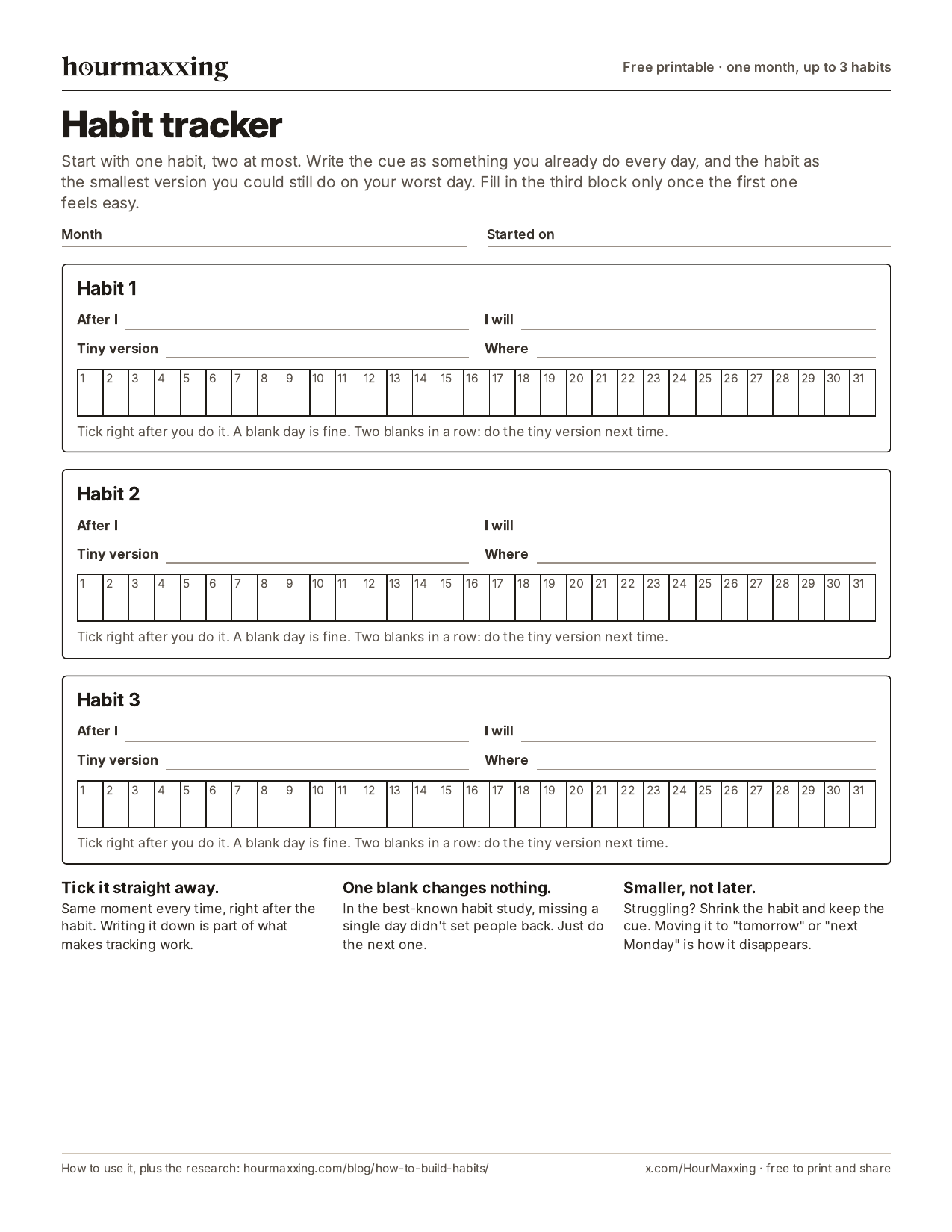
How to use a habit tracker printable
- Write the habit as something you can tick. "Read 1 page" works. "Read more" doesn't, because you can't tell on a Tuesday night whether it happened.
- Tie it to something you already do. "After coffee, read 1 page." A daily cue is what turns repetition into habit.
- Put the page where the habit happens. On the fridge, by the bed, taped inside a notebook. A tracker in a drawer tracks nothing.
- Tick the box straight after. Not at the end of the week from memory.
- Never miss two in a row. One empty box is normal. After a miss, do the smallest possible version the next day so the chain picks back up.
Monthly or weekly habit tracker?
| Layout | Best for | Watch out for |
|---|---|---|
| Monthly grid (above) | Daily habits you want to see as a streak | A bad first week stares at you all month |
| One habit per block (PDF page 1) | One to three new habits with a cue and a tiny version | Fewer habits per page, on purpose |
| Weekly check (PDF page 2) | Telling when a habit is done forming | Needs ten weeks of honest ratings |
Does a habit tracker actually work?
Mostly, yes. A meta-analysis of 138 experiments with almost 20,000 people found that monitoring progress toward a goal made people more likely to reach it, and the effect was bigger when progress was physically recorded or shared with someone (Harkin and colleagues, 2016). Paper counts.
Expect it to take a while. In Phillippa Lally's study at University College London, volunteers repeating one daily behaviour took a median of 66 days to reach peak automaticity, with a range of 18 to 254 days, and missing one day didn't noticeably set them back (Lally and colleagues, 2010). That's about two printed months per habit, not 21 days.
For the full setup (picking the cue, shrinking the habit, stacking it onto your routine), read how to build habits that stick. If the habit you're after is less phone, the screen time calculator gives you a starting number to beat.
FAQ
Is this habit tracker printable free?
Yes. Type your habits and print as many copies as you like, or download the PDF. There is no email gate, no signup and no watermark beyond a small web address at the bottom.
How many habits should I track at once?
Fewer than you want to. One to three is a good start. Habits took a median of about two months to become automatic in the best-known study, so a tracker with ten new habits on it usually turns into a grid of guilt by week two.
What if I miss a day?
Leave the box empty and carry on. In that same study, missing a single day did not noticeably slow habit formation. Longer gaps are the problem, so the rule worth keeping is never two in a row: after a miss, do the tiny version the next day.
Do habit trackers actually work?
Tracking helps more than most tips. A meta-analysis of 138 experiments found that monitoring progress toward a goal improved the odds of reaching it, and the effect was larger when people wrote their progress down physically.
Sources
- Harkin, B., Webb, T. L., Chang, B. P. I., Prestwich, A., Conner, M., Kellar, I., Benn, Y., and Sheeran, P. (2016). Does monitoring goal progress promote goal attainment? A meta-analysis of the experimental evidence. Psychological Bulletin, 142(2), 198-229.
- Lally, P., van Jaarsveld, C. H. M., Potts, H. W. W., and Wardle, J. (2010). How are habits formed: Modelling habit formation in the real world. European Journal of Social Psychology, 40(6), 998-1009.
More free printables and tools: all printables, the Pomodoro timer, the study timer, the visual timer and all tools.