It’s the first Monday of the month and you have a new plan: gym four times a week, read 30 minutes a night, drink more water, journal, meditate, stop doomscrolling. By Thursday you’ve done the water twice, and the journal is a very nice notebook with one entry in it.
Nothing was wrong with those goals. What was missing is the part habit research spends the most time on, which is the setup. Which cue, where, how small, and how long you’ll need to keep at it before it runs on its own.
This guide covers how long habits actually take to form, a 6-step setup built from the studies, habit stacking examples, what to do when you miss a day, and how to break a bad habit. There’s also a free printable habit tracker with a 10-week check that tells you when a habit is done forming.
TL;DR: Pick one habit, shrink it to a version you could do on your worst day, and attach it to something you already do daily (“after I pour my coffee, I will…”). Do it in the same place, make it pleasant, and tick it off right after. Expect about two months for it to feel automatic, longer for complex habits like exercise. Missing one day doesn’t reset anything.
How long does it take to form a habit? (not 21 days)
The 21-day figure is usually traced to Maxwell Maltz’s 1960 self-help book Psycho-Cybernetics, which talked about how long people took to adjust to changes like a new face after plastic surgery. It wasn’t a study of habits.
The study people now cite is by Phillippa Lally and colleagues at University College London (2010). 96 volunteers each picked one eating, drinking or exercise behaviour, like “drink a bottle of water with lunch” or “run for 15 minutes before dinner”, and did it daily in the same context for 12 weeks. Each day they rated how automatic it felt.
What they found:
- The median was 66 days. That’s how long it took for the behaviour to reach 95% of the automaticity it was ever going to reach, among the 39 people whose data fitted the model well.
- The range was 18 to 254 days. Some people got there in under three weeks. Others were still on their way at eight months.
- Early repetitions count most. Automaticity rose quickly at first and then flattened out, like a curve that levels off.
- Complex habits were slower. The exercise group took about one and a half times longer than the eating and drinking groups.
- About half didn’t do it often enough to form the habit at all, even though they had volunteered for a habit study.
Later work landed in the same place. A 2024 systematic review by Ben Singh and colleagues pooled 20 studies with 2,601 people. Median times ranged from 59 to 66 days, average times from 106 to 154 days, and individual times from 4 to 335 days. Jan Keller’s 2021 trial of nutrition habits found a median of 59 days among people who formed the habit.
For exercise specifically, Navin Kaushal and Ryan Rhodes (2015) followed 111 new gym members for 12 weeks. Going at least four times a week for six weeks was the minimum it took to establish an exercise habit.
So plan on two months for a simple daily habit, and more for anything with several steps. If day 30 still takes effort, you’re on schedule.
What a habit actually is (and why motivation runs out)
In psychology, a habit is a behaviour that your surroundings trigger automatically, because you’ve repeated it many times in the same situation. Wendy Wood and Dennis Rünger’s 2016 review describes habits as the efficient, default mode of acting. You don’t decide to put your seatbelt on. Getting in the car does it.
That’s what you’re building. You want the cue to start the behaviour, so you no longer have to remember it or talk yourself into it.
Two things follow from that.
Motivation gets you started, and the cue keeps it going. In diary studies by Wood, Jeffrey Quinn and Deborah Kashy (2002), people doing habitual things were usually thinking about something else, and felt less stressed than when doing non-habitual things. A habit is cheap to run. Willpower isn’t, and it runs out by Thursday.
The ingredients are well known. A 2026 study by Sebastian Bürgler and colleagues tracked 254 people building a habit for six months. The ones whose habits grew stronger did the behaviour more often and in a more stable context, wanted to do it for their own reasons, found it pleasant and energising, and found it easy. Some people’s habits formed and then faded again over the months, so a habit can weaken if the setup slips.
How to build habits that stick (the 6-step setup)
This is our setup, built from the studies above. Copy it into your notes app and fill in the right-hand column for one habit.
| Step | Ask yourself | Example |
|---|---|---|
| 1. Pick one | What’s one habit I actually want, not one I think I should have? | “Read before bed.” |
| 2. Shrink it | What’s the smallest version I could do on my worst day? | “Read one page.” |
| 3. Pick the cue | What do I already do every day that could trigger it? | “After I plug my phone in to charge at night.” |
| 4. Fix the place | Where will it happen, every time? | “In bed, book already on the pillow.” |
| 5. Make it pleasant | What makes this something I look forward to? | “The good lamp, and a book I picked for fun.” |
| 6. Tick it off | Where do I record it, right after? | “The tracker taped inside the wardrobe door.” |
Why pick only one. Habits take about two months each, and in Lally’s study about half of motivated volunteers didn’t repeat one behaviour often enough. The Singh review found that habits people chose themselves formed more strongly than assigned ones, which fits the “own reasons” finding in Bürgler’s study. Start the second habit once the first one feels easy.
Why shrink it. Complexity slows habit formation (the exercise group in Lally’s study) and perceived difficulty predicted weaker habits in Bürgler’s. A tiny version also means a bad day still counts as a repetition. One page read keeps the cue and the habit linked. Skipping because “30 minutes isn’t happening tonight” breaks the link. You can always read more than one page.
Why the cue matters most. Benjamin Gardner, Phillippa Lally and Jane Wardle’s 2012 guide for doctors comes down to one instruction: pick a time and place you encounter every day, and every time you encounter it, do the action. The cue can be an event (“when I get to work”) or part of a routine (“after breakfast”).
Keller’s 2021 trial randomly assigned 192 adults to link a nutrition habit to either a daily routine or a set clock time, and both worked about equally well. What mattered was actually doing it when the cue came round.
Why the same place. Context stability came up in every study above. The place is part of the cue, so a habit done in a different spot each day has to be remembered each day.
Why pleasant. Feeling pleased and energised by the behaviour predicted stronger habits in Bürgler’s study. One way to make it pleasant is temptation bundling: Katherine Milkman and colleagues (2014) gave people page-turner audiobooks they could only listen to at the gym, and they went 51% more often than a control group at first. The effect faded over the weeks (especially after Thanksgiving), so think of bundling as a way to get through the early weeks, when automaticity grows fastest.
Why tick it off. See does a habit tracker actually work below. Short answer: yes, and especially on paper.
Habit stacking: examples you can copy
Habit stacking is the name James Clear made popular for step 3: “After [current habit], I will [new habit].” Researchers call the idea cue-based planning, and it’s closely related to the if-then plans from our procrastination guide, which had a medium-to-large effect on following through across 94 tests.
The trick is an anchor you never skip. Some that work for most people:
- After I pour my first coffee, I will write today’s three tasks on a sticky note.
- After I sit down on the bus or train, I will do 10 flashcards.
- After I close my laptop for the day, I will write tomorrow’s first task on a sticky note and leave it on the keyboard.
- After I brush my teeth at night, I will floss one tooth (yes, one).
- After I put the kettle on, I will do 10 squats while it boils.
- After I get into bed, I will put the phone on the charger across the room.
Order matters a little. In one small flossing study, people told to floss after brushing built stronger flossing habits than people told to floss before. Put the new habit right after the anchor, not before it. If you want to stack a whole morning, our morning routine guide chains the steps so each one cues the next.
A free printable habit tracker (PDF)
Here’s the tracker we built for this setup: download the habit tracker (PDF). It’s free, and you don’t have to give us an email. To track more habits on one page, use the fill-in habit tracker printable.
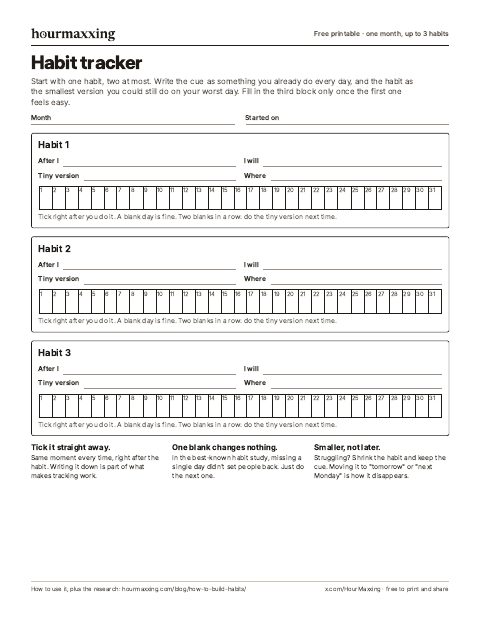
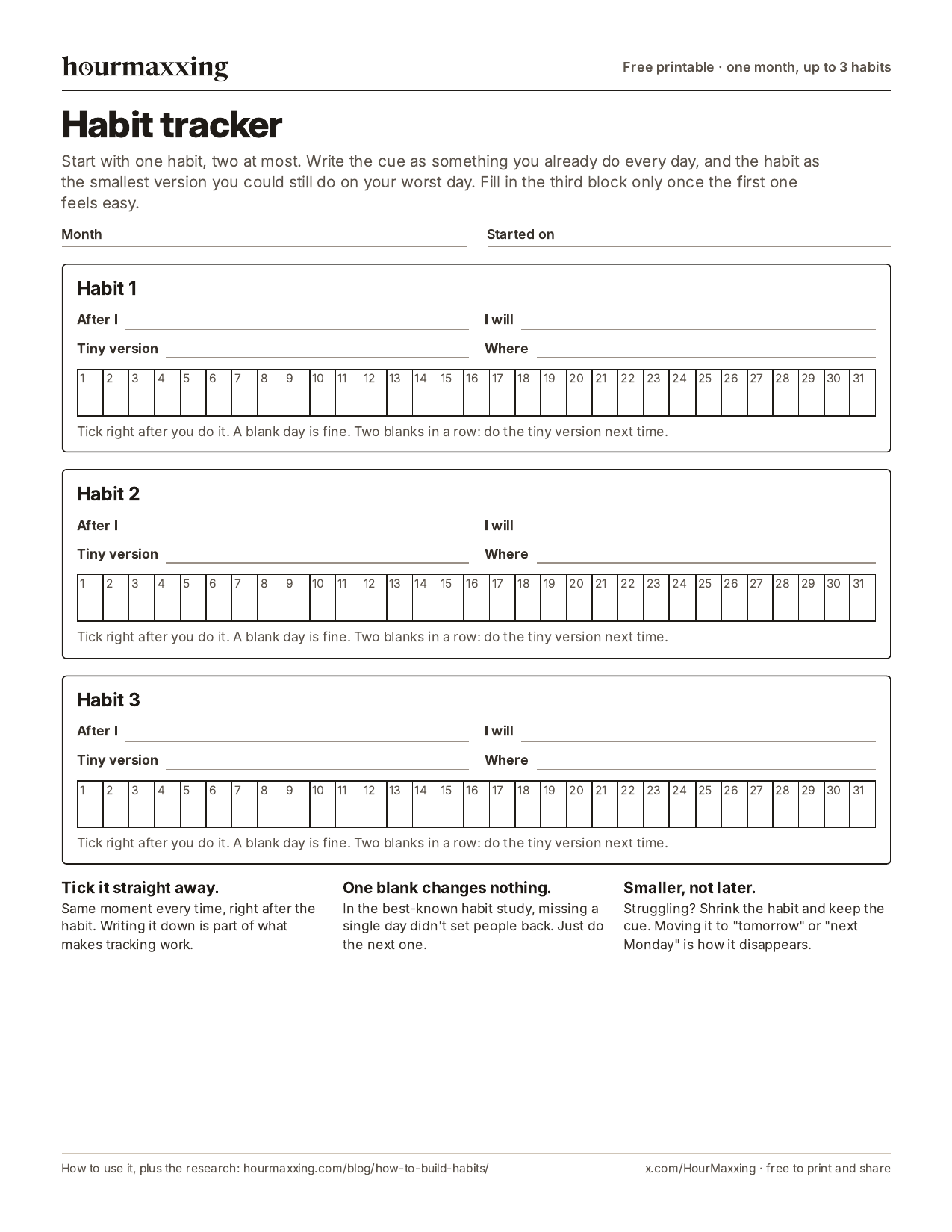
Page 1 is one month for up to 3 habits. Each block has the cue (“After I…”), the habit (“I will…”), a tiny version, a place, and 31 boxes. The page tells you to fill in the third block only once the first feels easy, because that’s the part people skip.
Page 2 is the 10-week “is it a habit yet?” check. Once a week you rate four statements from 1 to 7: I do it automatically, I do it without having to consciously remember, I do it without thinking, and I start doing it before I realize I’m doing it. Those four are the Self-Report Behavioural Automaticity Index, a short scale Gardner and colleagues (2012) took from the longer habit questionnaire researchers use. The total is out of 28.
Expect your total to climb quickly and then level off, like the curves in Lally’s study. When it stops rising for two or three weeks, the habit is about as automatic as it’s going to get. That’s your signal to start the next one. There’s also a phone image of page 1 if you’d rather not print.
Does a habit tracker actually work?
Mostly yes. Benjamin Harkin and colleagues’ 2016 meta-analysis pooled 138 experiments with 19,951 people, all of which randomly assigned people to monitor their progress toward a goal or not. Monitoring improved goal attainment (d = 0.40). It helped more when progress was physically recorded, and when it was reported to someone else or made public.
Gardner’s habit guide suggests a simple tick sheet for the same reason. The tick also gives the habit a clear finish line every day.
Two ways a tracker goes wrong:
- It becomes the habit. If you’re updating a 14-row spreadsheet, you’re running a spreadsheet habit. Track one to three things.
- It punishes you. A wall of blanks feels like failure, and the urge is to start over with a fresh sheet next month. Keep the same sheet and keep ticking. The blanks show you which days need a smaller version.
If you’d rather show it to someone, a friend, a group chat or a body double works, and that fits Harkin’s finding about reporting progress.
What to do when you miss a day
Nothing dramatic. In Lally’s study, a single missed day caused a small, short dip in automaticity, and the score went back up the next time people did the behaviour. Missing once didn’t materially slow habit formation. Missing early in the process wasn’t worse than missing later.
Longer gaps are different. The study’s authors point to earlier work where lapsing for a whole week made people less likely to keep going.
So the rule worth keeping is “never miss twice”, which James Clear also uses. That’s a rule of thumb, not a study finding, but it fits the data. One blank day is noise. Two blank days in a row means it’s time for the tiny version, not a new start date.
Don’t reschedule it to Monday, either. Starting over on a symbolic date throws away the cue you’ve been building, and the cue is the habit.
When is the best time to start a new habit?
Right after something in your life changes, if you can. Bas Verplanken and Deborah Roy (2016) sent a sustainable-living intervention to 800 households, half of which had recently moved. It worked better on people who’d moved within the previous three months. The authors call it the habit discontinuity hypothesis: when old cues are disrupted, you’re more open to new routines. The effect was small, and they describe it as a proof of concept.
A new job, a move, a new semester or a schedule change is a good time to set up the habit you want, because the old cues are already gone.
The same thing works against you. If a trip or a new timetable breaks your cue, the habit can quietly fall apart. Bürgler’s study saw habits weaken over a few months. Before a big change, pick the cue you’ll use in the new routine.
Timing within the day matters a little too. The Singh review found habits practised in the morning tended to be stronger, and in one stretching study, morning habits formed faster than evening ones. If you can choose, put a new habit early.
How to break a bad habit
Breaking a habit isn’t building one in reverse. Habits are cued by your surroundings, so the most reliable fix is to change or avoid the cue. When students in another of Wood’s studies transferred to a new university, their old habits survived mainly when parts of the old setting came along. That’s why moving the phone charger out of the bedroom does more than deciding to scroll less.
When you can’t avoid the cue, monitor it. In diary studies by Quinn, Wood and colleagues (2010), people controlled strong bad habits best with vigilant monitoring: thinking “don’t do it” and watching carefully for slip-ups. Removing themselves from the situation worked well for temptations but not for strong habits. A follow-up experiment found monitoring worked by boosting control in the moment, not by weakening the habit itself.
Put together:
- Name the cue. When does it happen? “Lying in bed, phone in hand, 11pm.”
- Change the cue if you can. Charger in the kitchen. App off the home screen. Snacks on a high shelf.
- Plan for the moments you can’t. “If I pick up my phone in bed, then I put it face down and say ‘not now’.” That’s monitoring with an if-then plan attached.
- Put something in the gap. A cue with nothing attached tends to pull the old behaviour back. Book on the pillow, phone across the room.
For the phone specifically, our phone guide has the 15-minute settings version, and the dopamine menu gives you something to reach for instead of the feed. If you want to see what the habit adds up to first, the screen time calculator turns your daily average into hours per year and years of your life.
How to build habits with ADHD
The setup is the same, but ADHD makes “remember to do it” the weak link, so more of the cue has to live outside your head:
- Make the cue visible. Vitamins next to the kettle, not in a cupboard. Running shoes by the door. A cue you can see does the remembering for you.
- Anchor to something you never skip. Brushing your teeth, the first coffee, locking the front door. A cue like “after work” is too vague.
- Make the tiny version really tiny. One flashcard. One push-up. Shoes on. Starting is usually the hard part, and once you’ve started, doing more is easy.
- Put the tracker where you’ll trip over it. On the fridge or the bathroom mirror. A tracker app you have to open is another thing to remember.
- Borrow other people. A body double or a check-in text works the way a cue does.
Our ADHD morning routine guide shows how to chain steps so the end of each one cues the next. That’s habit stacking for a whole morning.
Common habit mistakes
- Starting five habits on the first of the month. Each one needs its own cue and about two months of repetition. Do one, then the next.
- A goal instead of a behaviour. “Get fit” can’t be cued. “After I put the kettle on, I do 10 squats” can.
- A vague cue. “In the morning” isn’t one, but “after I pour my coffee” is.
- Judging it at day 21. If it still takes effort at three weeks, you’re right on the typical schedule.
- Treating a miss as a restart. One blank day doesn’t cost you anything. Restarting next Monday throws away the cue you’ve built.
- Changing everything at once when life changes. A move or new job is a good time to add a habit, but pick its new cue on purpose or it’ll drift.
Sources
- Lally, P., van Jaarsveld, C. H. M., Potts, H. W. W., & Wardle, J. (2010). How are habits formed: Modelling habit formation in the real world. European Journal of Social Psychology, 40(6), 998-1009. https://doi.org/10.1002/ejsp.674. 96 volunteers, 82 with enough data, 39 with good model fit; median 66 days to 95% of asymptote (range 18 to 254); exercise about 1.5 times longer; a single missed opportunity did not materially affect formation.
- Singh, B., Murphy, A., Maher, C., & Smith, A. E. (2024). Time to form a habit: A systematic review and meta-analysis of health behaviour habit formation and its determinants. Healthcare, 12(23), 2488. https://doi.org/10.3390/healthcare12232488. 20 studies, 2,601 participants; medians 59 to 66 days, means 106 to 154 days, range 4 to 335 days; morning and self-selected habits stronger.
- Keller, J., Kwasnicka, D., Klaiber, P., Sichert, L., Lally, P., & Fleig, L. (2021). Habit formation following routine-based versus time-based cue planning: A randomized controlled trial. British Journal of Health Psychology, 26(3), 807-824. https://doi.org/10.1111/bjhp.12504. N = 192; median 59 days; routine and time cues similarly effective.
- Kaushal, N., & Rhodes, R. E. (2015). Exercise habit formation in new gym members: A longitudinal study. Journal of Behavioral Medicine, 38(4), 652-663. https://doi.org/10.1007/s10865-015-9640-7. N = 111; at least four sessions a week for six weeks.
- Bürgler, S., Milyavskaya, M., McMillan, G., Burns, R. J., Lally, P., & Gardner, B. (2026). What makes a habit? Investigating potential determinants of habit formation. Personality and Social Psychology Bulletin. https://doi.org/10.1177/01461672261440446. N = 254 over six months; formation and degradation trajectories; frequency, context stability, autonomous motivation, feeling energized and pleased (positive), perceived difficulty (negative).
- Wood, W., & Rünger, D. (2016). Psychology of habit. Annual Review of Psychology, 67, 289-314. https://doi.org/10.1146/annurev-psych-122414-033417.
- Wood, W., Quinn, J. M., & Kashy, D. A. (2002). Habits in everyday life: Thought, emotion, and action. Journal of Personality and Social Psychology, 83(6), 1281-1297. https://doi.org/10.1037/0022-3514.83.6.1281.
- Wood, W., Tam, L., & Witt, M. G. (2005). Changing circumstances, disrupting habits. Journal of Personality and Social Psychology, 88(6), 918-933. https://doi.org/10.1037/0022-3514.88.6.918.
- Gardner, B., Lally, P., & Wardle, J. (2012). Making health habitual: The psychology of “habit-formation” and general practice. British Journal of General Practice, 62(605), 664-666. https://doi.org/10.3399/bjgp12X659466.
- Gardner, B., Abraham, C., Lally, P., & de Bruijn, G.-J. (2012). Towards parsimony in habit measurement: Testing the convergent and predictive validity of an automaticity subscale of the Self-Report Habit Index. International Journal of Behavioral Nutrition and Physical Activity, 9, 102. https://doi.org/10.1186/1479-5868-9-102. The 4-item SRBAI used on page 2 of the tracker.
- Harkin, B., Webb, T. L., Chang, B. P. I., Prestwich, A., Conner, M., Kellar, I., Benn, Y., & Sheeran, P. (2016). Does monitoring goal progress promote goal attainment? A meta-analysis of the experimental evidence. Psychological Bulletin, 142(2), 198-229. https://doi.org/10.1037/bul0000025. 138 studies, N = 19,951; d = 0.40 on goal attainment; larger when physically recorded or reported.
- Milkman, K. L., Minson, J. A., & Volpp, K. G. M. (2014). Holding the Hunger Games hostage at the gym: An evaluation of temptation bundling. Management Science, 60(2), 283-299. https://doi.org/10.1287/mnsc.2013.1784.
- Gollwitzer, P. M., & Sheeran, P. (2006). Implementation intentions and goal achievement: A meta-analysis of effects and processes. Advances in Experimental Social Psychology, 38, 69-119. https://doi.org/10.1016/S0065-2601(06)38002-1.
- Judah, G., Gardner, B., & Aunger, R. (2013). Forming a flossing habit: An exploratory study of the psychological determinants of habit formation. British Journal of Health Psychology, 18(2), 338-353. https://doi.org/10.1111/j.2044-8287.2012.02086.x.
- Verplanken, B., & Roy, D. (2016). Empowering interventions to promote sustainable lifestyles: Testing the habit discontinuity hypothesis in a field experiment. Journal of Environmental Psychology, 45, 127-134. https://doi.org/10.1016/j.jenvp.2015.11.008. 800 participants; window of about three months after relocation; small effect.
- Quinn, J. M., Pascoe, A., Wood, W., & Neal, D. T. (2010). Can’t control yourself? Monitor those bad habits. Personality and Social Psychology Bulletin, 36(4), 499-511. https://doi.org/10.1177/0146167209360665.
- Clear, J. (n.d.). How to build new habits by taking advantage of old ones [Excerpt from Atomic Habits]. https://jamesclear.com/habit-stacking
Want one more of these each week?
One technique a week, the study behind it, and a low-energy version. Free, about a 3-minute read, unsubscribe anytime.
We use your address only to send the email, and you can unsubscribe in one click.
FAQ
How long does it take to form a habit?
Longer than 21 days, and it varies a lot. In the best-known study, Phillippa Lally and colleagues (2010) had volunteers repeat one daily behaviour in the same context. It took a median of 66 days for it to become as automatic as it was going to get, with a range of 18 to 254 days. A 2024 review of 20 studies found median times of 59 to 66 days and individual times from 4 to 335 days. Simple habits form faster than complex ones.
Is it true that it takes 21 days to form a habit?
No study backs the 21-day number. It's usually traced to Maxwell Maltz's 1960 self-help book Psycho-Cybernetics, about how long people took to get used to changes like a new face after surgery. When researchers actually measured habit formation, the typical time was about two months, and some people took far longer.
How do I build habits that stick?
Pick one habit you actually want, shrink it to a version you could do on your worst day, attach it to something you already do every day (after I pour my coffee, I will...), do it in the same place, make it pleasant, and tick it off right after. Then repeat it for about two months. Habit studies keep finding the same ingredients: frequent repetition, a stable cue and context, low difficulty, and enjoying it.
What is habit stacking?
Habit stacking means attaching a new habit to one you already have, using the formula 'After [current habit], I will [new habit].' James Clear popularised the name in Atomic Habits. Research calls the idea cue-based planning. Examples: after I pour my morning coffee, I will write today's 3 tasks; after I sit down on the train, I will do 10 flashcards; after I brush my teeth at night, I will floss one tooth.
Is there a free printable habit tracker?
Yes. We made a free two-page habit tracker PDF, no email needed: hourmaxxing.com/printables/habit-tracker.pdf. Page 1 tracks up to 3 habits for a month, each with its cue (After I...), the habit (I will...), a tiny version and 31 tick boxes. Page 2 is a 10-week 'is it a habit yet?' check using the four statements researchers use to measure how automatic a behaviour has become.
Do habit trackers actually work?
Tracking progress helps, with a caveat. A 2016 meta-analysis of 138 experiments (19,951 people) by Benjamin Harkin and colleagues found that interventions that got people monitoring their progress improved goal attainment (d = 0.40), and the effect was bigger when progress was physically recorded or shared. The caveat: the tracker supports the habit, but the cue and the repetition are what actually build it.
What happens if I miss a day of a habit?
Not much. In Lally's study, missing a single day didn't materially affect how fast the habit formed, and scores went back up the next time people did it. Longer gaps are a different story, so the useful rule is to make sure one missed day doesn't turn into a missed week. If you miss two in a row, do the tiny version next time.
How do I break a bad habit?
Change the cue if you can, and watch for the moment when you can't. In diary studies by Jeffrey Quinn, Wendy Wood and colleagues (2010), people controlled strong bad habits best with vigilant monitoring: thinking 'don't do it' and watching for slip-ups. Removing temptation worked well for temptations but not for strong habits. Habits also loosen when your context changes, like after a move.
How do I build habits with ADHD?
The same steps apply, with more of the cue outside your head. Use a visible trigger (the vitamins next to the kettle, not in a cupboard), keep the habit tiny, attach it to something you already do without fail, and put the tracker where you'll see it. Our ADHD morning routine guide shows how to chain steps so each one cues the next.
New here? Start with the reading order → Rather use paper? Grab a free printable.