White noise generator
The player needs JavaScript. A fan or any steady white noise track at low volume works the same way.
Our white noise generator makes the sound on your device while it plays, so you don't need a ten-hour video. Nothing cuts in at full volume, and there's no loop that hiccups every few minutes. Press play, pick a timer if you'd like it to stop on its own, and leave the tab open behind whatever you're working on.
It fades in over a couple of seconds so it won't make you jump, and it fades out when the timer runs down. You can switch to pink or brown at any point without stopping it. There's no account, and nothing to install on a school or work laptop.
Why white noise covers voices
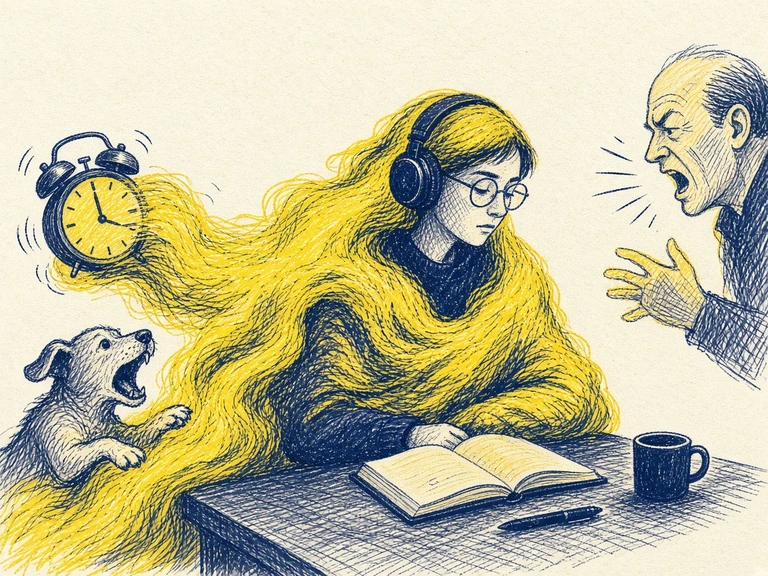
White noise has the same amount of energy at every pitch, from the low rumble right up to the top end, which is why it sounds like a hiss or an untuned radio. That flat spread is also what makes it good at hiding sharp, high sounds. Speech is the worst offender, since your brain tries to follow any conversation it can make out, and a lot of what makes words easy to follow sits in those higher pitches. White noise fills them in, so the call two desks over turns into a murmur you can ignore.
The catch is that it can feel harsh, especially through headphones. If it starts to grate after ten minutes, try pink, which keeps most of the cover with less hiss. If your room's fairly quiet and you just want something soft in the background, the brown noise generator is the better fit.
Which color for which noise
For voices, open offices and a TV next door, use white, since it covers the high sounds that make speech easy to follow. For traffic, wind or footsteps upstairs, pick pink or brown, because a low rumble needs low sound on top of it. If nothing in particular is bothering you, use whichever you forget about first.
Does white noise help you focus?
White noise is the color that's actually been studied, and the answer depends on who's listening. In an early experiment, kids with ADHD remembered more with white noise playing, while kids without ADHD did slightly worse (Söderlund and colleagues, 2007). A 2024 meta-analysis of 13 studies found the same split: a small boost on attention tasks for young people with ADHD or attention problems, and a slight cost for everyone else (Nigg and colleagues, 2024).
So test it on yourself. Pick one task you can count, like pages read or problems done, and alternate days with noise and without for a week. Our guide on brown noise and ADHD has the full one-week test and the rest of the research. If you work in rounds, set the noise timer to match the study timer, and the fade-out tells you it's break time.
White noise for sleep and babies
Plenty of people sleep better with a hiss covering the street, and if it works for you, that's fine. The research is weaker than the sleep aisle suggests, though. A 2021 review of 38 studies rated the evidence that steady noise improves sleep as very low quality, and noted that noise left on all night might also disturb sleep and hearing (Riedy and colleagues, 2021).
Volume matters most with babies. When researchers in Toronto played 14 infant sleep machines at full volume, every one was louder than the limit recommended for hospital nurseries at 30 cm from the crib, and three were loud enough that a full night would pass workplace safety limits for adults (Hugh and colleagues, 2014). If you use this page in a nursery, play it from a device across the room, keep it low and set the timer. We're not clinicians, and none of this is medical advice.
FAQ
Is this white noise generator free?
Yes. It runs in your browser with no ads or account, and there's nothing to download. The sound is made live on your device, so there's no recording that loops and no ad break halfway through.
Is white noise or brown noise better?
White is better at covering voices, typing and other sharp sounds, because it has as much energy in the high pitches as the low ones. Brown is softer and easier to leave on when the room is already fairly quiet. Try each for a minute at the same volume and keep the one you stop noticing first.
How loud should white noise be?
Only loud enough that the distraction fades. If you can't comfortably talk over it, it's too loud. For a baby, keep the speaker across the room and the volume low, since a 2014 study found infant sleep machines at full volume were louder than the limit recommended for hospital nurseries.
Is it OK to sleep with white noise on all night?
The evidence that steady noise improves sleep is thin, and a 2021 review noted that noise left on all night might also disturb sleep and hearing. Use the timer instead, so it fades out once you've fallen asleep.
Does it keep playing in another tab or on a phone?
It keeps playing in a background tab on a laptop or desktop. Some phones pause browser audio when the screen locks, so keep the screen on or use a computer for long sessions.
Sources
- Söderlund, G., Sikström, S., and Smart, A. (2007). Listen to the noise: Noise is beneficial for cognitive performance in ADHD. Journal of Child Psychology and Psychiatry, 48(8), 840-847.
- Nigg, J. T., Bruton, A., Kozlowski, M. B., Johnstone, J. M., and Karalunas, S. L. (2024). Systematic review and meta-analysis: Do white noise or pink noise help with task performance in youth with attention-deficit/hyperactivity disorder or with elevated attention problems? Journal of the American Academy of Child and Adolescent Psychiatry, 63(8), 778-788.
- Riedy, S. M., Smith, M. G., Rocha, S., and Basner, M. (2021). Noise as a sleep aid: A systematic review. Sleep Medicine Reviews, 55, 101385.
- Hugh, S. C., Wolter, N. E., Propst, E. J., Gordon, K. A., Cushing, S. L., and Papsin, B. C. (2014). Infant sleep machines and hazardous sound pressure levels. Pediatrics, 133(4), 677-681.
More free tools: the brown noise generator, the study timer, the Pomodoro timer, the visual timer and all tools.