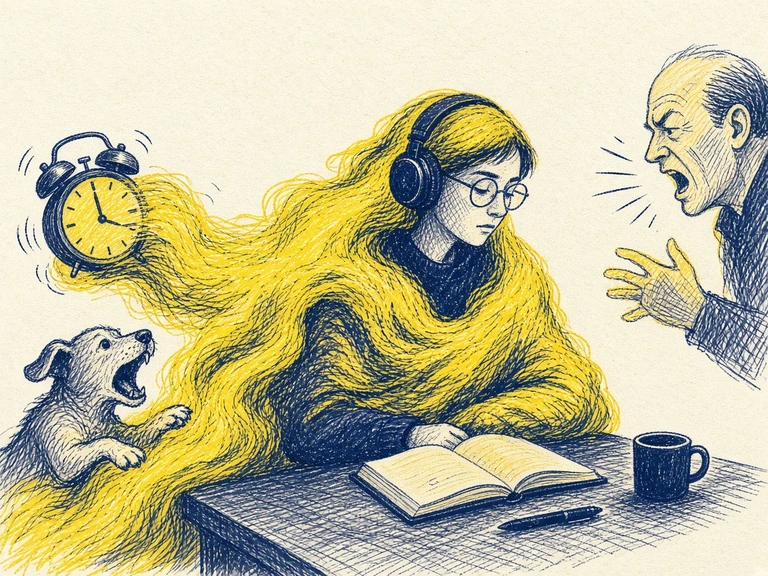
Short answer: nobody has tested brown noise for ADHD directly. A 2024 meta-analysis of white and pink noise found a small attention boost for kids and young adults with ADHD (about 0.25 effect size across 13 studies), and a slight hurt for people without it. Try brown noise for one week on one task type, keep it quiet, and keep a tally.
It’s 2pm. You type “brown noise for ADHD” into YouTube, pick the 10-hour one with the black screen, and settle in. Eleven minutes later, a loud ad for a meal kit plays at full volume. Then, for a while, you’re reading the comments instead of the report.
Brown noise is one of the few ADHD internet tips with real lab research nearby. The catch is that the research is about its cousins, white and pink noise, and the effect is small.
Below is what the studies actually found, which color of noise to try, how loud is safe, how it stacks up against music and binaural beats, and a free player that makes the noise right in your browser with no ads and no gaps.
Does brown noise help ADHD?
Maybe, a little. Nobody has checked brown noise directly.
The best evidence is a 2024 meta-analysis by Joel Nigg and colleagues at Oregon Health & Science University. They looked for randomized studies of white, pink or brown noise during attention tasks in people with ADHD or high ADHD symptoms. They found 13 usable studies (12 on white noise, 1 on pink) and zero on brown noise.
Across 335 children, teens and college students, steady noise gave a small, consistent boost on lab tasks (an effect size of about 0.25). For comparison, the authors put ADHD medication effects at 0.7 or above. In the comparison groups without attention problems, the same noise made performance slightly worse (Nigg et al., 2024).
A few limits worth knowing before you buy the premium app:
- Sessions lasted minutes. Nobody has tested hours a day, every day.
- It was lab tasks. Memory tests and reaction time, not your inbox.
- Adults are barely in it. The two adult studies were both unpublished master’s theses with college students.
- Brown noise is a guess. The authors think the effect “may well extend to brown noise,” but they say directly that it hasn’t been studied.
So the honest version is that steady noise is a cheap, low-risk thing to try, and the effect is probably closer to “a slightly better hour” than a different brain.
Why does brown noise help me focus?
Nobody knows for sure. There are three decent explanations, and they can all be true at once.
It adds a bit of stimulation. A long-running idea in ADHD research is under-arousal: a quiet room leaves some brains under-stimulated, so attention wanders off looking for input. Arousal works on an upside-down U: too little and you drift, too much and you scatter. That would explain why noise helped the ADHD groups and hurt everyone else in the meta-analysis. They started at different points on the curve.
Maybe the randomness matters, maybe not. In 2007, Göran Söderlund and colleagues found white noise improved memory in kids with ADHD and worsened it in kids without. They explained it with stochastic resonance, the idea that a little random noise can make a weak signal easier to detect, plus a model in which dopamine levels set how much noise a brain needs (Söderlund et al., 2007).
That model took a hit in 2024. In a Belgian study of 60 adults, a plain, steady 100 Hz hum helped people with higher ADHD traits on a slow reaction task, and so did pink noise (Rijmen & Wiersema, 2024). If a boring tone works too, the “random” part may not matter much.
It covers the sounds that grab you. A door, a coworker laughing, half a sentence from the next room. In a big meta-analysis of reading studies, real-world environmental noise was more distracting than steady artificial noise like white noise (Vasilev et al., 2018). Brown noise is a steady wall that sits on top of the interesting stuff.
Who it helps (and who it doesn’t)
Averages hide a lot here. In a 2024 study of 43 kids with diagnosed ADHD, noise did nothing on average. Split the group, though, and the kids with more inattentive traits did better with noise, while the kids with more hyperactive and impulsive traits did worse (Söderlund et al., 2024).
Music showed the same split. In a classroom study, music helped some boys with ADHD and hurt others compared with quiet. A video playing in the room distracted them, especially the boys with ADHD (Pelham et al., 2011).
So “does brown noise help ADHD?” doesn’t have one answer. Whether it helps you is something a one-week test can tell you, laid out below.
Does brown noise help anxiety? (and why it gives some people anxiety)
Both of these autocomplete for “brown noise anxiety,” sometimes in the same search. Both can be true.
The calming side has some evidence, just not for brown noise. Two 2026 hospital trials in Turkey played noise to people waiting for a colonoscopy, which is a pretty reliable anxiety setup.
In one, 135 adults got white noise, pink noise or nothing for 20 minutes before and during the procedure. Both noise groups reported less pain, and the pink noise group ended with lower anxiety than the other two (Toprak et al., 2026).
In the other, with 90 older adults, white noise and music both lowered fear and anxiety compared with ordinary room sound, and music worked better (Çullu et al., 2026).
That’s short sessions, in a stressful waiting room, with no brown noise and no ADHD. It’s a reason to try noise when you’re keyed up, not proof it treats anxiety.
The tense side has a mechanism. Brown noise is mostly low rumble, and low rumble is the part of noise people tend to hate.
In a Swedish study, 32 people did two hours of work tasks with quiet ventilation noise (40 dBA) playing. The rumble-heavy version was rated more annoying and worse for getting work done than a flatter version at the same level.
In the people who described themselves as sensitive to noise, the rumble also kept their cortisol from dropping the way it normally does over the day (Persson Waye et al., 2002).
That was a fan hum, not a brown noise track, and a small group, but it fits the “this sounds like a plane engine and I hate it” crowd.
The ADHD kids study points the same way: noise helped the more inattentive kids and made the more hyperactive ones worse (Söderlund et al., 2024). Our reading, not a tested finding: if you’re already wound up, extra input can push you past the top of the arousal curve instead of up to it.
So:
- If brown noise calms you, keep it, at a safe volume.
- If it makes you tense, switch to pink, which has less rumble, or drop it. Silence or calm music are fine settings too.
- If anxiety is most days, not just before a hard task, that’s worth a conversation with a doctor. Noise is a comfort, not a treatment.
ADHD noise sensitivity (overwhelmed by noise, but brown noise helps?)
“ADHD overwhelmed by noise” and “noise for ADHD focus” autocomplete side by side. It sounds like a contradiction. It mostly isn’t.
Sound sensitivity is common with ADHD. In a Dutch study of 116 adults diagnosed with ADHD, Bijlenga and colleagues (2017) found more sensory over- and under-sensitivity than in norm groups. Hearing was one of the two areas where it stood out most.
It rose with ADHD symptom scores, not with autistic traits, and 43% of the women reported it, against 22% of the men.
A British survey of 234 adults from the general population pointed the same way: the more ADHD traits people had, the more sensory difficulties they reported, across every sense (Panagiotidi et al., 2018).
Both studies used questionnaires. They measure how sound feels to you, not how well your ears work.
The sounds that get you are usually the changing ones. A voice, chewing, a door, a phone buzzing on the desk. In the reading meta-analysis, real-world noise was more distracting than steady artificial noise (Vasilev et al., 2018).
Brown noise is the steady kind. Our reading, not a tested finding: it works less like extra sound and more like a curtain over the sounds that keep grabbing you.
That’s also why gaps hurt. In the 2025 online study, short silences dropped into steady noise disrupted memory more for adults with self-reported ADHD (Elbe et al., 2025). The curtain drops, and everything behind it is back.
So:
- If voices and random sounds are the problem, cover them with brown or pink noise at low volume, using the player below.
- If all sound is too much, try earplugs or noise-cancelling headphones with nothing playing. No ADHD study has tested either, but the WHO backs noise-cancelling in loud places (WHO, 2026).
- If noise winds you up, that’s the hyperactive pattern from the 2024 kids study. Silence wins.
- If a sound makes you snap at someone, that’s a short fuse as much as a noise problem. Our ADHD anger guide has the in-the-moment steps.
- If it builds until you check out, here’s what to do in an ADHD shutdown.
- If sound overload has been intense since childhood, with a need for total quiet, ask about an autism assessment as well. ADHD and autism often show up together, as the Bijlenga paper notes.
Brown noise vs white noise vs pink noise (which is best for ADHD?)
The colors describe how the sound’s energy is spread from low notes to high notes.
- White noise has equal energy at every frequency. It sounds like radio static or a hiss.
- Pink noise loses a little energy as it goes up (3 decibels per octave). It sounds more like steady rain.
- Brown noise loses energy twice as fast (6 dB per octave), so it’s mostly low rumble, closer to a waterfall. It’s named after Brownian motion, the random jiggle of particles, and has nothing to do with the color (Robjohns, 2004).
Which is best for ADHD? Nobody has compared them in ADHD. White noise is the one with most of the evidence, pink has one study, and brown has none. If you want to start with the studied one, our white noise generator opens on white. Sound apps also sell green, gray and other colors, and we couldn’t find a single ADHD study on any of them.
Green is the one people ask about most, so it gets its own section below.
We’d start with brown, because it has the least hiss and most people find it easiest to forget about. If it feels muddy, or you need to cover voices, try pink, then white. The right one is the one you stop noticing within a few minutes.
Brown noise vs green noise (and what green noise actually is)
Green noise is a sleep-app color, not an engineering one. Sound On Sound’s rundown of noise colors covers white, pink, brown, blue and violet, and green isn’t on it (Robjohns, 2004).
The usual description comes from a 1996 “Colors of noise” FAQ on an audio newsgroup. It calls green noise a relaxation-tape label, “supposedly the background noise of the world,” rather like pink noise with a hump added around 500 Hz (Wisniewski, 1996).
In printing, “green noise” means something else entirely, a dot pattern for halftone images (Lau et al., 1998).
So the practical difference looks like this.
- Brown noise has a fixed recipe: the most bass and the least hiss of the standard colors. Every brown noise track is roughly the same sound.
- Green noise has no recipe. Most tracks trim the bass and hiss and push the middle forward, more stream than rumble. Two apps can sell two quite different sounds under the name.
Which is better for focus or sleep? We couldn’t find a single study that tested green noise for either, in ADHD or in anyone else.
There is research on real nature recordings: a 2021 review in PNAS concluded that natural sounds improve health and mood and lower stress (Buxton et al., 2021). But that’s birds and water, not filtered noise with a green label.
Our take: if brown feels heavy or muddy, a green track is a fine thing to try in the one-week test. Treat it as a preference, not an upgrade.
The player below makes brown, pink and white. Pink is the closest standard color to that 1996 description. The volume rules are the same for every color.
A free brown noise player (no ads, no gaps)
Free noise player
The player needs JavaScript. Any steady brown noise track at low volume works the same way.
The noise is generated live in your browser, so nothing repeats (full-page version). It fades in over two seconds, so it won’t startle you, and it fades out when the timer ends. Start with your device volume low and turn the slider up only until the room’s background sounds go away.
Why make one instead of linking a video? Two reasons. Ads land at full volume in the middle of a session, and loops on some tracks restart with a tiny gap of silence. In a 2025 online study, short silent breaks in steady white noise disrupted memory more for adults with self-reported ADHD, while sudden bursts of noise in a quiet room bothered adults without ADHD more (Elbe et al., 2025). One study, but it fits the complaint people make about ads and loops.
How to use brown noise for ADHD focus (a one-week test)
Most people try brown noise once, feel calmer, and decide it works. Feeling calmer is nice, but the studies measured work getting done, and those two don’t always go together. This takes a week and costs nothing.
- Pick one repeatable task. Something you can count: pages read, problems done, emails answered, words written. Use the same kind of task all week.
- Alternate noise and quiet. Monday noise, Tuesday quiet, and so on. Or alternate 25-minute rounds inside the same session. Same time of day if you can, because your energy curve changes a lot by hour.
- Keep a tally. At the end of each round, write two numbers: how much you got done, and how many times you drifted to your phone or another tab.
- Keep the volume low. Just enough to cover the fridge, the traffic or the voices next door. More on how loud is safe below.
- Use a timer. A Pomodoro-style round gives each test a clean start and end. The player above has one built in.
- Decide after a week. If the noise days win on both numbers, keep it. If they’re the same, keep it only if you like it. If you were more restless with noise, that’s a real result too, and it matches the hyperactive kids in the 2024 study. Silence is a valid setting.
Noise also stacks with company. If you work better at a cafe than at home, that’s partly the noise and partly ambient body doubling, and you can borrow both at home.
How loud should brown noise be? (and is it safe?)
What can hurt you is volume multiplied by hours.
The World Health Organization says adults can listen at 80 decibels for up to 40 hours a week. At 90 decibels, that drops to about 4 hours a week. The simple version is to keep your device at or below 60% of its maximum volume, and use noise-cancelling headphones in loud places so you don’t have to turn things up (WHO, 2026).
Brown noise is easy to forget you’re wearing. That’s the point, and it’s also how it ends up running for six hours.
The Nigg team raised the same worry. The studies used short sessions at different volumes, nobody knows the lowest level that still helps, and “sustained exposure to even moderate decibel levels can harm hearing” (Nigg et al., 2024). One 2024 study set its noise around 80 dB through headphones (Söderlund et al., 2024). That’s the level the WHO treats as safe for up to 40 hours a week, and the study only ran it for a short test.
A few habits keep it safe.
- Use speakers or an open-back headset when you can, and earbuds at low volume when you can’t.
- If someone has to raise their voice for you to hear them, it’s too loud.
- Take it off between rounds. Your ears get breaks too.
- Ringing ears or muffled hearing afterwards means it was too loud. If that keeps happening, get your hearing checked.
Brown noise vs music for ADHD focus (lyrics, lofi, binaural beats)
Music is the obvious alternative, and the research there is clearer than you’d think.
Vasilev, Kirkby and Angele (2018) pooled 65 studies on background sound and reading. Every kind of sound slightly lowered reading comprehension on average: noise, speech and music. The two worst were lyrical music and speech you can understand, with similar effects. Instrumental music and steady noise came out about even.
Those studies weren’t about ADHD, and the ADHD noise studies point the other way for steady noise, so don’t treat that as the final word. But the lyrics finding is consistent, and it suggests a rule of thumb:
- Reading, writing, studying: no lyrics in a language you understand. Brown noise, instrumental lofi or a soundtrack.
- Boring hands-busy tasks (dishes, laundry, data entry, cleaning your room): play whatever you want. Our guess is that the cost of lyrics mostly shows up when you’re also processing words.
- Podcasts and YouTube compete for the same attention as the task. Save them for chores.
If you’re asking because you want music to pull you into a deep focus session, the hyperfocus guide covers ADHD hyperfocus music, including one small study where music helped kids with ADHD read better.
Do binaural beats help ADHD?
Binaural beats play a slightly different tone into each ear, and your brain hears a third, pulsing “beat” between them. That means they only work with headphones.
A 2019 meta-analysis of 22 studies, not specific to ADHD, found a medium overall effect on memory, attention, anxiety and pain (Garcia-Argibay et al., 2019).
The only randomized trial in ADHD we found was a small pilot: 20 kids and teens listened to binaural beats or a sham recording for 20 minutes, three times a week, for three weeks. Attention tests didn’t differ between the groups, though parents said homework problems improved during the study (Kennel et al., 2010).
Our read: plain noise has more ADHD evidence than binaural beats, works on speakers, and costs nothing. If you already like a binaural track, there’s no reason to stop. Just don’t pay extra for “ADHD frequencies.”
Does brown noise help ADHD sleep?
Search “brown noise ADHD” and half the results are about sleep. The evidence is thinner here.
There’s no ADHD sleep study on brown noise. A 2021 systematic review of 38 studies on continuous noise and sleep found results all over the place, from better sleep to worse. It rated the evidence that steady noise improves sleep as very low quality, and pointed out that all-night noise might also disturb sleep and hearing (Riedy et al., 2021).
If brown noise helps you fall asleep, there’s no need to quit. Keep it quiet, put it on a speaker instead of earbuds, and use a timer so it stops after you’re out. If the actual problem is that bedtime keeps sliding to 2am, noise won’t fix that. Start with revenge bedtime procrastination or a brain dump before bed.
Brown noise or music for sleep? (ADHD sleep music)
“ADHD sleep music” autocompletes right next to “brown noise sleep,” usually with “no ads” or “8 hours” stuck on the end. Music actually has better sleep evidence than noise. It just isn’t ADHD evidence.
A 2022 Cochrane review pooled 13 trials with 1,007 adults who had insomnia symptoms. They listened to prerecorded music for 25 to 60 minutes a day, for anywhere from three days to three months (Jespersen et al., 2022).
- Sleep felt better. On a 0 to 21 sleep quality questionnaire (lower is better), the music groups ended up about 2.8 points better than people without music. The reviewers rated that moderate-certainty evidence.
- The equipment was less impressed. In the three trials that measured sleep with equipment instead of questionnaires, music didn’t clearly change time to fall asleep, total sleep or wake-ups.
- None of it was ADHD. We couldn’t find a single trial of music or noise for sleep in people with ADHD.
Our take: if a calm playlist or brown noise helps you wind down, keep it.
Put it on a speaker and set a timer instead of the 8-hour video, since the noise review flagged all-night sound as a possible cost to sleep and hearing (Riedy et al., 2021). The player above has a timer up to 90 minutes and no ads to wake you up.
If you’re lying there at 2am because your whole body clock runs late, no playlist will move that. Here’s how to fix an ADHD sleep schedule instead.
When brown noise isn’t enough
Even in the best studies, noise moved performance a little. If it does nothing for you, the bottleneck is probably somewhere else.
- You can’t start at all. Noise helps once you’re working. For getting started, try the 10-minute unstick routine.
- You only work with someone around. That’s body doubling, and noise is a weaker version of it.
- Your phone keeps winning. Brown noise on a phone is one swipe away from the feed. Make the phone boring first, or play the noise from a laptop.
- It’s every day, everywhere. Noise doesn’t replace an ADHD assessment or treatment. The meta-analysis authors put medication effects at roughly three times the size. If focus is wrecking school or work, talk to a doctor.
Sources
- Bijlenga, D., Tjon-Ka-Jie, J. Y. M., Schuijers, F., & Kooij, J. J. S. (2017). Atypical sensory profiles as core features of adult ADHD, irrespective of autistic symptoms. European Psychiatry, 43, 51-57. https://doi.org/10.1016/j.eurpsy.2017.02.481
- Buxton, R. T., Pearson, A. L., Allou, C., Fristrup, K., & Wittemyer, G. (2021). A synthesis of health benefits of natural sounds and their distribution in national parks. Proceedings of the National Academy of Sciences, 118(14), e2013097118. https://doi.org/10.1073/pnas.2013097118
- Elbe, P., Marsh, J. E., Sörman, D. E., Nyberg, L., Vega-Mendoza, M., & Ljungberg, J. K. (2025). Differential impacts of addition and omission deviants on the working memory performance of adults with and without self-reported ADHD. Journal of Cognitive Psychology. https://doi.org/10.1080/20445911.2025.2563538
- Çullu, M., Parlak, A. G., & Özkaraca, Z. (2026). The effect of music therapy and white noise on pre-procedural fear, anxiety, and vital signs of elderly colonoscopy patients: A double-blind randomized controlled trial. Journal of PeriAnesthesia Nursing. Advance online publication. https://doi.org/10.1016/j.jopan.2026.06.010
- Garcia-Argibay, M., Santed, M. A., & Reales, J. M. (2019). Efficacy of binaural auditory beats in cognition, anxiety, and pain perception: A meta-analysis. Psychological Research, 83(2), 357-372. https://doi.org/10.1007/s00426-018-1066-8
- Jespersen, K. V., Pando-Naude, V., Koenig, J., Jennum, P., & Vuust, P. (2022). Listening to music for insomnia in adults. Cochrane Database of Systematic Reviews, 8, CD010459. https://doi.org/10.1002/14651858.CD010459.pub3
- Kennel, S., Taylor, A. G., Lyon, D., & Bourguignon, C. (2010). Pilot feasibility study of binaural auditory beats for reducing symptoms of inattention in children and adolescents with attention-deficit/hyperactivity disorder. Journal of Pediatric Nursing, 25(1), 3-11. https://doi.org/10.1016/j.pedn.2008.06.010
- Lau, D. L., Arce, G. R., & Gallagher, N. C. (1998). Green-noise digital halftoning. Proceedings of the IEEE, 86(12), 2424-2444. https://doi.org/10.1109/5.735449
- Nigg, J. T., Bruton, A., Kozlowski, M. B., Johnstone, J. M., & Karalunas, S. L. (2024). Systematic review and meta-analysis: Do white noise or pink noise help with task performance in youth with attention-deficit/hyperactivity disorder or with elevated attention problems? Journal of the American Academy of Child & Adolescent Psychiatry, 63(8), 778-788. https://doi.org/10.1016/j.jaac.2023.12.014
- Panagiotidi, M., Overton, P. G., & Stafford, T. (2018). The relationship between ADHD traits and sensory sensitivity in the general population. Comprehensive Psychiatry, 80, 179-185. https://doi.org/10.1016/j.comppsych.2017.10.008
- Pelham, W. E., Jr., Waschbusch, D. A., Hoza, B., Gnagy, E. M., Greiner, A. R., Sams, S. E., Vallano, G., Majumdar, A., & Carter, R. L. (2011). Music and video as distractors for boys with ADHD in the classroom: Comparison with controls, individual differences, and medication effects. Journal of Abnormal Child Psychology, 39(8), 1085-1098. https://doi.org/10.1007/s10802-011-9529-z
- Persson Waye, K., Bengtsson, J., Rylander, R., Hucklebridge, F., Evans, P., & Clow, A. (2002). Low frequency noise enhances cortisol among noise sensitive subjects during work performance. Life Sciences, 70(7), 745-758. https://doi.org/10.1016/S0024-3205(01)01450-3
- Riedy, S. M., Smith, M. G., Rocha, S., & Basner, M. (2021). Noise as a sleep aid: A systematic review. Sleep Medicine Reviews, 55, 101385. https://doi.org/10.1016/j.smrv.2020.101385
- Rijmen, J., & Wiersema, J. R. (2024). Stochastic resonance is not required for pink noise to have beneficial effects on ADHD-related performance? The moderate brain arousal model challenged. Neuropsychologia, 202, 108961. https://doi.org/10.1016/j.neuropsychologia.2024.108961
- Robjohns, H. (2004, October). Q. What do the different ‘colours’ of noise do? Sound On Sound. https://www.soundonsound.com/sound-advice/q-what-do-different-colours-noise-do
- Söderlund, G., Sikström, S., & Smart, A. (2007). Listen to the noise: Noise is beneficial for cognitive performance in ADHD. Journal of Child Psychology and Psychiatry, 48(8), 840-847. https://doi.org/10.1111/j.1469-7610.2007.01749.x
- Söderlund, G. B. W., et al. (2024). Sensory white noise in clinical ADHD: Who benefits from noise, and who performs worse? Scandinavian Journal of Child and Adolescent Psychiatry and Psychology, 12(1), 92-99. https://doi.org/10.2478/sjcapp-2024-0010
- Toprak, Ç., Akbulut, S. C. Y., Kurtuluş, N., & Cavdar, I. (2026). Effects of white and pink noise administered before and during colonoscopy on pain and anxiety: A randomized controlled trial. Surgical Endoscopy. Advance online publication. https://doi.org/10.1007/s00464-026-13165-x
- Vasilev, M. R., Kirkby, J. A., & Angele, B. (2018). Auditory distraction during reading: A Bayesian meta-analysis of a continuing controversy. Perspectives on Psychological Science, 13(5), 567-597. https://doi.org/10.1177/1745691617747398
- Wisniewski, J. S. (1996, October 7). Colors of noise pseudo FAQ, version 1.3 [Newsgroup post, comp.dsp]. Archived copy: https://web.archive.org/web/20110430151608/https://www.ptpart.co.uk/colors-of-noise
- World Health Organization. (2026, March 6). Deafness and hearing loss: Safe listening [Questions and answers]. https://www.who.int/news-room/questions-and-answers/item/deafness-and-hearing-loss-safe-listening
Want one more of these each week?
One email a week. Reads fine with the noise on. One technique a week, the study behind it, and a low-energy version. Free, about a 3-minute read, unsubscribe anytime.
We use your address only to send the email, and you can unsubscribe in one click.
FAQ
Does brown noise help ADHD?
Nobody has tested brown noise for ADHD directly. A 2024 meta-analysis found zero brown noise studies. What has been tested is white and pink noise: across 13 lab studies with 335 children and young adults with ADHD or high ADHD symptoms, steady noise gave a small boost on attention tasks, while it slightly hurt people without attention problems (Nigg and colleagues, 2024). The authors think the effect may carry over to brown noise, which sounds deeper and softer. So it's cheap and worth a one-week test, but expect a small effect, not a fix.
Why does brown noise help me focus?
Nobody knows for sure. The leading idea is arousal: if a quiet room leaves an ADHD brain under-stimulated, a steady sound adds just enough input. One theory says the randomness of noise matters (stochastic resonance), but a 2024 study found a plain steady tone helped adults with high ADHD traits as much as pink noise did (Rijmen and Wiersema, 2024). Brown noise also covers changing sounds like voices and doors, and changing sounds are more distracting than steady ones.
Does brown noise help anxiety?
Maybe a little, but brown noise itself hasn't been tested. In two 2026 hospital trials, people waiting for a colonoscopy felt less anxious with 20 minutes of pink noise (135 adults) or white noise (90 older adults) than without it, and calm music beat white noise in the second trial (Toprak and colleagues, 2026; Çullu and colleagues, 2026). Those were short sessions with no ADHD focus. If brown noise calms you, keep it at a low volume. If anxiety is most days, talk to a doctor.
Why does brown noise give me anxiety?
Brown noise is mostly low rumble, and rumble is the kind of noise people find most annoying. In a study of 32 people doing two hours of work tasks, quiet ventilation noise heavy on low frequencies was rated more annoying than a flatter noise at the same level, and in noise-sensitive people it kept cortisol from dropping normally (Persson Waye and colleagues, 2002). In a 2024 ADHD study, noise also made the more hyperactive kids do worse. If it makes you tense, try pink noise or silence.
Is noise sensitivity part of ADHD?
It isn't one of the official ADHD symptoms, but it's common. In a Dutch study of 116 adults with ADHD, sensory over- and under-sensitivity was more common than in norm groups, especially for sound, and it rose with ADHD symptoms rather than autistic traits (Bijlenga and colleagues, 2017). A survey of 234 adults found that more ADHD traits went with more sensory difficulties (Panagiotidi and colleagues, 2018). Changing sounds like voices distract more than steady noise does, which is why steady noise at low volume helps some people.
Is brown, white or pink noise better for ADHD?
No study has compared them head to head in ADHD. Almost all the evidence is for white noise, with one pink noise study and none on brown. Pick the one you stop noticing fastest. Brown noise has the most bass and least hiss, so many people find it easiest to leave on for an hour. White noise is the version that was actually tested.
How loud should brown noise be for focus?
Just loud enough to cover the fridge hum or the voices in the next room, and no louder. The noise itself isn't harmful; the risk to your hearing is volume times hours, the same as music. The WHO says adults can listen at 80 decibels for up to 40 hours a week, but only about 4 hours a week at 90 decibels, and suggests keeping device volume at or below 60% of maximum. Lab studies only ran noise for minutes at a time, so prefer speakers over earbuds and take breaks if it runs all day.
What is green noise, and is it better than brown noise?
Green noise has no technical definition. It's a label from relaxation recordings, usually described as pink noise with extra energy around 500 Hz, so it has less rumble than brown noise and less hiss than white (Wisniewski, 1996). We couldn't find any study that tested green noise for focus or sleep, in ADHD or anyone else. If brown noise feels too heavy, try a green track in the same one-week test and keep whichever one you stop noticing.
Does brown noise help with ADHD sleep?
There's no ADHD sleep study on brown noise. A 2021 systematic review of 38 studies on continuous noise and sleep rated the evidence that it improves sleep as very low quality, and noted it might also disturb sleep and hearing (Riedy and colleagues, 2021). If it helps you fall asleep, keep it quiet and use a timer so it isn't running all night.
Does music help you sleep with ADHD?
Probably a bit, though nobody has tested it in ADHD. A 2022 Cochrane review of 13 trials with 1,007 adults with insomnia symptoms found that listening to calm prerecorded music for 25 to 60 minutes a day made sleep feel better, with moderate-certainty evidence. In the three trials that measured sleep with equipment, it didn't clearly change how fast people fell asleep or how long they slept (Jespersen and colleagues, 2022). If music helps you wind down, keep it quiet and use a timer.
Is music or brown noise better for studying with ADHD?
For reading and writing, skip the lyrics. A meta-analysis of 65 studies found every kind of background sound slightly hurt reading comprehension on average, and lyrical music and understandable speech hurt it most (Vasilev and colleagues, 2018). Instrumental music and steady noise came out about even. That research wasn't on ADHD, and in an ADHD classroom study, music helped some boys and hurt others (Pelham and colleagues, 2011), so test your own.
Do binaural beats help ADHD?
Probably not enough to choose them over plain noise. A 2019 meta-analysis of 22 studies, not specific to ADHD, found a medium overall effect on memory, attention, anxiety and pain. But the one small randomized trial in ADHD (20 children and teens, three weeks) found no difference from a sham recording on attention tests (Kennel and colleagues, 2010). Binaural beats also need headphones to work at all.
New here? Start with the reading order → Rather use paper? Grab a free printable.