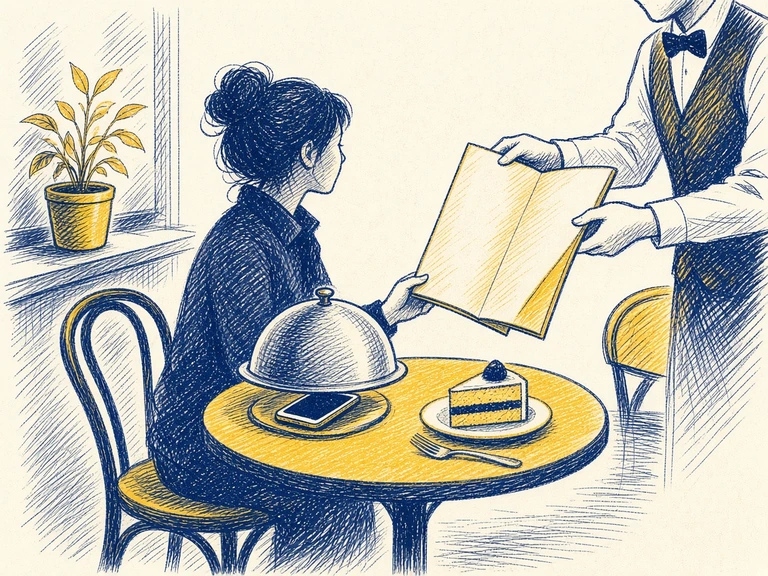
It’s Sunday, about 3pm, and the plans you had for the day have dissolved. You open the phone “for a second.” At 4:30 your thumb is still moving, you couldn’t name a single thing you watched, and you feel worse than when you sat down. You weren’t even enjoying it. You were bored, and the phone was the closest thing that wasn’t boredom.
A dopamine menu is a written list of things that reliably make you feel better, sorted like a restaurant menu and made ahead of time, so that on an afternoon like that you pick from the list instead of grabbing the nearest screen. Below is what a dopamine menu is, how to make one in about 20 minutes, a pile of dopamine menu ideas for adults, a template you can copy, an honest look at what “dopamine” has to do with any of it, and whether a dopamine detox works.
TL;DR: Make the menu on a good day, not a bored one. Sort options into appetizers (quick boosts with an end), entrees (things that actually satisfy), sides (add-ons that make boring tasks bearable), desserts (scrolling and other easy picks) and specials (big occasional treats). Cut anything you won’t really do. Make the good options quicker to start and the desserts a bit slower. Put the menu on your lock screen. Swap items when they go stale.
What is a dopamine menu?
A dopamine menu, or “dopamenu,” is a written list of things that reliably make you feel more awake, more interested or more like yourself, laid out like a restaurant menu. The name came from ADHD coach Eric Tivers. He told CNN’s Sanjay Gupta it came out of a conversation with Jessica McCabe about how they each fight boredom, and that he’s “always been kind of into wordplay and really bad dad jokes” (Gupta, 2025). McCabe then turned it into a method in a 2020 How to ADHD video, borrowing the sections from her experience working in restaurants (McCabe, 2020).
Here are the sections as she set them up, and what goes in each:
- Appetizers: quick boosts that “can give me a quick dopamine burst without sucking me in.” A minute of jumping jacks, a coffee, five minutes of social media on a timer.
- Entrees: the things that “excite me and make me feel alive.” Playing guitar, the dog park, the gym, a game night with friends.
- Sides: things you add to another activity to make it more engaging. A playlist, a fidget, turning a task into a challenge.
- Desserts: your go-tos “that I tend to overdo it on” and that don’t really fill the tank. Scrolling, texting, TV. McCabe is clear that dessert is allowed. The point is to notice when it’s all you’re eating.
- Specials: bigger things you can only do now and then. Concerts, trips, a new outfit.
What’s the point of a dopamine menu?
It moves the choosing to a time when you’re good at choosing. Tivers’s version of the idea in the video: picking what to do when you’re already bored is like “going to the grocery store hungry.” Whatever’s fastest wins.
That bit of folk wisdom has a study behind it. Read and van Leeuwen (1998) had people choose a free snack they’d get a week later, either right after lunch or late in the afternoon when they were hungry. Hungry people picked more junk food for next week, and when the day came and they could switch, people chose far more junk food for right now than they had for later. Bored-you and planning-you are two different shoppers. The menu lets planning-you do the shopping.
It also takes a decision off the pile at the exact moment you have the least to give. If you’ve read our guide to decision fatigue, a dopamine menu is the “pre-decide the repeats” idea applied to free time.
Does it have anything to do with dopamine?
A little, and less than the name suggests. Three things are worth knowing before you build one.
Dopamine is more about wanting than enjoying. Berridge and Robinson’s influential 1998 review argued that dopamine mostly drives the pull toward a reward (“wanting”), and has much less to do with the pleasure of having it (“liking”). That fits an awkward feature of scrolling: you can want the next video badly and not enjoy any of them. So aim the menu at things you’re glad you did afterward, and forget about “more dopamine.”
ADHD does involve the reward system, on average. In a PET study of 53 unmedicated adults with ADHD and 44 controls, the ADHD group had fewer dopamine receptors and transporters in parts of the brain’s reward pathway, and lower levels went along with worse attention scores (Volkow and colleagues, 2009). That’s a group average from brain scans. It doesn’t tell you anything about your own levels, and no menu, food or detox lets you check or set them. Treat “low dopamine” as a loose way of saying “boredom hits harder,” because that part is well supported: in 148 college students, boredom proneness was one of the strongest predictors of attention-deficit scores (Kass, Wallace and Vodanovich, 2003).
The idea underneath the menu has real evidence. Deliberately scheduling enjoyable, meaningful activities is the core of behavioral activation, a therapy first built for depression. A meta-analysis of 20 randomized trials with 1,353 people found behavioral activation raised well-being, with a medium-sized effect (g = 0.52), in people with and without depression symptoms (Mazzucchelli, Kane and Rees, 2010). Nobody has run a trial on a dopamine menu itself. It’s a friendly, ADHD-shaped version of a well-tested idea, so it’s a good bet, and an untested one.
Overstimulated or understimulated? (ADHD overstimulation, and when to close the menu)
A dopamine menu is built for boredom. Some days the problem is the opposite. The TV is on, two people are talking at you, and the tag in your shirt has become a personal enemy.
And somehow you also feel flat and restless. “Am I overstimulated or understimulated?” is a real search for a reason: with ADHD it can be both at once.
Noticing too much and missing things. In a small study of 45 adults (23 with ADHD), the ADHD group reported more sensory sensitivity (noticing things and being bothered by them).
They also reported more “low registration,” which means missing things other people notice (Kamath and colleagues, 2020).
The authors’ summary: adults with ADHD “may simultaneously notice and miss stimuli.” The same group also reported more sensation seeking.
A bigger study of 116 adults with ADHD found the same split. They had more hypersensitivity and more hyposensitivity than norm groups, especially for sound, and both rose with ADHD scores (Bijlenga and colleagues, 2017).
Limits: both used self-report questionnaires, and they don’t agree on everything. Kamath’s team notes that earlier studies, Bijlenga’s included, found less sensation seeking in ADHD, not more.
Kamath also found that anxiety and low mood went along with higher sensitivity. So a stressful week can feel like an “overstimulated” week.
Everybody has some of each. That questionnaire comes from occupational therapist Winnie Dunn’s model of sensory processing. She says each person has “a certain amount of seeking, avoiding, etc., not one or the other” (Dunn, 2001).
Our reading: overstimulated and understimulated aren’t two types of person. They’re two states, and with ADHD you may flip between them fast, or sit in both.
A rough way to tell which one you’re in (our guide, not a test):
- Overstimulated: sound, light or touch feels too loud, you want to leave the room, and adding anything makes it worse. Small things can bring on tears or a snap.
- Understimulated: everything feels flat, you’re fidgety, your hand keeps finding the phone, and adding something you like helps.
- Both: a loud room full of things you didn’t choose, and nothing in it you’d actually pick.
When you’re overstimulated, close the menu. Most appetizers add input: loud music, jumping jacks, a scroll. That’s the wrong direction. Take something away first.
Leave the room, dim the lights and put the phone face down. Wear headphones with nothing playing, or with steady brown noise if voices are the problem.
Once the edge is off, the boredom underneath is often still there. That’s when the menu helps again.
Our suggestion: add a “palate cleansers” line at the top of your menu with two or three zero-input options. A shower, lying on the floor in a dark room, a walk without earbuds.
If it keeps building until you can’t do anything at all, that’s closer to an ADHD shutdown.
If sensory overload has been strong since childhood and recovery takes hours, ask about an autism assessment too. ADHD and autism often show up together.
How to make a dopamine menu (about 20 minutes)
This follows McCabe’s four steps, which she calls DOPA (design, omit, prep, advertise), with sorting split out as its own step. Do it on a decent day. If you try to write a dopamine menu while bored and stuck, you’ll get the same blank you’re trying to fix.
1. Design: list what actually worked
Grab a notes app and spend five minutes on two lists:
- Times you felt good afterward. Look back over the last few weeks. When did you feel awake, absorbed or more like yourself? Be specific. “Music” is too vague to order. “Singing along to the Hamilton soundtrack while making pasta” is something you can actually pick.
- What you do when you’re bored. Be honest. These become your desserts.
In the video, McCabe passes on Tivers’s prompt: think about things you’ve done that “made you feel really excited, or alive.” Feeling good later counts for more than how tempting something looks in the moment, since tempting is what the phone is good at.
2. Sort it into the five sections
Put each item into appetizers, entrees, sides, desserts or specials. Quick check: an appetizer has a built-in end (a song, a round, a lap of the block). If it doesn’t have an end, it’s a dessert, whatever you’d like to call it.
3. Omit: cross off what you won’t really order
McCabe’s line: “I will actually never choose ‘write a novel’ over ‘post on Twitter.’” A menu full of aspirational items is a to-do list in disguise, and you’ll stop opening it. Keep things you’d pick on a Tuesday. Move anything expensive or rare to specials. Seasonal stuff (the lake, the outdoor pool) can come off and go back on later.
4. Prep: make the good stuff quicker to start
This step does most of the work. McCabe put her guitar on a stand by the couch and set up a table for painting miniatures so it was ready to go. She also added friction to her desserts: phone charger out of reach of the couch, Facebook deleted from her phone, and a “cover charge” on the kitchen (roll a d20 and do the matching exercise before a snack).
The general rule: for the options you want more of, count the steps it takes to start and remove a few. For desserts, add a couple. Sneakers by the door, the book on the arm of the couch, the puzzle app on the home screen where TikTok used to be. If you want a deeper version of the friction side, our guide to making your phone boring has the settings.
5. Advertise: put it where boredom happens
A menu in a drawer doesn’t work. McCabe put copies on the coffee table, on the fridge and in her studio, and made a mini version for her phone’s lock screen, so picking up the phone shows you the other options first. Give items names you’d want to order (“Sunset walk with the true crime podcast” beats “exercise”). Tivers rates each item from 1 to 5, like prices on a menu, for how much it tends to deliver, and marks the ones that cost money or need planning (Gupta, 2025). If you freeze between two options, flip a coin. Picking takes energy, and the menu is supposed to save it.
Dopamine menu ideas for adults
Steal what fits and skip what doesn’t. The best dopamine menu ideas are specific to you, so treat these as prompts.
Appetizers (2 to 10 minutes, with an end):
- One song, loud, with the door shut. Sing if nobody’s home.
- Step outside with a cold glass of water and look at something far away.
- One round of a daily puzzle (Wordle, the mini crossword, Connections).
- Ten pushups or a minute of jumping jacks.
- Text one specific person one specific thing (“this reminded me of you”).
- A five-minute scroll with a timer set before you open the app.
Entrees (the stuff that actually satisfies):
- A walk with a podcast, a route you don’t always take.
- Cook something you’ve never made, start to finish.
- Call a friend, a real call, while doing something with your hands.
- A 20-minute bike ride, run or class. In a small crossover study of 32 young men with ADHD symptoms, 20 minutes of moderate cycling raised motivation for mental work and feelings of energy afterward, compared with 20 minutes of sitting, though it didn’t improve attention test scores (Fritz and O’Connor, 2016).
- A hobby with your hands: drawing, building, knitting, fixing a bike.
- Play a game with someone, online or in the same room.
- Go somewhere with other people doing their thing: a library, a climbing gym, a cafe.
Sides (add-ons that make boring things bearable):
- A playlist that only plays during chores.
- A podcast or audiobook you only allow while cleaning or at the gym. That’s temptation bundling, and in a field experiment it got people to the gym 51% more often at first, before the effect faded (Milkman, Minson and Volpp, 2014). Swap the show when it stops pulling you.
- A fidget, a standing desk or a walking call for meetings.
- Racing a timer (like how many things you can bag before one song ends), or doing the dull task somewhere new.
- A body double, online or in person.
Music shows up in three sections for a reason. In a small brain imaging study, eight people who reliably got chills from music they had picked themselves showed dopamine release in the brain’s reward system while listening, and the build-up just before a peak lit up a different part of that system than the peak itself (Salimpoor and colleagues, 2011). It’s one of the few everyday pleasures with a measured dopamine story.
Desserts (fine in portions):
- Scrolling, with a timer set before you open the app.
- One episode with autoplay off.
- A game you’ve played a thousand times.
- Snack plus show.
Desserts aren’t banned. They’re just bad at doing the thing you open them for. In one set of experiments, 20 minutes of Facebook left people in a worse mood than 20 minutes of ordinary web browsing, mostly because it felt like wasted time, and people expected to feel better afterward, not worse (Sagioglou and Greitemeyer, 2014). One trick helps desserts taste better: take breaks in them. Across six studies, interrupting a pleasant experience (a massage chair, a song) made the rest of it more enjoyable, even though people avoided breaks when given the choice (Nelson and Meyvis, 2008). A five-minute scroll you stop and come back to later may beat one 40-minute session.
Specials (now and then):
- A concert or a comedy show.
- A day trip to a town you’ve never been to.
- A new game, ideally with a friend.
- A class you’ve wanted to try for a year.
A dopamine menu for work (or school)
Same menu, smaller portions. At a desk, the useful sections are appetizers that fit in under ten minutes and sides that ride along with the boring task. Entrees and specials can wait until after work. If the boring task is one you keep putting off, a menu won’t fix that by itself. That part is covered in how to stop procrastinating at work.
- Appetizers between tasks: refill your water at the far kitchen, one song with headphones on, a lap of the hallway, a stretch, one round of the daily puzzle.
- Sides during the task: a focus playlist (or brown noise), a fidget for calls, a walking meeting, a body double for the dull hour, a different room after lunch.
- Desserts, with a cover charge: the phone lives in a bag or a drawer, so scrolling is a decision instead of a reflex.
Short breaks do something, just not everything. A 2022 meta-analysis pooled 22 study samples on micro-breaks of 10 minutes or less (2,335 healthy employees and students, not an ADHD sample).
The breaks gave small boosts to energy and small drops in fatigue (Albulescu and colleagues, 2022).
Performance didn’t improve overall, only on less demanding tasks, and longer breaks helped performance more. So an appetizer is a good way to feel less fried. After a draining stretch of hard thinking, you may need more than ten minutes.
One work-specific trap is an appetizer that’s too interesting. “One quick look” at a side project can turn into three hours. That’s hyperfocus, and the fix is to build the exit before you go in.
At work, pick appetizers with a built-in end (one song, one lap) over ones that open into something bigger.
A dopamine menu template you can copy
Paste this into your notes app or onto a sticky note and fill it in. Three to five items per section is plenty. If you’d rather use paper, there’s a printable version below.
- Appetizers (under 10 min, has an end): …
- Entrees (leaves me feeling good after): …
- Sides (makes a boring task bearable): …
- Desserts (fine in portions, timer on): …
- Specials (now and then): …
- Prep for this week (one thing to make easier to start): …
- If I’m stuck choosing: flip a coin between the first two entrees.
A dopamine menu example
Here’s what a filled-in menu might look like for someone who works from home and loses most evenings to the couch:
- Appetizers: one loud song while making tea, Connections, ten pushups, stand on the balcony for two minutes.
- Entrees: a walk to the far park with a comedy podcast, cooking a new recipe on Wednesdays, a Sunday call with a friend, climbing gym on Thursdays.
- Sides: “chores only” playlist, a mystery audiobook for laundry and dishes, the cafe on Fridays.
- Desserts: 10 minutes of TikTok with a timer, one episode of a comfort show with autoplay off.
- Specials: the concert in November, a day trip on the train.
- Prep: climbing shoes in the bag by the door, phone charger in the kitchen.
- Stuck? Coin flip between the walk and the call.
A free printable dopamine menu worksheet (PDF)
Rather fill it in with a pen? Download the dopamine menu worksheet (PDF), a two-page printable version of the template above. It’s free, and you don’t have to give us an email.
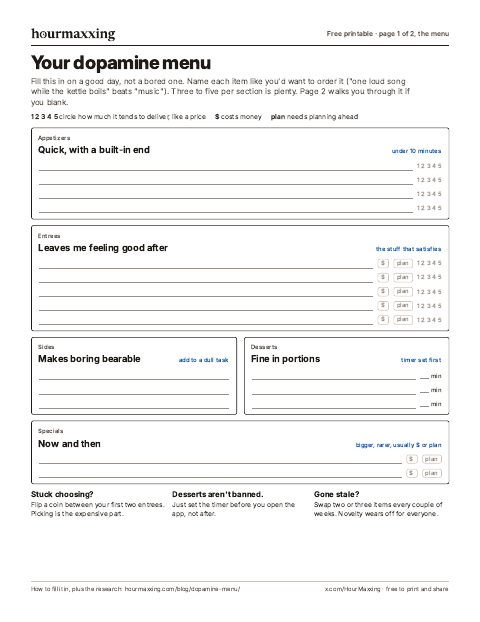
Page 1 is the menu itself, with room for three to five items in each section. Every appetizer and entree has a 1 to 5 to circle for how much it tends to deliver. We borrowed that from Tivers, who rates each item on his own menu from 1 to 5 so it reads like prices on a real menu, and puts a little dollar icon on the ones that cost money (Gupta, 2025).
Entrees and specials also get a $ tag and a plan tag to circle, and each dessert gets a blank for the timer.
Page 2 is the worksheet. It has the design, sort, omit, prep and advertise steps from above with space to write, a date for a calendar reminder to look at the menu again (Tivers sets those for himself), and a “maybe later” box for retired favorites.
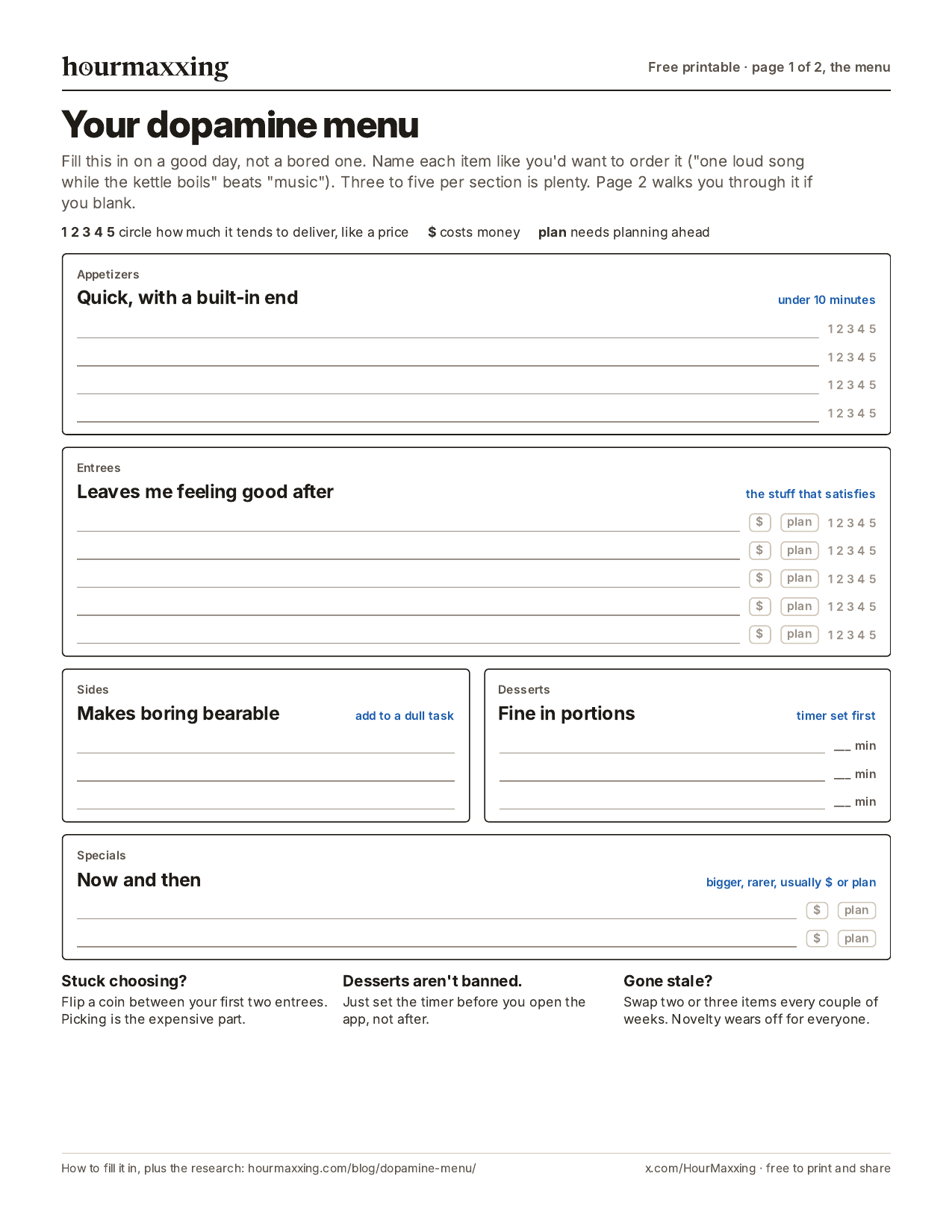
No printer? Fill in page 1 and set a photo of it as your lock screen, one of the spots Tivers suggests along with the fridge and your desk. There’s also an image of the menu page you can write on with the markup tool in your photos app.
Is a dopamine detox real, and does it work for ADHD?
If you’ve been reading about dopamine menus, you’ve probably run into the stricter cousin. A dopamine detox (or “dopamine fast”) is the plan where you cut out your phone, games, snacks and sometimes music or even talking for a day or a weekend so your brain can “reset.” The reset part has no evidence behind it. Time away from your phone does have some, and the version with the best case is a lot smaller and more boring than the one on TikTok.
What is a dopamine detox? (and can it reset your brain?)
The term took off after San Francisco psychologist Cameron Sepah posted “The Definitive Guide to Dopamine Fasting 2.0” on LinkedIn in 2019. His version was narrow. You pick one habit that’s causing you problems, like checking your phone, and keep it out of set windows of time, using ordinary CBT tools: make the trigger harder to reach, do something that can’t happen at the same time, and let urges pass without acting on them. He was blunt about the name: “To be clear, we ARE NOT fasting from dopamine itself, but from impulsive behaviors reinforced by it.” His own list of what it is not includes avoiding all stimulation and not talking to people (Sepah, 2019). The internet version drifted toward exactly those things anyway.
So can a day off fun reset your dopamine? Nobody we could find has measured anyone’s dopamine before and after a detox. And the premise doesn’t match how the chemical works. UCSF neuroscientist Joshua Berke, who studies dopamine, told the San Francisco Chronicle that “dopamine is not a pleasure juice” and “it’s also not the case that dopamine is something that just has a level and that you deplete it” (Kost, 2019). Add the wanting-versus-liking point from earlier, and “I’ll be more motivated after 24 hours of staring at a wall” stops making much sense.
How long does a dopamine detox take, then? Sepah’s suggested schedule is one to four hours at the end of each day, one weekend day a week, one weekend a quarter and one week a year, starting with an hour if four sounds impossible. For habits you want to shrink without quitting, he adds “feasting” windows of 5 to 30 minutes, one to three times a day, such as checking your phone right after meals. Those are his suggestions. No study has found a length that resets anything.
What Anna Lembke says about dopamine fasting (and Dopamine Nation)
If you searched “dopamine fasting Anna Lembke” or “dopamine fasting science,” you mostly land on Stanford psychiatrist Anna Lembke’s 2021 book Dopamine Nation: Finding Balance in the Age of Indulgence, not on Sepah’s LinkedIn post. Same catchy phrase. Different protocol.
Lembke’s account of the chemistry is the pleasure-pain balance. Rewarding substances and behaviors raise dopamine in the reward pathway. The brain answers by turning transmission down, often past the old baseline into a deficit state where ordinary pleasures feel flatter and cravings get louder.
With enough repeats you need more of the same hit to feel anything, which is ordinary tolerance language applied to Instagram as much as to a drug (Lembke, 2021; Goldman, 2021). In the Stanford Medicine Q&A she put the social-media version bluntly: it often feels good while you’re on it and horrible the moment you stop, because signing off drops you into that deficit state while the brain tries to catch up.
Her clinical “dopamine fast” is about a month off the specific thing that has taken over, “whether it’s heroin or Instagram,” so the pathway can settle and smaller rewards start to register again (Goldman, 2021). She then suggests coming back with limits, such as fixed windows of use and dropping the apps that suck hardest. She warns people they usually feel worse before they feel better.
Her version also skips the Silicon Valley stunt of quitting music, conversation and stimulation in general (she draws that contrast in interviews, including the ABC All in the Mind discussion of her DOPAMINE framework). Abrupt stoppage is also the wrong move when withdrawal can be dangerous (alcohol, some benzodiazepines, some opioids). That needs a clinician.
How much of this is settled science? The neuroadaptation story is mainstream addiction neuroscience, told for a general audience. The 30-day number is her clinical rule of thumb for how long patients need before baseline feeling returns, not a lab measurement of receptor recovery after Instagram.
A systematic review of short-term abstinence from potential behavioral addictions looked at 47 prospective studies across exercise, gambling, gaming, mobile phones, pornography and social media. Exercise had the clearest withdrawal-like mood effects. Short breaks looked promising for gaming, pornography, phones and social media.
Rebound and compensatory behaviors were barely measured, so the authors said they could not yet judge how useful abstinence is as an intervention (Fernandez, Kuss and Griffiths, 2020). Nobody in that literature ran Lembke’s branded 30-day protocol as a randomized trial.
For ADHD brains, that leaves a practical split. If one app has taken over your evenings and you can stand a hard month, Lembke’s single-behavior break is the version with a clinical story behind it, and you still want something to put in the gap (the menu above).
If a month sounds like a fantasy, Sepah’s one-app windows plus a blocker are closer to the phone-block trial in the next section, and easier to restart after a slip. Either way, “reset my dopamine with a silent Saturday” is the internet remix neither of them is selling.
Does a dopamine detox work?
The closest research is on digital detox: time off your phone, or off social media. A 2021 systematic review pulled together 21 studies with 3,625 participants, 12 of them randomized trials, and the results were all over the place. Some found benefits for well-being. Others found no effect, or even found people felt worse (Radtke and colleagues, 2021).
A large 2025 trial blocked all mobile internet on people’s phones for two weeks with an app, while calls, texts and laptop internet still worked. It helped. Mental health, well-being and an objective test of sustained attention all improved, and the attention gain was about the size of 10 years of age-related decline, by the authors’ estimate. Average screen time in the first group fell from 314 to 161 minutes a day. People without mobile internet spent more time with people in person, exercising and outside, and that shift explained part of the benefit (Castelo and colleagues, 2025).
There’s a catch, and it applies to everyone. Of the 467 people who signed up to do it, only 119 (about a quarter) kept the block on as planned. People who slipped still improved, just less. And two weeks after the block came off, average screen time in that group had climbed back to 265 minutes.
Does a dopamine detox work for ADHD?
As far as we can find, nobody has tested a dopamine detox in people diagnosed with ADHD. The phone-block trial above did measure ADHD symptoms. People with more symptoms reported a bigger jump in how aware they felt of their own attention, but symptoms made no difference to the gain on the objective attention test, and they didn’t predict who managed to keep the block on (Castelo and colleagues, 2025). That’s adults in general with a range of symptoms, which is a long way from an ADHD trial.
Our read: the version worth trying with ADHD is Sepah’s small one. Pick one app and one window (the end of the day is his default and ours too), let a blocker enforce it so willpower doesn’t have to, and decide ahead of time what fills the window. The all-day ban of everything fun is the version most likely to collapse by lunch, because it leaves a hole, and a bored brain fills a hole with the nearest feed. Our phone detox steps have the settings for the blocker part, and the menu above is for the window itself.
Is a dopamine menu the same as a dopamine detox?
No. A detox takes things away for a stretch. A menu adds better options and makes them easier to reach. Neither one changes your brain chemistry in any way you could measure at home. We think the menu is the kinder bet for ADHD brains, and the two work fine together: run a short detox window on your worst app and order off the menu during it. (Our phone guide covers why “just sit with the boredom” fails.)
Why your dopamine menu stopped working
It’s easy to make a beautiful dopamenu, use it for a week and forget it exists. The usual causes:
- It went stale. Tivers says in the video that a favorite can stop working because “you’ve already been doing this for a week and I need something new now.” Expect it. Swap two or three items every couple of weeks and keep a “maybe later” list for retired favorites.
- It’s hidden. If you have to remember the menu exists, you won’t, especially with ADHD. Lock screen, fridge, the spot on the couch where you usually sit. Tivers also puts reminders in his calendar asking whether he has looked at his dopamenu lately (Gupta, 2025).
- It turned into a to-do list. “Meditate, journal, run 5k” is homework. If you feel guilty reading your menu, cut it back to things you’d actually pick.
- It’s mostly desserts. That’s useful information. Add one easy entree and prep it so it’s as quick to start as the phone.
- Nothing on it feels good anymore. Tivers’s first answer to “what if nothing feels enjoyable?” in the video was “Call your doctor. Maybe that’s depression.” Losing interest in things you used to love, for weeks, is worth a real conversation with a doctor. If you’re stuck for a different reason, wanting to do something and unable to start, that’s closer to task paralysis, and it has its own fixes.
Sources
- Albulescu, P., Macsinga, I., Rusu, A., Sulea, C., Bodnaru, A., & Tulbure, B. T. (2022). “Give me a break!” A systematic review and meta-analysis on the efficacy of micro-breaks for increasing well-being and performance. PLoS ONE, 17(8), e0272460. https://doi.org/10.1371/journal.pone.0272460
- Berridge, K. C., & Robinson, T. E. (1998). What is the role of dopamine in reward: Hedonic impact, reward learning, or incentive salience? Brain Research Reviews, 28(3), 309-369. https://doi.org/10.1016/S0165-0173(98)00019-8
- Bijlenga, D., Tjon-Ka-Jie, J. Y. M., Schuijers, F., & Kooij, J. J. S. (2017). Atypical sensory profiles as core features of adult ADHD, irrespective of autistic symptoms. European Psychiatry, 43, 51-57. https://doi.org/10.1016/j.eurpsy.2017.02.481
- Castelo, N., Kushlev, K., Ward, A. F., Esterman, M., & Reiner, P. B. (2025). Blocking mobile internet on smartphones improves sustained attention, mental health, and subjective well-being. PNAS Nexus, 4(2), pgaf017. https://doi.org/10.1093/pnasnexus/pgaf017
- Dunn, W. (2001). The sensations of everyday life: Empirical, theoretical, and pragmatic considerations. American Journal of Occupational Therapy, 55(6), 608-620. https://doi.org/10.5014/ajot.55.6.608
- Fernandez, D. P., Kuss, D. J., & Griffiths, M. D. (2020). Short-term abstinence effects across potential behavioral addictions: A systematic review. Clinical Psychology Review, 76, 101828. https://doi.org/10.1016/j.cpr.2020.101828
- Fritz, K. M., & O’Connor, P. J. (2016). Acute exercise improves mood and motivation in young men with ADHD symptoms. Medicine & Science in Sports & Exercise, 48(6), 1153-1160. https://doi.org/10.1249/MSS.0000000000000864
- Goldman, B. (2021, October 29). Addictive potential of social media, explained [Interview with Anna Lembke]. Stanford Medicine. https://med.stanford.edu/news/insights/2021/10/addictive-potential-of-social-media-explained.html
- Gupta, S. (Host). (2025, February 7). How to hack your brain’s reward system [Audio podcast episode, with Eric Tivers]. In Chasing Life. CNN. https://www.cnn.com/audio/podcasts/chasing-life/episodes/af3c5cb0-37bb-11ef-8219-ab8d404559ae
- Kamath, M. S., Dahm, C. R., Tucker, J. R., Huang-Pollock, C. L., Etter, N. M., & Neely, K. A. (2020). Sensory profiles in adults with and without ADHD. Research in Developmental Disabilities, 104, 103696. https://doi.org/10.1016/j.ridd.2020.103696
- Kass, S. J., Wallace, J. C., & Vodanovich, S. J. (2003). Boredom proneness and sleep disorders as predictors of adult attention deficit scores. Journal of Attention Disorders, 7(2), 83-91. https://doi.org/10.1177/108705470300700202
- Lembke, A. (2021). Dopamine Nation: Finding Balance in the Age of Indulgence. Dutton.
- Kost, R. (2019, November 6). No food, fun or friends: Dopamine fasting is Silicon Valley’s latest trend. San Francisco Chronicle. https://www.sfchronicle.com/culture/article/Dopamine-fasting-How-Silicon-Valley-is-trying-to-14811245.php
- Mazzucchelli, T. G., Kane, R. T., & Rees, C. S. (2010). Behavioral activation interventions for well-being: A meta-analysis. The Journal of Positive Psychology, 5(2), 105-121. https://doi.org/10.1080/17439760903569154
- McCabe, J. (2020). How to give your brain the stimulation it needs [Video, with Eric Tivers]. How to ADHD, YouTube. https://www.youtube.com/watch?v=-6WCkTwW6xg
- Milkman, K. L., Minson, J. A., & Volpp, K. G. M. (2014). Holding the Hunger Games hostage at the gym: An evaluation of temptation bundling. Management Science, 60(2), 283-299. https://doi.org/10.1287/mnsc.2013.1784
- Nelson, L. D., & Meyvis, T. (2008). Interrupted consumption: Disrupting adaptation to hedonic experiences. Journal of Marketing Research, 45(6), 654-664. https://doi.org/10.1509/jmkr.45.6.654
- Radtke, T., Apel, T., Schenkel, K., Keller, J., & von Lindern, E. (2021). Digital detox: An effective solution in the smartphone era? A systematic literature review. Mobile Media & Communication, 10(2), 190-215. https://doi.org/10.1177/20501579211028647
- Read, D., & van Leeuwen, B. (1998). Predicting hunger: The effects of appetite and delay on choice. Organizational Behavior and Human Decision Processes, 76(2), 189-205. https://doi.org/10.1006/obhd.1998.2803
- Sagioglou, C., & Greitemeyer, T. (2014). Facebook’s emotional consequences: Why Facebook causes a decrease in mood and why people still use it. Computers in Human Behavior, 35, 359-363. https://doi.org/10.1016/j.chb.2014.03.003
- Sepah, C. (2019, August 7). The definitive guide to dopamine fasting 2.0: The hot Silicon Valley trend. LinkedIn. https://www.linkedin.com/pulse/dopamine-fasting-new-silicon-valley-trend-dr-cameron-sepah
- Salimpoor, V. N., Benovoy, M., Larcher, K., Dagher, A., & Zatorre, R. J. (2011). Anatomically distinct dopamine release during anticipation and experience of peak emotion to music. Nature Neuroscience, 14(2), 257-262. https://doi.org/10.1038/nn.2726
- Volkow, N. D., Wang, G.-J., Kollins, S. H., Wigal, T. L., Newcorn, J. H., Telang, F., et al. (2009). Evaluating dopamine reward pathway in ADHD: Clinical implications. JAMA, 302(10), 1084-1091. https://doi.org/10.1001/jama.2009.1308
Want one more of these each week?
One technique a week, the study behind it, and a low-energy version. Free, about a 3-minute read, unsubscribe anytime.
We use your address only to send the email, and you can unsubscribe in one click.
FAQ
What is a dopamine menu?
A dopamine menu (or 'dopamenu') is a list of things you already know make you feel better, written down ahead of time and sorted like a restaurant menu: appetizers (quick boosts with a hard stop), entrees (the stuff that actually satisfies), sides (add-ons that make boring tasks less boring), desserts (scrolling and other easy picks you tend to overdo) and specials (occasional big treats). ADHD coach Eric Tivers came up with the name and Jessica McCabe of How to ADHD turned it into a method in a 2020 video.
How do I make a dopamine menu?
On a day when you're not bored, list five to ten things that left you feeling good afterward, plus what you default to when bored. Sort them into appetizers, entrees, sides, desserts and specials. Cross off anything you won't do in real life right now. Make the good options quicker to start (guitar on a stand, sneakers by the door) and put a small 'cover charge' on the desserts, like a phone charger across the room. Then put the menu where boredom happens: your lock screen, the fridge, the arm of the couch.
What are some dopamine menu ideas for adults?
Appetizers: two minutes of loud music, a cold glass of water outside, one round of a daily puzzle, ten pushups. Entrees: a walk with a podcast, cooking something new, a call with a friend, a class, a 20-minute bike ride. Sides: a playlist for chores, a fidget during calls, a podcast you only allow while cleaning, working from a cafe. Desserts: one episode with autoplay off, a timed scroll. Specials: a concert, a day trip, a new game played with a friend. The best ideas are specific to you.
Does a dopamine menu actually increase dopamine?
Nobody has measured that, and you don't need it to. Dopamine is tied more to wanting and anticipation than to enjoyment itself (Berridge and Robinson, 1998), so 'more dopamine' isn't really the goal. The idea underneath the menu does have support: planning enjoyable, valued activities is the core of behavioral activation, and a meta-analysis of 20 randomized trials (1,353 people) found it raised well-being (Mazzucchelli and colleagues, 2010). No one has tested a dopamine menu as such.
Can you be overstimulated and understimulated at the same time with ADHD?
It looks that way. In a small 2020 study of 45 adults, the ADHD group reported both more sensory sensitivity (noticing and being bothered by things) and more low registration (missing things others notice), and the authors wrote that adults with ADHD 'may simultaneously notice and miss stimuli' (Kamath and colleagues, 2020). A study of 116 adults with ADHD also found more of both hyper- and hyposensitivity than norm groups (Bijlenga and colleagues, 2017). Both used questionnaires, so treat it as a pattern, not a diagnosis. When you're overstimulated, cut input first (quiet, dim lights, phone away) before reaching for anything on a dopamine menu.
What should be on a dopamine menu for work?
Mostly appetizers and sides. Appetizers are short breaks with a built-in end that fit between tasks: one song, a water refill, a lap of the hallway. Sides ride along with the dull task: a focus playlist or brown noise, a fidget, a walking meeting, a body double. Put the phone somewhere that takes a step to reach. A 2022 meta-analysis of breaks of 10 minutes or less (2,335 healthy employees and students) found small gains in energy and less fatigue, but no overall boost to performance, so after hard thinking you may need a longer break.
Is a dopamine menu only for ADHD?
No. It was designed with ADHD in mind, because boredom tends to hit harder and choosing in the moment is harder, but the problem it solves (picking the easiest option when you're bored or tired) is a general human one. In a classic study, people choosing a snack for next week picked fruit far more often than they did when choosing a snack to eat right away (Read and van Leeuwen, 1998). A menu is choosing for later.
What's the difference between a dopamine menu and a dopamine detox?
A dopamine detox asks you to cut out pleasurable things for a while. A dopamine menu adds better options and makes them easier to pick. Neither changes your dopamine levels in any way you could measure at home. The menu is the gentler of the two, and it doesn't ban desserts. It just labels them so you notice what you're ordering.
Does a dopamine detox work for ADHD?
Nobody has tested one in people diagnosed with ADHD. The closest evidence is on phone breaks: in a 2025 trial, blocking mobile internet for two weeks improved mental health, well-being and sustained attention, but only about a quarter of the 467 people who signed up kept the block on as planned, and screen time crept back up once it ended. There's no evidence that a full day without anything fun resets your dopamine. A small daily window off one app, enforced by a blocker and filled with something you planned, is the version most likely to stick.
Is there a free dopamine menu template or worksheet (PDF)?
Yes. We made a free two-page printable, no email needed: hourmaxxing.com/printables/dopamine-menu-worksheet.pdf. Page 1 is the menu itself, with appetizers, entrees, sides, desserts and specials, a 1 to 5 'price' to circle for how much each item tends to deliver (an idea from ADHD coach Eric Tivers), tags for things that cost money or need planning, and a timer blank for each dessert. Page 2 is a worksheet that walks you through building it: list what worked, sort, cross off, prep, and decide where the copies go. There's also an image of the menu page you can save to your phone.
Why did my dopamine menu stop working?
Usually one of four reasons. The options got stale (novelty wears off, so swap a few every couple of weeks). The menu is in a drawer instead of where boredom happens. It has turned into a to-do list full of things you think you should do. Or it's all desserts. If nothing on it feels good anymore, including things you used to love, that can be a sign of depression, so talk to a doctor.
What does Anna Lembke say about dopamine fasting?
In Dopamine Nation (2021) and a Stanford Medicine interview, psychiatrist Anna Lembke describes a clinical 'dopamine fast': about 30 days off one substance or behavior that has become compulsive (Instagram, for example), long enough that reward pathways can settle. She is clear it is not a ban on all pleasure. The Silicon Valley version that cuts music, talking and everything fun is a different idea. Her framing comes from addiction neuroscience and clinical practice; there is no randomized trial of 'dopamine fasting' as a branded protocol.
New here? Start with the reading order → Rather use paper? Grab a free printable.