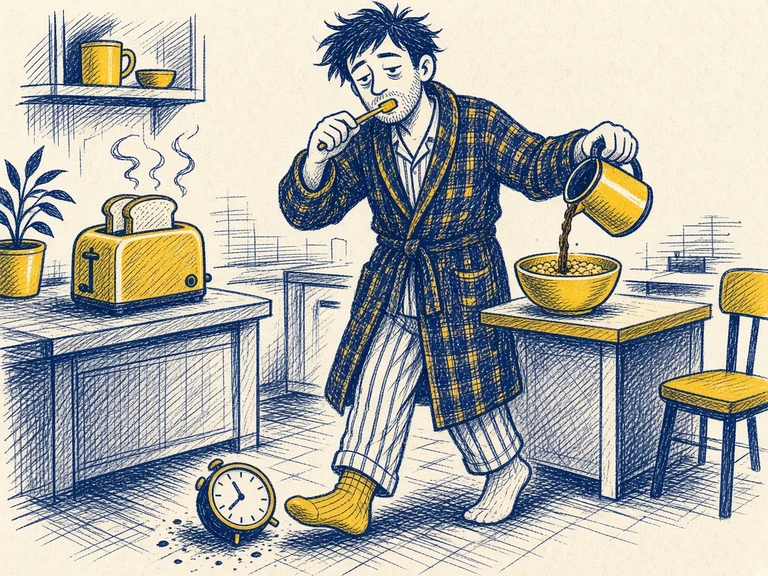
It’s 8:41. You’ve technically been awake since 7:30. In that time you have turned off three alarms, read an entire thread about a celebrity you don’t care about, walked into the kitchen, forgotten why, walked back, and found one sock. You need to leave at 8:50. The other sock is somewhere in the multiverse.
Nobody is choosing this. A morning is a long chain of small steps with a deadline at the end, done by a brain that isn’t fully awake yet, and for a lot of people with ADHD that’s close to the worst possible setup.
A good ADHD morning routine cuts the number of decisions until half-asleep you can run it on rails. Becoming a morning person is optional. Below is why mornings are so hard with ADHD, an ADHD morning routine checklist you can copy (plus a free printable), how to build your own so it sticks, and what to do on the days it falls apart anyway.
TL;DR: Make every choice the night before. Write the morning as a short checklist in the order you walk through your home, so the end of each step is the cue for the next. Time it once with a stopwatch. Keep a three-item bad-day version. Put the list where your eyes land first. Run the same order every day, and when you miss a day, just start again tomorrow.
Why are mornings so hard with ADHD?
Three separate problems tend to land in the same hour.
Your brain is still booting. Everyone wakes up into sleep inertia, the groggy stretch where reaction time, memory and simple math are measurably worse. A 2019 review found recovery is fairly quick over the first 15 to 30 minutes, but effects lasting at least an hour show up even in well-rested people, and on some tests the dip right after waking is as bad as, or worse than, a night of sleep deprivation (Hilditch & McHill, 2019).
The same review noted something sneaky: people coming out of sleep inertia rated their own performance as better than it measured. So the half-awake voice saying “you can skip the list, you’ve got this” is the least reliable judge in the building.
Your clock may run late. In a Dutch study of 40 adults with ADHD, 31 reported long-running trouble falling asleep, and that group’s sleep and evening melatonin rise ran later than in healthy controls (Van Veen et al., 2010). A 2019 review put delayed sleep phase, a body clock that runs late, at 73 to 78% of children and adults with ADHD (Bijlenga et al., 2019). That’s a high estimate from a team arguing sleep deserves more attention in ADHD, so read it as “very common.”
Night owls (later chronotypes) also took longer to shake off sleep inertia in one study the Hilditch review describes. If your clock runs late, a 7am alarm lands in what your body still files as night. There’s more on that in why it’s so hard to get out of bed with ADHD.
A morning is a sequence task with a deadline. Shower, meds, dressed, food, keys, out. Each step is easy. The hard parts are remembering what comes next, choosing (which shirt, what breakfast, which bag), and noticing time passing while you do it. Those happen to be the parts ADHD makes harder: small choices drain you faster (decision fatigue), and time doesn’t feel real until it’s urgent (time blindness).
Anything you can’t see, like the keys in yesterday’s jacket, may as well not exist (object permanence).
Is ADHD worse in the morning?
We couldn’t find good evidence that ADHD itself gets worse in the morning, and there is no official “morning ADHD” symptom. Search “adhd symptoms worse in morning” and you’ll find plenty of people saying it feels that way, which makes sense given the three problems above.
If it’s your mood that feels worst before 9am, that has its own section below: morning anger, anxiety and brain fog.
If you take ADHD medication, add a fourth: the stretch before it kicks in, which often covers exactly the hour you’re trying to get out the door. That one is worth raising with whoever prescribes it, because timing and formulation can usually be adjusted. Don’t change doses on your own.
ADHD morning anger, anxiety and brain fog (why mornings feel so bad)
“Morning rage,” “morning anxiety” and “morning fog” all autocomplete right after “ADHD.” None of them is an official symptom either. But each has a boring, checkable explanation, and they stack.
The fog is mostly sleep inertia. That’s the groggy stretch from the section above, and it can run an hour or more. If the fog lasts the whole morning, most mornings, look at the late body clock or a night that was simply too short.
Short sleep makes everyone touchier. A 2021 paper pooled 64 studies in three meta-analyses. Losing sleep moderately raised negative mood and sharply lowered positive mood (Tomaso, Johnson & Nelson, 2021).
ADHD often comes with a shorter fuse anyway. A review put impairing emotion dysregulation (fast frustration, big swings, slow cool-down) at roughly 30 to 70% of adults with ADHD, mostly in clinic samples (Shaw et al., 2014).
If the fuse is short all day, not just before 9, our ADHD anger guide has the in-the-moment plan.
Add those up: a short fuse, a short night, a brain that’s still booting, and a deadline at 8:50. No wonder a missing sock feels like a personal attack. The morning asks for the most patience at the hour you have the least.
What we’d try, in order (our suggestion, not a treatment plan):
- Remove the triggers. Every item on the night-before list is one less thing to be missing at 8:47.
- Buy back ten minutes. Set the alarm from your stopwatch time plus a buffer, so the clock isn’t yelling at you too.
- Protect the night. Late nights show up as mornings like this. Our ADHD bedtime routine is six steps. If 1am keeps winning, read about revenge bedtime procrastination.
- Talk to a doctor if it’s heavy. Daily dread, anger that wrecks the day, or low mood that’s worst every morning count. Mood regularly worse in the morning is a DSM-5 marker for one type of depression (American Psychiatric Association, 2013).
If it’s less fog and more lying there unable to start, that’s closer to task paralysis: here’s how to get out of bed with ADHD.
The ADHD morning routine checklist (copy this)
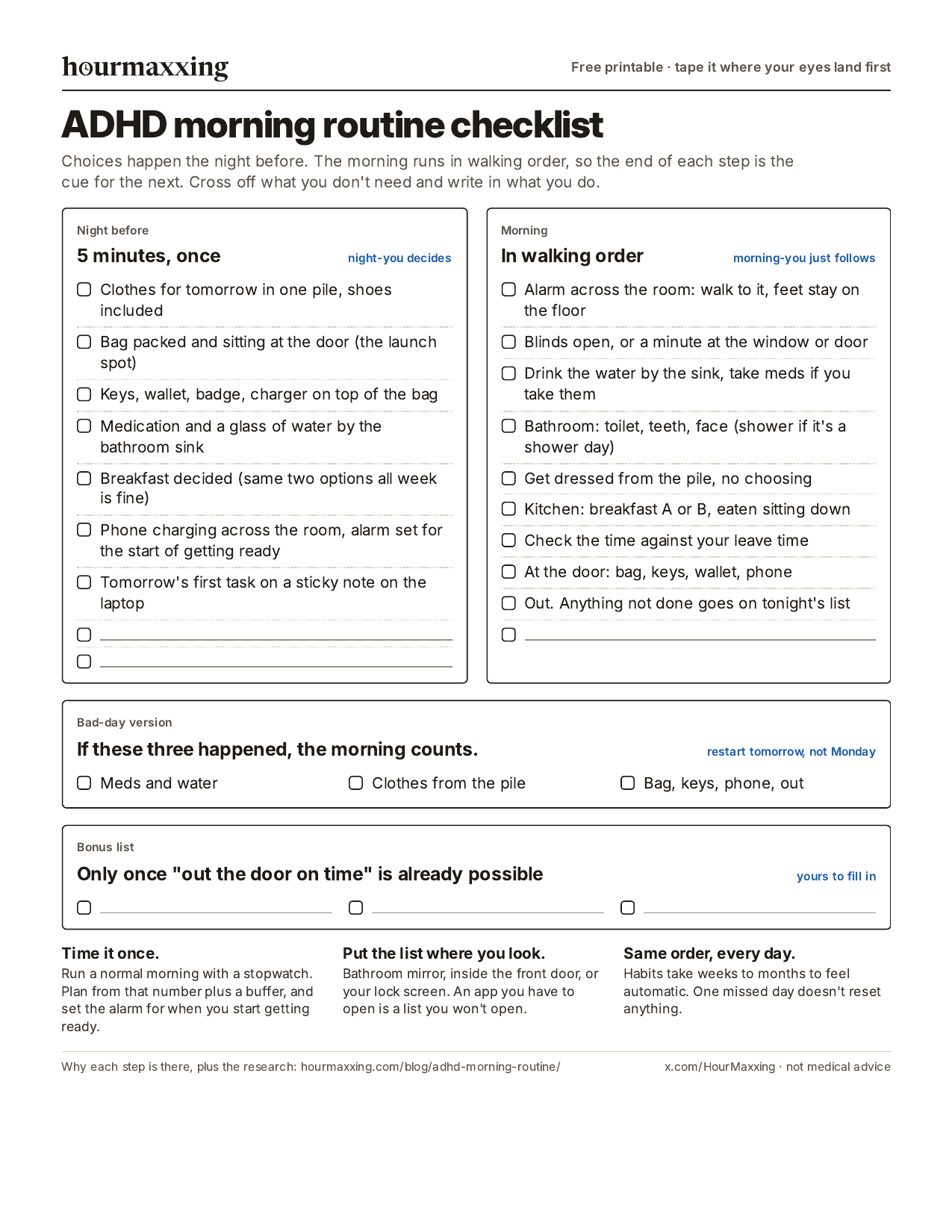
This is our default. It follows the order most homes force on you anyway (bed, bathroom, bedroom, kitchen, door), so each step physically leads to the next. Paste it into your notes app as a checklist, or download the free printable and tape it to the bathroom mirror.
The night before (5 minutes):
- Clothes for tomorrow in one pile, shoes included
- Bag packed and sitting at the door (the launch spot)
- Keys, wallet, badge, charger on top of the bag
- Medication and a glass of water by the bathroom sink
- Breakfast decided (same two options all week is fine)
- Phone charging across the room, alarm set for the start of getting ready
- Write tomorrow’s first task on a sticky note on the laptop
The morning (in walking order):
- Alarm across the room: walk to it, feet stay on the floor
- Blinds open or a minute at the window or door
- Drink the water by the sink, take meds if you take them
- Bathroom: toilet, teeth, face (shower if it’s a shower day)
- Get dressed from the pile, no choosing
- Kitchen: breakfast option A or B, eat it sitting down
- Check the time against your leave time
- At the door: bag, keys, wallet, phone
- Out. Anything not done goes on tonight’s list
Bad-day version (three things):
- Meds and water
- Clothes from the pile
- Bag, keys, phone, out
Everything else (workout, journaling, a nice breakfast, reading, the full skincare routine) goes on a separate bonus list that you only open once step 9 is possible on time. Otherwise it’s a wish list.
A free printable ADHD morning routine checklist
We turned the checklist above into a one-page printable: download the ADHD morning routine checklist (PDF). Free, no email, no account.
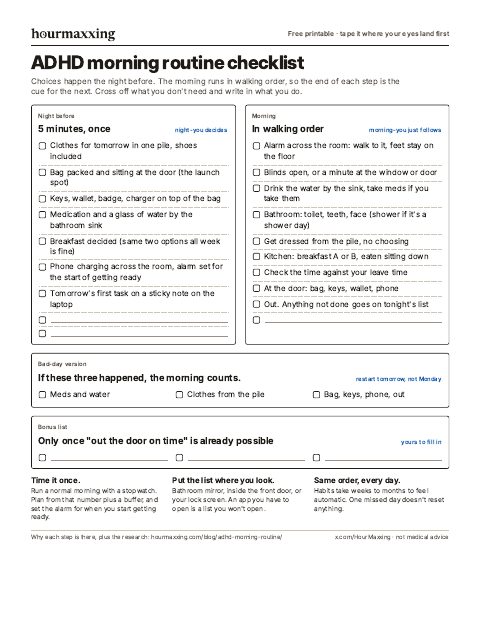
It has the night-before list, the morning steps in walking order, the bad-day version, a box for your bonus list, and blank lines so you can cross off what you don’t need and add what you do. Print it, edit it with a pen, then tape it where your eyes land before your phone does. The bathroom mirror and the inside of the front door both work.
No printer? There’s an image version you can save to your phone’s photos. For the rest of the day, there’s a matching printable ADHD to-do list too.
How to build an ADHD morning routine that sticks
Our checklist is a starting point. Yours will be different, because your home, your job and your body are. These six steps get you from “I should have a morning routine” to one that runs most days.
1. Time your real morning once, with a stopwatch
Before you plan anything, do your normal morning with a stopwatch running and write down how long each part took. Most people remember familiar tasks as shorter than they were, so the number in your head is probably small. Plan from what you measured, add a buffer, and set your alarm for when you need to start getting ready, not when you need to leave. The time blindness guide has the full version of this, including the research behind it.
If you also want to know whether your guesses are just a bit optimistic or properly off, the same stopwatch numbers make a free one-week time blindness test. For a quick check today, our time blindness test runs in your browser and gives you a ratio you can multiply your morning guesses by.
2. Cut it down to what has to happen before you leave
Look at the measured list and sort every item into “has to happen before I leave” and “nice to have.” Be ruthless. A 45-minute aspirational morning that runs twice a month helps less than a 20-minute one that runs every day. The nice-to-haves go on the bonus list. If the must-do list is still longer than about ten steps, something on it is probably a nice-to-have in disguise.
3. Order the steps by where you are, so each one cues the next
This is the part most routines skip. A habit is a behavior you do almost daily in the same context. In two diary studies, people doing habitual things tended to think about something else entirely, and they reported less stress than when doing non-habitual things (Wood, Quinn & Kashy, 2002). The context does the remembering for you.
So link each step to the end of the one before it, and to a place. James Clear calls this habit stacking (“After [CURRENT HABIT], I will [NEW HABIT]”), building on BJ Fogg’s term “anchoring” (Clear, n.d.).
One small study tested where to put the new step. People taught to floss after brushing their teeth built stronger flossing habits than people told to floss before brushing, and were still flossing more at 8 months (Judah, Gardner & Aunger, 2013). It’s 50 people and one behavior, so take the general idea, not a law: attach the new step to the end of something you already do every day.
That’s why our checklist puts meds next to the water glass by the sink. You don’t have to remember the meds. You have to drink the water you already walk past. (If water is the thing you forget for the rest of the day too, our hyperfocus guide covers why drinks and meals go missing.)
4. Move every choice to the night before
Every choice you leave for the morning gets made by the least reliable version of you, mid sleep inertia, against a deadline. Night-you is slower but smarter. So night-you picks the clothes, packs the bag, decides breakfast and writes tomorrow’s first task down. Same breakfast all week counts as a decision, made once. The decision fatigue guide calls this pre-deciding the repeats, and it’s the single biggest change most people can make to a chaotic morning.
The launch spot is the physical version. One place by the door where everything leaving the house lives: bag, keys, wallet, badge, the library book, the parcel to return. If it’s visible at the door, you can’t forget it exists.
One catch: a launch spot that never gets emptied slowly becomes part of the wall, and your eyes start skipping it. That’s clutter blindness. Clear it out once a week so the things on it still register.
5. Put the checklist where your eyes land first
A checklist in an app you have to open is a checklist you won’t open. Put it on paper at eye level in the bathroom, or as your phone’s lock screen.
And if a checklist feels childish, consider that surgeons use one. When eight hospitals around the world introduced a 19-item WHO surgical safety checklist, the death rate after surgery fell from 1.5% to 0.8% and complications from 11.0% to 7.0% (Haynes et al., 2009). That was a before-and-after comparison, not a randomized trial, and nobody was trying to find their keys. Routine steps are exactly the ones people skip on autopilot.
6. Run the same order every day, and expect it to take weeks
Same steps, same order, same places, weekends included if you can manage it. In the best-known study of habit formation, it took a median of 66 days for a simple daily behavior to become as automatic as it was going to get, with a range of 18 to 254 days, and missing one day didn’t measurably hurt (Lally et al., 2010). So the first few weeks will feel like reading a list, because you will be reading a list. That’s the routine doing its job until it doesn’t need to. Our habits guide has the full setup for making any new step stick, and there’s a free printable habit tracker you can fill in with your routine steps.
How to wake up with ADHD (and actually get up)
The routine starts at the alarm, and the alarm is where half the mornings die. The short version: put the alarm across the room, name the first upright action in advance, and save something you want for after you’re standing. We wrote a full section on what to do when the alarm goes off and you go straight back to bed, and another on how to get out of bed with ADHD when you’re awake but still horizontal.
Two things worth adding for a routine specifically:
Light early. That’s why “blinds open” is step 2. In an open trial, 29 adults with ADHD used a bright light box each morning for three weeks during fall and winter. ADHD symptom scores and mood improved, and the people who shifted most toward feeling like morning types improved most (Rybak et al., 2006). A later pilot found something similar after two weeks (Fargason et al., 2017).
Neither had a placebo group, and light boxes are far brighter than normal room light, so treat an open window or a few minutes outside as the free, untested version. If you have bipolar disorder or an eye condition, ask a doctor before using a light box.
Keep the phone out of the first steps. If the phone is your alarm and it’s in your hand at minute one, the routine is competing with every feed on Earth. Charging it across the room helps twice. More in how to stop doomscrolling first thing in the morning.
What about an ADHD morning routine for kids?
This guide is written for adults, and kids need child-specific advice. The CDC’s tips for parents of children with ADHD line up with the same ideas: follow the same schedule every day from wake-up to bedtime, have schoolbags and clothes go in the same place every day, use a chart to list goals and track what went well, and offer only a few choices, like this outfit or that one.
For children under 6, the American Academy of Pediatrics recommends parent training in behavior management as the first treatment, before medication (CDC, 2026). A picture version of our checklist on the bathroom door is a reasonable start, and a pediatrician or the CHADD parent resources can take it from there.
ADHD bedtime routine for adults (the night half of a good morning)
“ADHD bedtime routine,” “ADHD night routine” and “ADHD evening routine” all autocomplete together, and they’re one question. How do you get to bed on time and wake up able to run the list above? A lot of 8:41 disasters start at 11pm.
Nobody has trialed an “ADHD bedtime routine” as a package. So this is ours, built from pieces that do have research behind them. It’s for adults. For kids, start with the CDC tips above and a pediatrician.
1. Set an alarm for bedtime, not just for waking. If your clock runs late, bedtime never arrives on its own. A phone alarm 45 minutes before lights out is the cue that starts everything else (our suggestion, not a tested number).
2. Run the night-before list. Clothes, bag at the launch spot, meds by the sink, breakfast decided. It’s the same five minutes as the checklist above, and it pays off the most.
3. Dump tomorrow onto paper. In a sleep-lab study, people who wrote a to-do list for five minutes before bed fell asleep faster than people who wrote about tasks they’d finished. The more specific the list, the faster (Scullin et al., 2018).
Here’s how to do a brain dump before bed, with a template.
4. Phone across the room, lights down. In a lab study, 12 young adults read on a light-emitting e-reader for about 4 hours before bed, five nights in a row, and a printed book for five more.
On the e-reader they took nearly 10 minutes longer to fall asleep, made less melatonin, shifted their body clocks later and were less alert the next morning (Chang et al., 2015).
Four hours is more screen than most bedtimes, so the size of the effect at home is a guess. The direction is the one a late ADHD clock already leans, though. And a phone charging across the room is also your morning alarm.
If you fall asleep to brown noise or a sleep playlist, that can stay. Here’s what the research says about noise and music for sleep.
5. Move hard workouts earlier. A meta-analysis of 23 studies in healthy adults found evening exercise didn’t hurt sleep overall.
The exception: vigorous exercise ending within about an hour of bedtime might (Stutz, Eiholzer & Spengler, 2019). A walk or a stretch is fine. Save the sprints for before dinner.
6. Same order, same lights-out, most nights. It’s the morning rule again. Weekends can drift a little, but a 3am Saturday makes Monday’s alarm land in the middle of your night.
Bad-night version: the bedtime alarm, the bag at the door, the phone across the room. Three things, like the bad-day morning.
If the routine is fine but you keep refusing to let the day end, that’s revenge bedtime procrastination. It has its own fixes.
If you take ADHD medication and nights are rough, ask whoever prescribes it whether timing is part of it. Don’t move doses on your own.
How to fix your ADHD sleep schedule (sleep tips with actual evidence)
The routine above is the nightly part. This is the bigger job: moving the whole clock earlier.
The best test we found is a Dutch trial in 51 adults with ADHD and delayed sleep phase. On average their evening melatonin rise, the body’s “it’s getting dark” signal, started at 23:43 (van Andel et al., 2021).
For three weeks they took 0.5 mg of melatonin, melatonin plus 30 minutes of a bright light box between 7 and 8am, or a placebo. Everyone also got sleep education.
Melatonin alone moved the body clock about an hour and a half earlier and cut ADHD symptom scores 14%. Adding the light box moved the clock closer to two hours, oddly with no symptom change. Two weeks after stopping, everything was back where it started.
Then the twist. When the same team looked at the sleep itself, bedtimes and wake times hadn’t moved. The clock shifted and the people didn’t follow it to bed. Their conclusion: it needs behavioral coaching on top (van Andel et al., 2022).
So the clock can move, but you still have to walk your bedtime earlier yourself. Here’s how we’d do it:
- Pick the wake time first, then keep it 7 days a week. In a 30-day study of 61 students, the least regular sleepers’ body clocks ran about 2.5 hours later than the most regular ones’ (Phillips et al., 2017). A correlation in students, but free to try.
- Move bedtime in small steps. The Dutch trial moved its melatonin time one hour a week. Going 15 to 30 minutes earlier every few days is our suggestion in the same spirit, not a tested number.
- Light in the morning, dim at night. Blinds open at step 2 of the checklist, phone across the room at night.
- Skip the all-nighter “reset.” We didn’t find a study testing it, and it buys you a whole day of the short-sleep mood hit from earlier on this page.
- Ask a doctor about melatonin. The trial used a low dose timed to each person’s own clock, hours before bed. That’s not the same as a big gummy at lights out.
If you lie awake for hours most nights, that’s insomnia, and a tip list isn’t the fix. The American Academy of Sleep Medicine strongly recommends CBT for insomnia (CBT-I) and suggests not relying on sleep hygiene tips alone (Edinger et al., 2021).
Yes, that includes lists like this one. A doctor can point you to CBT-I.
When the routine falls apart
It will. A late night, a sick day, a trip, daylight saving time. That’s a normal week, and the plan should expect it.
-
Use the bad-day version. Meds and water, clothes from the pile, bag and keys and out. If those three happened, the morning counts.
-
Restart tomorrow, not Monday. Missing a day didn’t reset anyone in the Lally study. Waiting for a fresh start can turn one bad morning into a lost week. If the whole routine has been gone for a while, here’s how to restart a routine that broke with a smaller version 2.
-
Fix the night, not the morning. A lot of bad mornings are late nights wearing a disguise. If you keep stealing time back at 1am, that’s revenge bedtime procrastination, and it has its own fixes.
-
Get the sleep checked if it’s every day. If you can’t fall asleep until 2 or 3am no matter what you do, and mornings are wrecked most days, a late body clock can be a sleep disorder in its own right. A doctor or sleep clinic can check for it and treat it.
Before that, try moving your sleep schedule earlier for a couple of weeks.
Why do I get so upset when my routine is disrupted? (ADHD, autism or anxiety)
You finally built a morning that runs, and then a 7am delivery window eats it.
Short answer: hating routine changes isn’t on the ADHD symptom list. It is on the autism one. And anxiety turns up in it whichever label you have.
The habit part (everyone). Habits run on cues: the same place, the same order, the thing you just finished. Lose the cues and the steps go back to needing deliberate effort.
When students transferred to a new university, their exercise, newspaper and TV habits survived only where parts of the old setting came along, like still reading the paper with other people (Wood, Tam & Witt, 2005).
The ADHD part (our reading, not a tested finding). If the routine was doing the planning and remembering that’s shaky at 7am, losing it means running on the executive function you built it to avoid.
Add a short fuse (see morning anger) and a moved appointment feels huge. Getting interrupted mid-task is the same problem on a smaller clock.
The autism part. Autism’s diagnostic criteria include “insistence on sameness, inflexible adherence to routines,” with examples like “extreme distress at small changes” (DSM-5-TR, as quoted by Hodis, Mughal & Saadabadi, 2025).
ADHD’s criteria don’t mention routines at all.
The anxiety part. In 1,852 kids and teens diagnosed with autism, ADHD, OCD or tics, anxiety, or behavior disorders, insistence on sameness went along with anxiety in every group (Spackman et al., 2025).
Not knowing what comes next stalls decisions too: is analysis paralysis ADHD, anxiety, or just overthinking?
What we’d try when the day changes shape (our suggestions, not a tested protocol):
- Keep the cues you can. Order has to change? Keep the same mug, the same playlist, the same launch spot. The transfer students kept the habits whose setting survived.
- Write the new order the night before. A disrupted morning is a morning full of new choices. Make them the night before, on paper.
- Name the swap out loud. “Plumber at 8, shower after.” Then it’s a plan, not an ambush.
If small changes have hit hard since childhood, along with social stuff that never quite clicked, an autism assessment is worth asking about.
If it’s mostly worry about what will go wrong, that’s an anxiety conversation. A doctor can sort out which, or both.
Sources
- American Psychiatric Association. (2013). Diagnostic and Statistical Manual of Mental Disorders (5th ed.). Specifiers for depressive disorders: with melancholic features.
- Bijlenga, D., Vollebregt, M. A., Kooij, J. J. S., & Arns, M. (2019). The role of the circadian system in the etiology and pathophysiology of ADHD: Time to redefine ADHD? ADHD Attention Deficit and Hyperactivity Disorders, 11(1), 5-19. https://doi.org/10.1007/s12402-018-0271-z
- Centers for Disease Control and Prevention. (2026). Treatment of ADHD (reviewed July 30, 2026). https://www.cdc.gov/adhd/treatment/index.html
- Chang, A.-M., Aeschbach, D., Duffy, J. F., & Czeisler, C. A. (2015). Evening use of light-emitting eReaders negatively affects sleep, circadian timing, and next-morning alertness. Proceedings of the National Academy of Sciences, 112(4), 1232-1237. https://doi.org/10.1073/pnas.1418490112
- Clear, J. (n.d.). How to build new habits by taking advantage of old ones [Excerpt from Atomic Habits]. https://jamesclear.com/habit-stacking
- Edinger, J. D., Arnedt, J. T., Bertisch, S. M., Carney, C. E., Harrington, J. J., Lichstein, K. L., Sateia, M. J., Troxel, W. M., Zhou, E. S., Kazmi, U., Heald, J. L., & Martin, J. L. (2021). Behavioral and psychological treatments for chronic insomnia disorder in adults: An American Academy of Sleep Medicine clinical practice guideline. Journal of Clinical Sleep Medicine, 17(2), 255-262. https://doi.org/10.5664/jcsm.8986
- Fargason, R. E., Fobian, A. D., Hablitz, L. M., Paul, J. R., White, B. A., Cropsey, K. L., & Gamble, K. L. (2017). Correcting delayed circadian phase with bright light therapy predicts improvement in ADHD symptoms: A pilot study. Journal of Psychiatric Research, 91, 105-110. https://doi.org/10.1016/j.jpsychires.2017.03.004
- Hodis, B., Mughal, S., & Saadabadi, A. (2025). Autism spectrum disorder. In StatPearls. StatPearls Publishing. https://www.ncbi.nlm.nih.gov/books/NBK525976/
- Haynes, A. B., Weiser, T. G., Berry, W. R., Lipsitz, S. R., Breizat, A. H., Dellinger, E. P., et al. (2009). A surgical safety checklist to reduce morbidity and mortality in a global population. New England Journal of Medicine, 360(5), 491-499. https://doi.org/10.1056/NEJMsa0810119
- Hilditch, C. J., & McHill, A. W. (2019). Sleep inertia: Current insights. Nature and Science of Sleep, 11, 155-165. https://doi.org/10.2147/NSS.S188911
- Judah, G., Gardner, B., & Aunger, R. (2013). Forming a flossing habit: An exploratory study of the psychological determinants of habit formation. British Journal of Health Psychology, 18(2), 338-353. https://doi.org/10.1111/j.2044-8287.2012.02086.x
- Lally, P., van Jaarsveld, C. H. M., Potts, H. W. W., & Wardle, J. (2010). How are habits formed: Modelling habit formation in the real world. European Journal of Social Psychology, 40(6), 998-1009. https://doi.org/10.1002/ejsp.674
- Phillips, A. J. K., Clerx, W. M., O’Brien, C. S., Sano, A., Barger, L. K., Picard, R. W., Lockley, S. W., Klerman, E. B., & Czeisler, C. A. (2017). Irregular sleep/wake patterns are associated with poorer academic performance and delayed circadian and sleep/wake timing. Scientific Reports, 7, 3216. https://doi.org/10.1038/s41598-017-03171-4
- Rybak, Y. E., McNeely, H. E., Mackenzie, B. E., Jain, U. R., & Levitan, R. D. (2006). An open trial of light therapy in adult attention-deficit/hyperactivity disorder. Journal of Clinical Psychiatry, 67(10), 1527-1535. https://doi.org/10.4088/JCP.v67n1006
- Scullin, M. K., Krueger, M. L., Ballard, H. K., Pruett, N., & Bliwise, D. L. (2018). The effects of bedtime writing on difficulty falling asleep: A polysomnographic study comparing to-do lists and completed activity lists. Journal of Experimental Psychology: General, 147(1), 139-146. https://doi.org/10.1037/xge0000374
- Shaw, P., Stringaris, A., Nigg, J., & Leibenluft, E. (2014). Emotion dysregulation in attention deficit hyperactivity disorder. American Journal of Psychiatry, 171(3), 276-293. https://doi.org/10.1176/appi.ajp.2013.13070966
- Spackman, E., Chetcuti, L., Baker, E. K., Ferguson, E. F., Yerys, B. E., Herrington, J. D., Frazier, T. W., Leekam, S. R., Hardan, A. Y., Harrington, J. W., & Uljarević, M. (2025). Transdiagnostic examination of interrelationships between anxiety, insistence on sameness and compulsions. Autism Research, 18(10), 1991-1998. https://doi.org/10.1002/aur.70096
- Stutz, J., Eiholzer, R., & Spengler, C. M. (2019). Effects of evening exercise on sleep in healthy participants: A systematic review and meta-analysis. Sports Medicine, 49(2), 269-287. https://doi.org/10.1007/s40279-018-1015-0
- Tomaso, C. C., Johnson, A. B., & Nelson, T. D. (2021). The effect of sleep deprivation and restriction on mood, emotion, and emotion regulation: Three meta-analyses in one. Sleep, 44(6), zsaa289. https://doi.org/10.1093/sleep/zsaa289
- van Andel, E., Bijlenga, D., Vogel, S. W. N., Beekman, A. T. F., & Kooij, J. J. S. (2021). Effects of chronotherapy on circadian rhythm and ADHD symptoms in adults with attention-deficit/hyperactivity disorder and delayed sleep phase syndrome: A randomized clinical trial. Chronobiology International, 38(2), 260-269. https://doi.org/10.1080/07420528.2020.1835943
- van Andel, E., Bijlenga, D., Vogel, S. W. N., Beekman, A. T. F., & Kooij, J. J. S. (2022). Attention-deficit/hyperactivity disorder and delayed sleep phase syndrome in adults: A randomized clinical trial on the effects of chronotherapy on sleep. Journal of Biological Rhythms, 37(6), 673-689. https://doi.org/10.1177/07487304221124659
- Van Veen, M. M., Kooij, J. J. S., Boonstra, A. M., Gordijn, M. C. M., & Van Someren, E. J. W. (2010). Delayed circadian rhythm in adults with attention-deficit/hyperactivity disorder and chronic sleep-onset insomnia. Biological Psychiatry, 67(11), 1091-1096. https://doi.org/10.1016/j.biopsych.2009.12.032
- Wood, W., Quinn, J. M., & Kashy, D. A. (2002). Habits in everyday life: Thought, emotion, and action. Journal of Personality and Social Psychology, 83(6), 1281-1297. https://doi.org/10.1037/0022-3514.83.6.1281
- Wood, W., Tam, L., & Witt, M. G. (2005). Changing circumstances, disrupting habits. Journal of Personality and Social Psychology, 88(6), 918-933. https://doi.org/10.1037/0022-3514.88.6.918
Want one more of these each week?
One email a week, and you can read it after the morning is over. One technique a week, the study behind it, and a low-energy version. Free, about a 3-minute read, unsubscribe anytime.
We use your address only to send the email, and you can unsubscribe in one click.
FAQ
What is a good morning routine for adults with ADHD?
A short one, in a fixed order, that asks for almost no decisions. Make the choices the night before (clothes, bag by the door, breakfast), then run the same steps in the order you walk through your home: alarm across the room, feet on the floor, water, light, bathroom, dressed, medication if you take it, food, then a launch spot by the door with keys, wallet and anything leaving with you. Keep a three-item bad-day version for mornings when even that is too much. Our checklist and free printable follow exactly this order.
Why are mornings so hard with ADHD?
Several things pile up in the same hour. Everyone wakes up into sleep inertia, a groggy stretch where thinking is measurably worse, and a 2019 review found the effects can last an hour or more (Hilditch and McHill, 2019). Many adults with ADHD also have a body clock that runs late, so an early alarm lands in what still feels like night (Van Veen and colleagues, 2010; Bijlenga and colleagues, 2019). On top of that, a morning is a long chain of small steps and choices with a deadline at the end, which is exactly the kind of task ADHD makes harder.
Is ADHD worse in the morning?
There isn't good evidence that ADHD itself gets worse in the morning, and no official 'morning ADHD' symptom exists. What makes mornings feel worse is measurable, though: sleep inertia, a late-running body clock in many adults with ADHD, and, for people on medication, the hours before it kicks in. If mornings are consistently your worst time, tell whoever prescribes your medication, because timing can often be adjusted.
Why do I get so angry in the morning with ADHD?
Usually several things stack in the same hour. Sleep inertia leaves everyone groggy right after waking, short sleep raises negative mood and lowers positive mood (Tomaso, Johnson and Nelson, 2021), and impairing emotion dysregulation, like fast frustration and big swings, shows up in roughly 30 to 70% of adults with ADHD in clinic studies (Shaw and colleagues, 2014). Add a deadline and a missing key and the fuse is short. Removing morning choices the night before, adding a time buffer and protecting sleep help. If the anger is daily and spills into the rest of the day, talk to a doctor.
What is a good bedtime routine for adults with ADHD?
A short one with a cue at the start. Set a phone alarm about 45 minutes before lights out, do the night-before list (clothes, bag by the door, meds by the sink, breakfast decided), write tomorrow's to-do list on paper, then put the phone on its charger across the room and dim the lights. In a sleep-lab study, people who wrote a specific to-do list for five minutes before bed fell asleep faster than people who wrote about finished tasks (Scullin and colleagues, 2018). Keep the same order and lights-out time most nights.
How do I fix my sleep schedule with ADHD?
Pick a wake time and keep it every day, including weekends, then move bedtime earlier in small steps, with light in the morning and dim light at night. In a 30-day study of 61 students, the least regular sleepers had body clocks running about 2.5 hours later than the most regular ones (Phillips and colleagues, 2017). In a trial in adults with ADHD and a late body clock, low-dose melatonin moved the clock earlier but bedtimes didn't follow on their own, so the researchers said behavioral coaching is needed too (van Andel and colleagues, 2022). If you lie awake for hours most nights, ask a doctor about CBT for insomnia.
Why do I get so upset when my routine is disrupted?
Partly because routines run on cues, and when the cues change, the steps fall back on deliberate effort. In one study, students' habits survived a move to a new university only where parts of the old setting came along (Wood, Tam and Witt, 2005). With ADHD, that effort lands on the planning and memory the routine was covering for. Strong distress at small changes is also one of autism's diagnostic examples, and in a study of 1,852 young people across several diagnoses, insistence on sameness went along with anxiety in every group (Spackman and colleagues, 2025).
Is there a free printable ADHD morning routine checklist?
Yes. We made a one-page printable PDF of the checklist in this guide, free, no email needed: hourmaxxing.com/printables/adhd-morning-routine-checklist.pdf. It has the night-before list, the morning steps in walking order, a three-item bad-day version, and blank lines so you can cross off what you don't need and add what you do. Tape it where your eyes land first, like the bathroom mirror.
How long should an ADHD morning routine be?
As long as it really takes you, measured once with a stopwatch, plus a buffer. Most people underestimate familiar tasks, so the number in your head is likely too small. Keep the must-do part to roughly 6 to 10 steps and put anything nice-to-have (journaling, a workout, reading) in a separate bonus list you only start once the must-dos are done.
How do I wake up with ADHD?
Stop asking half-asleep you to decide anything. Put the alarm across the room so the first move is walking, name the first upright action in advance ('alarm off, open the blinds'), save something you want for after you're standing, and get light soon after you're up. Small studies of morning bright light in adults with ADHD found it went along with earlier body clocks and fewer symptoms, but they had no placebo groups (Rybak and colleagues, 2006; Fargason and colleagues, 2017).
How do I make a morning routine stick with ADHD?
Same steps, same order, same cues every day, with each step starting where the last one ends. In a flossing study, people told to floss after brushing built stronger habits than people told to floss before brushing, and were still flossing more 8 months later (Judah and colleagues, 2013). Missing a day is fine: in a study of habit formation, one missed day didn't measurably set people back (Lally and colleagues, 2010). Expect weeks to months before it feels automatic. Restart with the bad-day version the next morning, and don't wait for a perfect Monday.
What about an ADHD morning routine for kids?
This guide is written for adults. For children, the CDC's tips for parents line up with the same ideas: follow the same schedule every day, keep schoolbags and clothes in the same place, use a chart to list goals, and offer only a few choices (this outfit or that one). For kids under 6, the American Academy of Pediatrics recommends parent training in behavior management as the first treatment, before medication is tried.
New here? Start with the reading order → Rather use paper? Grab a free printable.