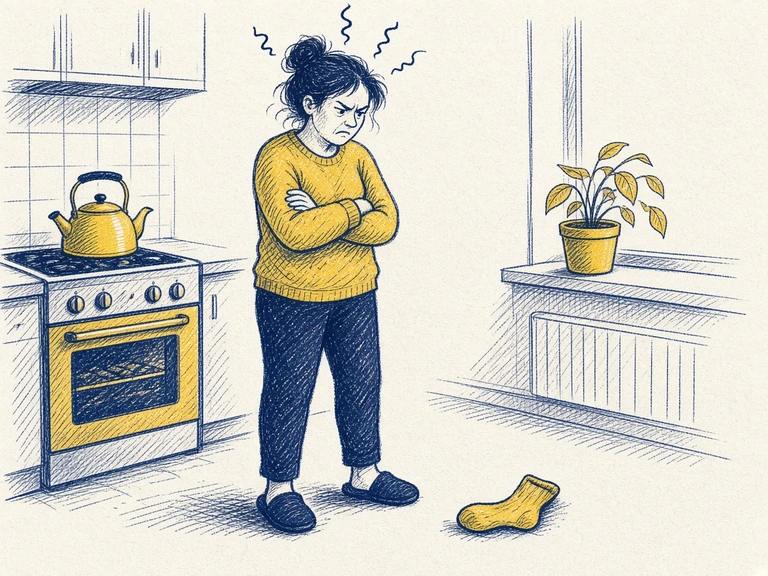
Short answer: to stop an ADHD anger outburst, catch it early and calm your body before you talk. Rate the anger from 1 to 10 and act at a 5, not a 9, call a timeout you agreed on in advance, leave the room for a few minutes and breathe out slowly. Have the actual conversation later. Hitting a pillow or going for an angry run doesn’t help (the six steps).
Someone moves your charger. Or asks “did you send that yet?” for the second time. Or the jar won’t open. And suddenly you’re at a 9, saying things in a voice you don’t recognize, over something you’ll have trouble even explaining an hour later.
Then comes the part nobody posts about. The cool-down takes ages, the apology is awkward, and you lie awake replaying it.
If that’s you, there’s a reason it keeps happening, and it isn’t that you’re a bad person.
Below is what the research says about ADHD and anger (it’s very common, and also not an official symptom), why tiny things set it off, what works in the moment and what backfires, and what medication and therapy actually do for it.
TL;DR: Fast, big anger that’s slow to settle is common with ADHD, and it has a name: emotional dysregulation. It gets much worse with short sleep, hunger and interruptions.
In the moment, catch it early (rate it 1 to 10), take an agreed timeout, and bring your body down with slow breathing. Punching a pillow or going for an angry run doesn’t help.
Long term, ADHD medication helps a little to a moderate amount, CBT has decent evidence, and anger that scares people needs professional help.
Does ADHD cause anger? (anger issues and emotional dysregulation)
ADHD doesn’t make everyone angry. But a short fuse shows up with it far more often than chance.
A 2014 review in the American Journal of Psychiatry put impairing emotion dysregulation at about 25 to 45% of children and 30 to 70% of adults with ADHD (Shaw et al., 2014). The adult numbers come mostly from clinic samples, and the authors called for population studies.
A 2020 meta-analysis pooled 13 studies with 2,535 adults. Adults with ADHD scored far higher on emotion dysregulation than adults without it, a large gap (Hedges’ g = 1.17). The biggest single gap was emotional lability, mood that flips fast (Beheshti, Chavanon & Christiansen, 2020).
The more ADHD symptoms people had, the more dysregulation they reported too (r = 0.54).
So why isn’t anger on the official symptom list? Researchers are still arguing about it. A 2019 practitioner review by seven US ADHD specialists said there’s a solid case for treating emotional impulsivity and poor emotional self-regulation as core ADHD symptoms (Faraone et al., 2019).
The same review notes the other side of the debate. Emotional symptoms show up in plenty of other conditions, so some experts think they’re too nonspecific to use for diagnosis, and there’s still no agreed way to define them that’s specific to ADHD.
What is emotional dysregulation? (examples)
Emotional dysregulation means a feeling arrives faster and bigger than the situation needs, and it’s slow to wind down. One review sums it up as “excitability, ease anger, and mood lability” (Lenzi et al., 2018).
In everyday ADHD life, it tends to look like this:
- Zero to furious. A small snag (a slow website, a sigh from your partner) jumps straight to rage, with no warm-up you noticed.
- Frustration that won’t let go. The annoying email is still running in your head at 11pm.
- Fast mood flips. Great mood at lunch, furious by 2, fine by 3, and confused about all of it.
- Snapping, then shame. The outburst lasts two minutes and the guilt lasts two days.
That last one may be part of the same package. In 213 newly diagnosed adults with ADHD, emotion regulation problems went closely with problems in self-concept, how people see themselves (Hirsch et al., 2018). That’s a link in one survey, not proof that one causes the other.
Why do I get so angry over little things?
Because the little thing is almost never alone. It’s the last straw on a pile, and with ADHD the pile tends to be taller. Each of these has evidence behind it:
Short sleep. In an experiment with 142 community residents, people randomly assigned to cut their sleep for two days got angrier during a task with annoying noise in the background. The rested group got used to the noise over time. The short-sleep group lost that (Krizan & Hisler, 2019).
Hunger. “Hangry” has a study. In three experiments, hunger made people read things more negatively, but only when the setting was already negative.
In the lab test, hungry people felt worse and judged a researcher more harshly mainly when they weren’t paying attention to their own feelings (MacCormack & Lindquist, 2019).
So hunger plus a jammed printer is the problem, and noticing “oh, I’m just hungry” may take some of the edge off. If you skip meals while locked in, our hyperfocus guide covers why you forget to eat.
Chewing on it. In three studies, people were provoked and then either ruminated about it or were distracted. The rumination lasted 25 minutes, and in one study 8 hours (Bushman et al., 2005).
The ruminators were more aggressive toward someone who later fumbled a simple task. The earlier anger landed on the wrong person.
Interruptions and mornings. Both get their own sections elsewhere. Here’s why being interrupted makes you so angry, and here’s why ADHD mornings come with a shorter fuse.
Too much input. A loud, crowded room shortens the fuse too. Here’s how to tell if you’re overstimulated or understimulated, and what to do about each.
Put a short fuse together with a short night, no lunch and a grudge from 10am, and a moved charger at 4pm makes a lot more sense.
What an ADHD anger outburst looks like in adults
The NHS lists the classic signs. In your body there’s a faster heartbeat, tense muscles, clenched fists, a tight chest and feeling hot. In behavior there’s shouting, sulking or ignoring people, starting fights, breaking things, and sometimes self-harm (NHS, Anger).
Some people turn it outward. Others turn it inward and take it out on themselves. Both count.
What people with ADHD often describe is the speed. It doesn’t feel like it builds, it feels like a switch. That’s partly an illusion, and it matters for how you stop it.
An anger management workbook from the US Substance Abuse and Mental Health Services Administration (SAMHSA) makes this point with what it calls the anger meter.
The meter runs from 1 (calm) to 10 (explosion, loss of control, consequences). Next to the middle of the scale it says “You have a choice!” And it says that even when anger is climbing quickly, a timeout can stop you short of 10 (Reilly et al., 2002).
So the switch is partly an illusion. There’s a window around 4 or 5, it’s just short.
How to stop an ADHD anger outburst in the moment
This is the part to practice when you’re calm, because you won’t invent it at an 8. In rough order of when you’d use it:
1. Learn your early warning signs
The SAMHSA workbook sorts anger cues into four groups (Reilly et al., 2002):
- Physical. Heart speeding up, chest tight, face hot.
- Behavioral. Fists clenching, voice rising, staring.
- Emotional. Feelings that ride along with the anger, like hurt, fear or feeling disrespected.
- Thoughts. Hostile self-talk (“they’re doing this on purpose”), revenge daydreams.
Write down your top two from each group. Those are your 4 or 5 on the meter, the point where you still have a choice.
2. Say it out loud (or in your head)
Naming the feeling sounds too simple to work. In a brain-imaging study at UCLA, labeling the emotion in a picture with a word lowered activity in the amygdala, a brain area that reacts to threats, compared with other ways of looking at the same picture (Lieberman et al., 2007).
That was pictures in a scanner, not a fight in a kitchen. But “I’m getting really angry” costs nothing, and it also warns the other person.
3. Take a timeout you agreed on in advance
The timeout is the one tool the SAMHSA workbook says “should be in everyone’s anger control plan.” The simple version is a few deep breaths before you react. The full version is stepping away from the conversation or the room (Reilly et al., 2002).
The workbook’s key detail is the agreement. Everyone involved agrees ahead of time that either person can call a timeout and leave. And the person who leaves comes back to finish or reschedule the talk.
Without that part, walking out mid-argument looks like storming off. With it, it’s the plan working.
A script helps: “I’m at a 7. I need 15 minutes. I’m coming back.” Then actually come back. Starting a 15-minute visual timer as you leave gives the break a clear end you can both see.
4. Turn the heat down
This is where most popular advice goes wrong. A 2024 meta-analysis pooled 154 studies with over 10,000 people (Kjaervik & Bushman, 2024).
Calming activities like deep breathing, mindfulness and meditation reduced anger and aggression, a solid effect (g = -0.63). It held across ages, genders, settings, and whether a therapist or an app delivered it.
Activities that raise arousal, like hitting a bag, jogging or cycling, did nothing on average (g = -0.02).
For the breathing part, make the exhale longer than the inhale. In a Stanford trial, five minutes a day of “cyclic sighing” improved mood more than five minutes of mindfulness over a month, in a group made up mostly of Stanford students (Balban et al., 2023).
You breathe in through the nose, top up with a second short inhale, then breathe out slowly through the mouth.
That study was about daily stress, not rage mid-argument. Using it during a timeout is our reading. It’s quick and discreet, though, and it fits what the anger meta-analysis found.
5. Hold back the words, let the feeling run
Trying to not feel angry doesn’t work. A 2012 meta-analysis of 306 experiments found suppressing the experience of an emotion did basically nothing (Webb, Miles & Sheeran, 2012).
Holding back how you show it (not yelling, keeping your face neutral) did help (d = 0.32). So aim for “I’m furious and I’m not going to say anything right now.” Telling yourself “I’m fine” doesn’t do much.
6. Distract, then reframe
In that same meta-analysis, distraction helped (d = 0.27) and concentrating on the feeling backfired (d = -0.26). Reinterpreting the situation helped (d = 0.36), and stepping back to look at it like a detached observer helped more (d = 0.45) (Webb, Miles & Sheeran, 2012).
In practice, that means doing something else during the timeout (dishes, a podcast, a walk around the block at an easy pace). Then ask how this would look to a stranger watching, and what else could be going on with the other person.
Skip the replay. That’s the rumination from the Bushman studies, and it makes the next small thing hit harder.
Does venting or hitting a pillow help?
No. Punching a pillow, screaming into it or going for a furious run all raise arousal, and in the 2024 meta-analysis that category didn’t lower anger on average (Kjaervik & Bushman, 2024).
The authors put it plainly, saying their findings “do not support the ideas that venting anger or going for a run are effective anger management activities.”
Two things that look similar are different. Exercise in general is on the NHS list of things that help with anger and stress. And talking it through later, with someone who isn’t involved, is also on the NHS list (NHS, Anger). The problem is revving up in the moment.
How to have fewer ADHD anger outbursts (the prevention part)
In-the-moment tools are the fire extinguisher. This is the wiring. Our suggestions, built from the findings above:
- Protect sleep first. It has a clean experiment behind it. If 1am keeps winning, start with revenge bedtime procrastination.
- Eat by the clock. Don’t wait for hunger to tell you, because during a busy afternoon it won’t, until it shows up as rage.
- Keep an anger log for two weeks. The SAMHSA workbook has people write down the highest number they hit each day. Add what set it off and what time it was. Patterns show up fast (always 5pm, always about money, always on no lunch).
- Write if-then plans for your top triggers. “If he asks about the bill when I’ve just walked in, I say ‘after dinner’ and go change.” If-then plans help people follow through on goals they’ve set (Gollwitzer & Sheeran, 2006).
- Cut the obvious stressors. A lot of ADHD anger is at your own life: lost keys, missed deadlines, the overflowing inbox. Fewer daily decisions and a system for being on time remove some fuel.
- Repair fast and plainly. “I’m sorry I yelled. It wasn’t about the charger.” Skip the long explanation of your neurology in the moment. That can come later.
ADHD anger in relationships
Partners and family get the worst of it, because they’re around when the pile is tallest.
A 2021 review of adult ADHD and romantic relationships found a lot of evidence that adults with ADHD have shorter, more conflict-heavy relationships, and much less research on why or what helps (Wymbs et al., 2021).
There’s a harder part too. A systematic review of seven studies found ADHD, in childhood or adulthood, was linked with a higher risk of domestic or intimate partner violence.
In several of the studies, conduct disorder or antisocial personality explained part of the link (Buitelaar, Posthumus & Buitelaar, 2020).
In a 2026 study of 69 young couples, both partners in couples where one or both had ADHD reported more psychological and physical aggression, given and received, than partners in couples without ADHD (Wymbs et al., 2026).
None of that means ADHD makes you violent. It does mean “I have ADHD” is a reason to take anger seriously, never an excuse for it.
What helps at home (our suggestions, drawn from the timeout section above):
- Agree on the timeout when things are calm. Same words, same rule, either person can call it, and whoever leaves comes back.
- Name the pattern together. “When I’m hungry and you ask about plans, I bite your head off” is useful information for both of you.
- Never handle money, the in-laws or big decisions at an 8. Reschedule them.
If your anger scares the people you live with, or you’ve broken things, grabbed someone or made threats, that’s past what a blog can fix. The NHS says to see a doctor if you’re acting in an abusive or violent way. In the US, the National Domestic Violence Hotline is 1-800-799-7233.
Does ADHD medication help with anger?
Usually somewhat, and occasionally it makes it worse.
A 2018 meta-analysis of 21 double-blind trials in adults found ADHD medications reduced emotional dysregulation by a small to moderate amount. Lisdexamfetamine showed the biggest effect (SMD = 0.50), then methylphenidate (0.34), then atomoxetine (0.24) (Lenzi et al., 2018).
The authors suggest the medications may reach the emotional side less well than the core ADHD symptoms.
A 2022 review was more upbeat. In 13 of 14 trials of the same three drugs, emotional behavior improved significantly. Depending on the trial, the effect on emotional behavior ranged from about a third of the effect on other ADHD symptoms to a bit more than it (Surman & Walsh, 2022).
The flip side is that mood changes can be a side effect. The NHS tells adults on methylphenidate to call their doctor straight away if they feel aggressive, irritable, depressed, anxious or tense (NHS, 2025).
If your anger got worse after starting or changing a medication, or it lines up with the time of day your dose kicks in or fades, tell your prescriber. That’s useful information, and there are usually other options.
Therapy for ADHD emotional dysregulation
For adults, CBT has the best evidence. A 2022 meta-analysis of 44 randomized trials found cognitive behavioral therapy improved emotional symptoms in adults with ADHD, right after treatment and at follow-up (Guo, Assumpcao & Hu, 2022).
A systematic review of 22 studies found adults with ADHD lean on unhelpful emotion regulation strategies more often than people without ADHD, and that’s the kind of habit skills-based therapy works on (Soler-Gutiérrez, Pérez-González & Mayas, 2023).
Anger management programs are another route. The NHS says most include CBT and counselling, one-to-one or in a group. On the NHS, you can refer yourself for free talking therapy such as CBT without seeing a GP first (NHS, Anger).
If you go private, look for a therapist who knows adult ADHD, and say up front that anger is what you want to work on.
What about ADHD anger in kids?
This guide is written for adults, and kids need child-specific advice. Emotion dysregulation is common in children with ADHD too, about 25 to 45% in the Shaw review.
For children, the treatment evidence points at the relationships around them. Parent training helped with children’s emotional dysregulation and depression, and social skills training also helped with dysregulation (Guo, Assumpcao & Hu, 2022). A pediatrician is the place to start.
Is it ADHD, or something else?
Trouble with emotions isn’t ADHD-only. A 2026 meta-analysis of 188 studies compared people with 15 psychiatric diagnoses against healthy controls.
Every one of the 12 conditions it could analyze on the main emotion regulation scale showed a large gap, with the biggest in borderline personality disorder (Sloan et al., 2026).
Trauma is one example. The NHS notes that PTSD can lead to angry outbursts, and it lists depression, anxiety and low mood as reasons to see a GP about anger (NHS, Anger). Plenty of people have ADHD plus one of these.
So if anger is a big part of your life, an assessment that looks at the whole picture beats guessing. Bring your anger log to the appointment.
When to get help for anger
The NHS says to see a GP if (NHS, Anger):
- you’re struggling to cope with anger
- what you’re doing to help yourself isn’t working
- you’re acting in an abusive or violent way
- you’re struggling with stress, anxiety or depression, or your mood has been low for more than 2 weeks
And if you’ve had thoughts of harming yourself or someone else, don’t wait for an appointment. In the US, call or text 988. Anywhere else, your local emergency number or crisis line.
Sources
- Balban, M. Y., Neri, E., Kogon, M. M., Weed, L., Nouriani, B., Jo, B., Holl, G., Zeitzer, J. M., Spiegel, D., & Huberman, A. D. (2023). Brief structured respiration practices enhance mood and reduce physiological arousal. Cell Reports Medicine, 4(1), 100895. https://doi.org/10.1016/j.xcrm.2022.100895
- Beheshti, A., Chavanon, M.-L., & Christiansen, H. (2020). Emotion dysregulation in adults with attention deficit hyperactivity disorder: A meta-analysis. BMC Psychiatry, 20, 120. https://doi.org/10.1186/s12888-020-2442-7
- Buitelaar, N. J. L., Posthumus, J. A., & Buitelaar, J. K. (2020). ADHD in childhood and/or adulthood as a risk factor for domestic violence or intimate partner violence: A systematic review. Journal of Attention Disorders, 24(9), 1203-1214. https://doi.org/10.1177/1087054715587099
- Bushman, B. J., Bonacci, A. M., Pedersen, W. C., Vasquez, E. A., & Miller, N. (2005). Chewing on it can chew you up: Effects of rumination on triggered displaced aggression. Journal of Personality and Social Psychology, 88(6), 969-983. https://doi.org/10.1037/0022-3514.88.6.969
- Faraone, S. V., Rostain, A. L., Blader, J., Busch, B., Childress, A. C., Connor, D. F., & Newcorn, J. H. (2019). Practitioner review: Emotional dysregulation in attention-deficit/hyperactivity disorder, implications for clinical recognition and intervention. Journal of Child Psychology and Psychiatry, 60(2), 133-150. https://doi.org/10.1111/jcpp.12899
- Gollwitzer, P. M., & Sheeran, P. (2006). Implementation intentions and goal achievement: A meta-analysis of effects and processes. Advances in Experimental Social Psychology, 38, 69-119.
- Guo, C., Assumpcao, L., & Hu, Z. (2022). Efficacy of non-pharmacological treatments on emotional symptoms of children and adults with attention-deficit/hyperactivity disorder: A meta-analysis. Journal of Attention Disorders, 26(4), 508-524. https://doi.org/10.1177/10870547211001953
- Hirsch, O., Chavanon, M., Riechmann, E., & Christiansen, H. (2018). Emotional dysregulation is a primary symptom in adult attention-deficit/hyperactivity disorder (ADHD). Journal of Affective Disorders, 232, 41-47. https://doi.org/10.1016/j.jad.2018.02.007
- Kjaervik, S. L., & Bushman, B. J. (2024). A meta-analytic review of anger management activities that increase or decrease arousal: What fuels or douses rage? Clinical Psychology Review, 109, 102414. https://doi.org/10.1016/j.cpr.2024.102414
- Krizan, Z., & Hisler, G. (2019). Sleepy anger: Restricted sleep amplifies angry feelings. Journal of Experimental Psychology: General, 148(7), 1239-1250. https://doi.org/10.1037/xge0000522
- Lenzi, F., Cortese, S., Harris, J., & Masi, G. (2018). Pharmacotherapy of emotional dysregulation in adults with ADHD: A systematic review and meta-analysis. Neuroscience & Biobehavioral Reviews, 84, 359-367. https://doi.org/10.1016/j.neubiorev.2017.08.010
- Lieberman, M. D., Eisenberger, N. I., Crockett, M. J., Tom, S. M., Pfeifer, J. H., & Way, B. M. (2007). Putting feelings into words: Affect labeling disrupts amygdala activity in response to affective stimuli. Psychological Science, 18(5), 421-428. https://doi.org/10.1111/j.1467-9280.2007.01916.x
- MacCormack, J. K., & Lindquist, K. A. (2019). Feeling hangry? When hunger is conceptualized as emotion. Emotion, 19(2), 301-319. https://doi.org/10.1037/emo0000422
- National Domestic Violence Hotline. https://www.thehotline.org/
- NHS. Get help with anger. https://www.nhs.uk/mental-health/feelings-symptoms-behaviours/feelings-and-symptoms/anger/
- NHS. (2025, March 25). Side effects of methylphenidate for adults. https://www.nhs.uk/medicines/methylphenidate-adults/side-effects-of-methylphenidate-for-adults/
- Reilly, P. M., Shopshire, M. S., Durazzo, T. C., & Campbell, T. A. (2002, revised 2012). Anger management for substance abuse and mental health clients: Participant workbook (HHS Publication No. SMA 12-4210). Substance Abuse and Mental Health Services Administration. https://www.veterantraining.va.gov/aims/media/AngerManagementWorkbook-508.pdf
- Shaw, P., Stringaris, A., Nigg, J., & Leibenluft, E. (2014). Emotion dysregulation in attention deficit hyperactivity disorder. American Journal of Psychiatry, 171(3), 276-293. https://doi.org/10.1176/appi.ajp.2013.13070966
- Sloan, M. E., Stellern, J., Xiao, K. B., Germeyer, A., Gill, K., Laputsina, V., Mulsant, B. H., Ngoy, A., Nguyen, M., Tang, V. M., Sanches, M., & Gowin, J. L. (2026). Emotion regulation impairment across psychiatric disorders: A systematic review and meta-analysis. Translational Psychiatry, 16, 386. https://doi.org/10.1038/s41398-026-04119-x
- Soler-Gutiérrez, A. M., Pérez-González, J. C., & Mayas, J. (2023). Evidence of emotion dysregulation as a core symptom of adult ADHD: A systematic review. PLOS ONE, 18(1), e0280131. https://doi.org/10.1371/journal.pone.0280131
- Surman, C. B. H., & Walsh, D. M. (2022). Do treatments for adult ADHD improve emotional behavior? A systematic review and analysis. Journal of Attention Disorders, 26(14), 1822-1832. https://doi.org/10.1177/10870547221110926
- Webb, T. L., Miles, E., & Sheeran, P. (2012). Dealing with feeling: A meta-analysis of the effectiveness of strategies derived from the process model of emotion regulation. Psychological Bulletin, 138(4), 775-808. https://doi.org/10.1037/a0027600
- Wymbs, B. T., Canu, W. H., Sacchetti, G. M., & Ranson, L. M. (2021). Adult ADHD and romantic relationships: What we know and what we can do to help. Journal of Marital and Family Therapy, 47(3), 664-681. https://doi.org/10.1111/jmft.12475
- Wymbs, B. T., Pickel, C. T., Evans, S. W., Zoccola, P. M., Shorey, R. C., & Toback, L. M. (2026). It takes two: Intimate partner violence according to both partners in young adult ADHD couples. Journal of Attention Disorders, 30(2), 222-233. https://doi.org/10.1177/10870547251382679
Want one more of these each week?
One technique a week, the study behind it, and a low-energy version. Free, about a 3-minute read, unsubscribe anytime.
We use your address only to send the email, and you can unsubscribe in one click.
FAQ
Does ADHD cause anger issues?
It often comes with them. A review in the American Journal of Psychiatry put impairing emotion dysregulation, which includes quick anger, at roughly 30 to 70% of adults with ADHD, mostly in clinic samples (Shaw and colleagues, 2014). A 2020 meta-analysis of 13 studies found adults with ADHD scored far higher on emotion dysregulation than adults without it. Plenty of people with ADHD don't have anger problems, though, and anger isn't one of the official diagnostic criteria.
What is emotional dysregulation in ADHD?
It means feelings come on faster and stronger than the situation calls for and take longer to settle. One review describes it as excitability, getting angry easily and mood that swings (Lenzi and colleagues, 2018). In a 2020 meta-analysis, the biggest gap between adults with and without ADHD was emotional lability, mood that changes fast. Researchers still argue about whether it should count as a core ADHD symptom.
Why do I get so angry over little things?
Usually because the little thing isn't arriving alone. A shorter fuse from ADHD stacks with short sleep, hunger, an interruption or a bad morning. In one experiment, cutting sleep for two days made people angrier during an annoying-noise task (Krizan and Hisler, 2019). Hunger made people read a negative situation more negatively (MacCormack and Lindquist, 2019). And people who chewed over an earlier provocation were more aggressive after a later small annoyance (Bushman and colleagues, 2005).
How do you stop an ADHD anger outburst?
Catch it early and bring your body down, then talk later. Rate your anger from 1 to 10 and act at a 5, not a 9. Call a timeout you agreed on in advance, leave for a few minutes, and breathe out slowly. A meta-analysis of 154 studies found calming activities like slow breathing and mindfulness reduced anger and aggression, while revving-up activities like hitting a bag or jogging didn't (Kjaervik and Bushman, 2024). Come back to the conversation once you're calmer.
Does venting help with anger?
Not the way people hope. In a meta-analysis of 154 studies, activities that raise arousal, like hitting a bag, jogging or cycling, didn't reduce anger overall (Kjaervik and Bushman, 2024). Turning the heat down did. Talking a problem through later, with someone who isn't involved, is different from venting in the moment, and the NHS suggests it.
Does ADHD medication help with anger and emotional dysregulation?
On average, a little to a moderate amount. A meta-analysis of 21 double-blind trials in adults found small to moderate effects on emotional dysregulation for methylphenidate, atomoxetine and lisdexamfetamine (Lenzi and colleagues, 2018). Irritability can also be a side effect, though. The NHS says to call your doctor if methylphenidate makes you feel aggressive or irritable.
What therapy helps with ADHD emotional dysregulation?
Cognitive behavioral therapy has the best evidence for adults. A meta-analysis of 44 randomized trials found CBT improved emotional symptoms in adults with ADHD, both right after treatment and at follow-up (Guo and colleagues, 2022). Anger management programs usually include CBT too, according to the NHS, and on the NHS you can refer yourself for free talking therapy.
Is ADHD anger the same as an autism or BPD meltdown?
Not necessarily, and the overlap is big. A 2026 meta-analysis found trouble regulating emotions in all 12 psychiatric conditions it could analyze, with the largest gap in borderline personality disorder (Sloan and colleagues, 2026). The NHS notes that PTSD can also lead to angry outbursts. If outbursts are a big part of your life, a full assessment is the only way to sort out what's driving them.
When should I get help for anger?
The NHS says to see a GP if you're struggling to cope with anger, your own strategies aren't working, or you're acting in an abusive or violent way. If you've thought about harming yourself or someone else, that's an emergency. In the US, call or text 988, or call your local emergency number.
These are everyday strategies, not medical advice. If ADHD, sleep or mood problems are making daily life hard, a doctor or therapist is the right person to ask. How we handle health topics.
New here? Start with the reading order → Rather use paper? Grab a free printable.