
Short answer: to stop being late with ADHD, stop trusting your gut for how long things take. Time your usual trips once with a stopwatch, plan backwards from when you need to be in the room, set an alarm for when to start getting ready (not when to leave), and give your buffer a job so it doesn’t get spent (the 6 steps). The reason it keeps happening is time blindness, a weaker felt sense of time that’s common with ADHD. You can’t fix the internal clock, so these steps work around it.
You care about being on time. You think about it constantly. And somehow you’re still pulling into the parking lot at 2:59 for a 3:00 appointment, heart rate at 140, having driven like you’re in a heist movie.
If that’s you, you’re not careless. A lot of people with ADHD (and plenty without) describe the same thing: time doesn’t feel real until it’s urgent, and by the time it’s urgent, it’s too late to do it calmly.
Time blindness examples (what it looks like on a normal day)
Time blindness rarely looks dramatic. It shows up as small, weirdly specific moments that make you look flaky to everyone, including yourself. There’s no official list of time blindness symptoms, so treat these as the moments people describe most, each with the part of this page that fixes it:
- The “10-minute shower” that takes 25. You’d swear it’s ten. The stopwatch disagrees every single time. Time it once and plan with the real number.
- Starting to get ready at the time you meant to leave. You knew it was at 3. You looked up at 2:40 wearing one sock. Alarm the start, not the leave.
- A 4pm dentist appointment that deletes the whole day. Nothing real gets started because something is “coming up.” That one has a name: waiting mode.
- The deadline that was three weeks away until it was tomorrow. Deadlines that sneak up on you is the section for this.
- “I’ll text back in a sec,” and now it’s Thursday. This is the one that hurts relationships, because your friend only sees the silence. Part of it is memory, not time: “reply later” has no time attached, so mark the chat unread and give later a slot.
- Looking up from a project and it’s dark out. Tea cold, lunch skipped (why that keeps happening), back complaining. That’s hyperfocus, and it gets its own section below.
Hyperfocus and time blindness (where did the afternoon go?)
You sat down at 1 to “quickly fix the formatting” on a spreadsheet. It’s now 6:15. The formatting is gorgeous. You missed two texts and lunch, and the thing you actually had to do today hasn’t been opened.
Hyperfocus is the long, locked-in stretch on one thing, usually something interesting rather than something important. This section is only about what it does to the clock.
Block, Hancock and Zakay (2010) pooled 117 experiments: when people know they’ll be asked how long something took, a more demanding task makes their estimate come out shorter. Attention is limited, and whatever the task uses, the clock doesn’t get. Caveats: unwarned people asked afterward show the reverse, and those lab stretches were seconds to minutes. Stretching it to a lost Saturday is our guess.
You probably can’t make hyperfocus behave, but you can give it an exit:
- Set the end before you start. A timer for when the session stops, set before you sit down. If you know you won’t look up, use a sound and put it across the room, so turning it off means standing up.
- Leave yourself a note on the way out. Jot the next step (“next: column F”) before you stop. In four studies, Leroy and Glomb (2018) found that a quick plan for getting back to an interrupted task made it easier to focus on the next thing. Leaving is easier when you know the thread will still be there.
- Put the snack and water in reach before you start. You are not going to remember lunch. Plan around that.
For hyperfocus vs flow, the autism overlap, and why you can’t switch it on at will, see the hyperfocus guide.
If the problem is the reverse, and hyperfocus never shows up for the boring task you actually need to do, that’s a different fix: when you hate the task.
Do I have time blindness? (a free time blindness test for adults)
There’s no validated test for time blindness on its own, so the online quizzes are checklists wearing a lab coat. They ask how time feels to you. A stopwatch or a time audit asks what time actually did, which is the better question. Our free online time blindness test does the stopwatch part in a browser tab: a hidden 30-second timer, then a guess-then-time-it check on a real task.
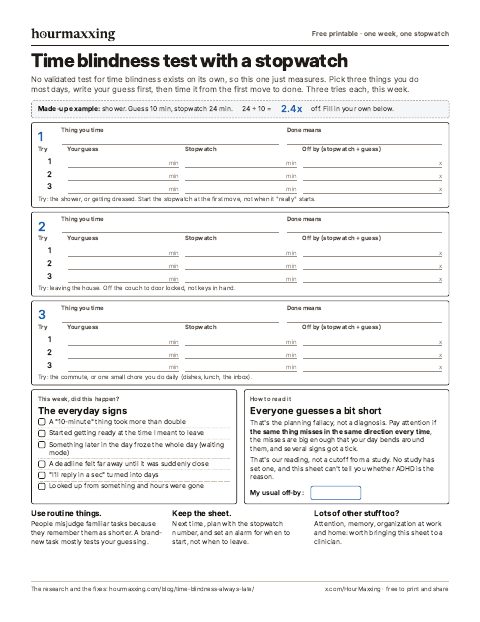
The one-week stopwatch test. Pick three things you do most days. Write your guess down before you start, then time it from the first move to done (off the couch to door locked, not keys in hand). Do each one three times over the week.
| Thing you time | Your guess | Stopwatch | Off by |
|---|---|---|---|
| Shower (made-up example) | 10 min | 24 min | 2.4x |
| Leaving the house | |||
| Commute |
“Off by” is the stopwatch number divided by your guess. The first row is invented so you can see the math. Fill in the rest with your own.
Rather do it on paper? The free time blindness test worksheet (PDF) has this table for three things and three tries each, the everyday signs as a tick list, and a box for your usual off-by number. No email needed.
Use routine things on purpose. In Roy and Christenfeld’s (2007) experiments, people underestimated familiar tasks because they remembered them as shorter, and that bias disappeared on brand-new tasks.
How to read it. Everyone guesses a bit short. That’s the planning fallacy, not a diagnosis: the honors thesis students in step 3 below missed by about three weeks.
What we’d pay attention to: the same task missing in the same direction every time, misses big enough that your day bends around them, and several of the examples above showing up weekly. That’s our reading; no study has set a cutoff.
Keep the sheet. Those numbers are what step 1 asks you to plan from. Big misses alone don’t mean ADHD. If they come with a pile of other stuff, bring it to a clinician.
What causes time blindness?
There isn’t one cause. “Time blindness” isn’t an official diagnosis, but it’s a useful name for a well-studied pattern, and the research points at a few pieces that stack:
- ADHD affects how you manage behavior across time. Psychologist Russell Barkley has argued since the 1990s that ADHD isn’t a lack of knowing what to do. It’s trouble using what you know at the moment it matters, especially when the payoff is in the future. Being “almost on time” is a textbook example: you know when to leave, you just don’t feel it until it’s late.
- Timing itself is harder. A 2013 review by Noreika, Falter and Rubia found people with ADHD tend to do worse on lab tasks like estimating, reproducing, and telling apart time intervals. So “I’ll be ready in five minutes” is a genuine estimate. It’s just often wrong.
- The future feels far away. A 2016 meta-analysis by Jackson and MacKillop found people with ADHD tend to discount future rewards more steeply than people without it. “Arriving calm in 40 minutes” loses to “one more video right now.”
- Everyone underestimates their own tasks. Even without ADHD, people predict their own work will take less time than it does, and keep doing it even when they know their past projects ran over. Psychologists call this the planning fallacy (Buehler, Griffin and Ross, 1994). ADHD stacks on top of it.
Put those together and you get the classic loop: the deadline doesn’t feel real, so you fill the time; then it feels very real, so you panic-start; then you’re late anyway because the task took longer than your gut said. Every part of that loop can be handled from the outside.
Is time blindness real, or just an excuse?
It’s real in the way that counts: it shows up in lab data, not just in apologies. A 2024 meta-analysis by Metcalfe, McFeaters and Voyer pooled 824 effect sizes and found people with ADHD did clearly worse than people without it on time-perception tasks, in kids and adults (a medium-to-large gap by the usual yardstick). A separate 2022 meta-analysis of 55 studies by Marx and colleagues found the same broad picture, from telling apart blips shorter than a second to estimating and producing intervals a few seconds long.
It is not a diagnosis, though. “Time blindness” isn’t in the DSM-5, and there’s no validated test for it on its own. It’s a nickname for a pattern that shows up a lot with ADHD, and sometimes without it (more on that next).
Real doesn’t mean nothing can be done. The useful version is “my gut clock runs wrong, so I use outside ones.”
How to explain time blindness to someone (partner, friend, boss)
Start with what it costs them, not with your brain. “I know it sucks sitting there waiting for me” lands before any word about executive function does, and it keeps the conversation from sounding like a defense.
Then one sentence of explanation, one real number, and one change:
“My sense of how long things take is genuinely off. I think getting ready takes 15 minutes and it actually takes 35, I timed it. So I’ve got a start-getting-ready alarm at 6:10 now, and I’ll text you when I’m actually in the car.”
“It takes me 35 minutes and I thought 15” is a thing anyone can picture, and the change matters even more: “I can’t help it” asks them to absorb the cost forever. With partners and close friends:
- Send a better signal than a promise. “Five minutes away” is an estimate, and your estimates are the broken part. “Leaving now,” sent when you’re actually leaving, is a fact they can plan around.
- Agree on a default for the big stuff. Flights, concerts, their mom’s birthday dinner: they tell you the time to be in the room, and you plan back from that with the count-every-step method, not from the start time on the invite.
- Put the leave time on a shared calendar. One event called “leave for dinner,” not just “dinner at 7.”
- Let them be annoyed sometimes. An explanation isn’t a request to stop minding. “Yeah, I blew the alarm” goes further than another round of the science.
Studies on what helps couples here are thin (Wymbs and colleagues, 2021), so treat the list as practical rather than proven. If lateness is the same fight every week, a couples therapist who knows ADHD is a reasonable next step.
Can you have time blindness without ADHD?
Yes, though the research is thinner and the pattern looks different.
- Autism. A 2019 systematic review of 45 studies by Casassus and colleagues found autistic and non-autistic groups often differed on time tasks, most consistently on complex ones, but said it’s still unclear whether autism involves a basic timing problem. ADHD and autism also often come as a pair.
- Depression. A 2015 meta-analysis of 16 studies by Thönes and Oberfeld found depressed people felt time dragging more, while their actual duration judgments were fine.
- Everyone, sometimes. The planning fallacy above hits people with no diagnosis at all, and so do being exhausted, stressed, or three videos deep.
The workarounds below don’t care where the problem comes from.
Is being late a symptom of ADHD?
Not by itself. Plenty of people run late because of an unreliable bus, a toddler who hides one shoe, or back-to-back meetings.
It does sit right next to one, though. The DSM-5 lists “has poor time management; fails to meet deadlines” as examples under one of nine inattention symptoms (difficulty organizing tasks and activities). An adult needs at least five, for six months or more, starting before age 12, in more than one setting, and getting in the way of work, school, or relationships.
So chronic lateness plus a pile of the other stuff (keys that vanish daily, half-finished projects, drifting off mid-conversation) is worth bringing to a clinician. Lateness on its own mostly means you need better outside clocks, which is what the rest of this page is.
Time blindness vs time optimism and procrastination
Three other things get called time blindness, and each one needs a different fix. One question sorts most of them: when you look back at the missing time, which part surprised you?
Time blindness vs time optimism
“Time optimism” is the internet’s name for planning too little time. The research term is the planning fallacy (Kahneman and Tversky, 1979): you picture the version of the task where nothing goes wrong and budget for that. The thesis students in step 3 guessed 33.9 days and took 55.5.
The difference is when it goes wrong.
- Time optimism is a planning problem. The number was wrong before you started. You said the email would take 10 minutes because you forgot it needed a file you’d have to find first.
- Time blindness is a tracking problem. The plan might have been fine. Once you started, the clock stopped registering. You meant to stop at 3 and looked up at 4:40.
Quick check: if someone had asked you the time halfway through, would you have known? Right time but behind is optimism. Shocked is blindness. Plenty of people get both.
They take different fixes. For optimism, change the number: count the boring bits and plan from last time. For blindness, move the clock outside your head with an alarm for the start and a timer you can see.
Is time optimism an ADHD thing? Everyone does it. The ADHD research is about the tracking side (the Metcalfe meta-analysis above); we couldn’t find a study showing ADHD makes the planning fallacy bigger.
Time blindness vs procrastination
Procrastination knows what time it is. Piers Steel’s 2007 review defines it as voluntarily delaying something you meant to do, even though you expect to be worse off, usually because starting feels bad right now (Sirois and Pychyl, 2013). Time blindness involves no choice in the moment. You just didn’t feel 2:30 arrive. Were you checking the clock with dread, or did the time surprise you? Dread points to procrastination, surprise to time blindness.
With ADHD the two feed each other. A deadline three weeks out doesn’t feel real (the steep discounting from what causes time blindness), so putting it off doesn’t feel like a decision until it suddenly is one.
If yours is mostly the dread kind, the task paralysis guide covers why people with ADHD procrastinate and how to shrink the first step until it’s easy to start. If it’s the surprise kind, deadlines that sneak up on you is the section for you.
Is time blindness a type of executive dysfunction?
More or less. Executive dysfunction is the broad name for trouble with planning, starting, switching, and holding things in mind, and Barkley’s 1997 model of ADHD ties the sense of time to working memory, one of those functions. So time blindness is a part of the whole, and task paralysis is another part, the one about starting. (Is executive dysfunction real?)
How to fix time blindness (or at least work around it)
The honest answer first: nobody has a proven way to install a better internal clock. What has some evidence is training the skills around time and moving the clock outside your head.
The closest studies are small. Wennberg and colleagues (2018) gave 38 medicated kids with ADHD (9 to 15) time-skill training plus time aids or education only; parents rated time management better at 24 weeks, the kids didn’t. In a Japanese pilot with 48 adults, Nakashima and colleagues (2022) found group CBT built around time management lowered ADHD symptoms versus usual care. Treat both as “worth trying,” not proof. (There’s a bigger CBT trial with a calendar-and-task-list module in does time blocking work for ADHD.)
So the practical version is the same move every section on this page makes: stop asking your gut what time it is. Pick the line that sounds most like you:
- “It’ll take 20 minutes” (it never has). Time the trip once with a stopwatch and count the boring steps. Start with how to stop being late to everything.
- You know when to leave but you don’t feel it. Set the alarm for when you start getting ready, labeled with the action: alarm the start, not the leave.
- Your 10-minute buffer keeps evaporating. Give your buffer a job.
- Deadlines feel fake until they’re tomorrow. Borrow urgency from other people and shrink the gap: deadlines that sneak up on you.
- You lose track of time once you’re into something. Put time where your eyes already are: visual timers.
- The day runs out before the list does. The task was probably secretly six tasks: why does everything take me so long?
Fix one of these, not all six.
When the alarm goes off and you go straight back to bed
The alarm screams. Your hand finds it. Pillow. Ten more minutes become forty, and you feel like you chose laziness on purpose.
You did not. You woke up into sleep inertia. (If “lazy” is your brain’s go-to word for this stuff, here’s how ADHD paralysis and laziness actually differ.)
Sleep inertia is a temporary dip in alertness and thinking right after you wake. Tassi and Muzet (2000) found it’s stronger after deep sleep or a short night, and Jewett and colleagues (1999) found the fog lifts in a curve, not a click. So “just make a different choice” fails at the worst moment. Choice is the skill that is offline.
So stop asking morning-you to decide. The bed is the nearest reward, so glue the first upright action to the alarm and make the bed a worse place to finish waking up.
- When the alarm rings, the next move is already named. “When the alarm goes off, I stand up and open the blinds” (or start the kettle, or put feet on the floor and say the day out loud). That is an implementation intention: Gollwitzer and Sheeran’s (2006) meta-analysis found these if-then plans help people follow through. Write the exact action on a sticky on the alarm so half-asleep you do not have to invent one.
- Put the alarm across the room. The first action becomes walking. You cannot silence it from the pillow. Cheap, annoying, effective. If the phone is the alarm, it should not sleep under the pillow anyway, or the first thing you do awake is scroll.
- Set a second labeled alarm three minutes later. Not “snooze.” A different sound that means “you are still in bed, stand up now.” Label it with the action. Two cues beat one when inertia is thick.
You are not trying to feel awake before you move. You are trying to be past the first physical step before sleep inertia gets a vote. Once you are upright, the get-out-the-door tools take over.
If the alarm isn’t the hard part and you’re awake but still horizontal an hour later, here’s how to get out of bed with ADHD, including why ADHD body clocks often run late. And if the alarm is fine but everything after it falls apart, the ADHD morning routine checklist puts the rest of the morning in walking order, with a free printable.
How to stop being late to everything
Being late to everything is rarely one big mistake. It’s the shower that ran four minutes long, plus a “20-minute drive” that has never once, in recorded history, taken 20 minutes. Each leak is small. Stack them on a schedule with zero slack and you walk into the 9:00 meeting at 9:07 again, coffee sloshing.
So the fix is boring on purpose. Swap your gut numbers for measured ones and plan backwards from the moment you need to be in the room. Then hand the moment of leaving to an alarm instead of a feeling.
1. Time your usual trips once, with a real stopwatch
Your memory of how long the commute takes is the wrong tool for this. Roy and Christenfeld (2007) found that people tend to remember familiar tasks as shorter than they really were, and that the memory error predicted how much they underestimated the next one. In a follow-up, Roy, Mitten and Christenfeld (2008) showed people their actual time on a similar earlier task before they made a prediction, and the predictions got more accurate in all three experiments.
So for your two or three most common trips, start a stopwatch when you stand up off the couch and stop it when you’re sitting in the room. Not when the car starts. Do it on an ordinary day, not the one where every light was green. Write the number in the calendar event or on a sticky by the door, and trust it over your gut. Start with work or school: same trip five days a week, so one honest measurement pays off fast.
2. Count the boring bits, then work back from the arrival time
When you estimate “it’s a 20-minute drive,” you’re only counting the drive. Kruger and Evans (2004) found that when people listed a task’s parts before estimating, their predictions got longer and closer to reality. (Their paper is literally titled “If you don’t want to be late, enumerate.”) So do the unglamorous math once:
- Find shoes, keys, wallet, charger: 5 min
- Bathroom, water bottle, “where are my headphones”: 5 min
- Walk to the car and get settled: 3 min
- Drive: 20 min
- Park, walk in, find the room: 7 min
That “20-minute drive” is really 40 minutes. Now plan backwards from when you need to be sitting down, not from the time on the invite:
| Time | What happens |
|---|---|
| 2:15 | Wrap-up alarm: finish the sentence you’re typing, phone face down |
| 2:20 | Get-ready alarm: shoes, keys, bathroom |
| 2:30 | Door closes behind you |
| 2:33 | Driving |
| 2:53 | Parking, walking in, finding the room |
| 3:00 | Sitting down |
The only times you have to obey are the two alarms. Everything after them runs on rails.
3. Plan from last time, not from your best time
In Buehler, Griffin and Ross’s (1994) studies, students writing an honors thesis predicted they’d finish in 33.9 days on average. They took 55.5, and fewer than a third finished by their own best guess. When people talked through their predictions out loud, they mostly described the plan for this time and barely mentioned how past projects went. In one of their experiments (a computer assignment, about 40 students per group), simply remembering past assignments didn’t fix the optimism. It went away when students had to connect those past experiences to the prediction they were making right then.
For lateness, that’s one question before you pick a leave time: “The last three times I left at 8:40, what time did I actually walk in?” If the answer is 9:05, 9:04 and 9:11, 8:40 is a fantasy. Move it.
4. Alarm the start, not the leave
An alarm at “time to leave” is too late, because leaving takes 15 minutes. Set it for when you need to start getting ready, and label it with the action: “Shoes on now.” Add a transition alarm five minutes earlier that says “wrap it up,” so you get to finish the email instead of arguing with the get-ready alarm.
Labels matter. Planning exactly what you’ll do when a cue shows up (“when the alarm goes, I put my shoes on”) is an implementation intention, and Gollwitzer and Sheeran’s (2006) meta-analysis of 94 tests found a medium-to-large effect on following through.
5. Give your buffer a job
“Leave 10 minutes early” fails because those 10 minutes look free, and your phone is very good at finding free time. Make the extra time something you’re heading toward:
- Be parked by 2:50 and finish your podcast in the car.
- Arrive early and answer two emails in the lobby.
- Grab a coffee near the place, if coffee is a reward for you.
Now being early is a small treat instead of wasted time.
6. Stop doing “one quick thing” before you leave
“I’ll just send this text / empty the dishwasher / check one email” is where most lateness actually happens, because quick things are rarely quick. A simple rule: after the get-ready alarm, no new tasks. If you think of something, write it down and do it when you get back. (If the phone is the main culprit, a nerfed phone makes this a lot easier.)
When you’re either 2 minutes late or completely late
Most days you land two minutes past the start, apologizing in the doorway. Or you blow it by twenty. You almost never arrive calmly early. That is what happens when leave-time is the only moment that feels real.
You hover near “just enough time.” That’s the planning fallacy (Kahneman and Tversky, 1979): you plan for the morning where nothing goes wrong. Two minutes late is that version. Completely late is the version where one sock, one text, or one red light showed up.
Starting the leave feels worse than staying. “Just a bit longer” is short-term mood repair (the Sirois and Pychyl idea above), and the closer the clock gets, the louder the urge to squeeze in one more tiny task.
The fix is to make leave a hard event, not a feeling. The get-out-the-door steps do most of the work, especially giving your buffer a job and no new tasks after the get-ready alarm. Two more things turn them into a wall:
- Name a “doors closed” time. Pick the minute the apartment door (or car door) must shut. Put it in the calendar as its own event. Everything after that is late, not “almost.”
- Put a visible countdown where you get ready. Analog clock, visual timer, or a watch face you do not have to unlock. Phone clocks fail here because unlocking is an invitation to start one more thing.
Waiting mode (when a 4pm appointment steals the whole day)
Some people call it waiting mode: you have an appointment at 4, and from the moment you wake up the day is already gone. You can’t start a real task and you can’t relax. The appointment doesn’t feel close enough to prepare for, but it’s close enough to block anything that might run long, so the whole day becomes a buffer for it.
A few outs that work better than “just ignore it”:
- Make the appointment the end of a short block, not the theme of the day. Pick one task that can die unfinished if you have to leave. Cap it at 20 minutes (that cap is a timebox). Put it on the calendar ending at your get-ready alarm.
- Give the empty stretch a tiny job. If there’s an hour of fog before you leave, fill it with something that has a hard stop (a podcast episode, one email, a load of laundry), not an open-ended scroll (here’s why those never end on their own).
- Alarm the transition, not just the leave. Same rule as getting out the door: the useful cue is “start wrapping up,” not “you should already be in the car.”
If waiting mode is eating most of your workdays, batch appointments onto fewer days when you can. And if you’re frozen even on days with nothing scheduled, the task paralysis guide covers the general version.
Deadlines that sneak up on you
Borrow urgency from other people
If a deadline only feels real the night before, move “the night before” earlier by adding a person. Tell a friend, coworker, or therapist: “I’ll send you a draft by Thursday at 6.” Now there’s a real deadline days before the real one, and you get the urgency without the 2am panic.
Working alongside someone, even on a video call, helps with getting started too. That’s body doubling. It started as an ADHD coaching trick, and the person on the call can be your coach or therapist too.
Shrink the gap between now and the deadline
A due date three weeks away is just a fog. Break it into dated checkpoints you can see: outline by Monday, rough draft by Friday. Each checkpoint is close enough to feel real. The 2-minute task triage helps turn “the project” into next steps, and flexible time-blocking gives them a slot in your week.
Track a few real times
For a week, jot down how long a handful of routine things actually took: showering, the commute, writing a status update. Most people find a couple that are way off from what they’d have guessed. Swap your gut number for the real one next time.
Why does everything take me so long?
You sit down to answer one email that needs a two-line reply. An hour later you’ve reread the thread twice, hunted for an attachment from March, written three first sentences, and the reply is still in drafts. That hour was a few separate leaks, and each one has its own fix.
The task was secretly six tasks
“Answer the email” is really read the thread, find the file, decide what you think, write it, fix the tone, send. Your estimate only counted the writing, and the planning fallacy from earlier does the rest. Same fix as the drive: list the parts once and write down the real number. If “decide what you think” is the step eating 40 minutes, you’re stuck on a decision, and decision fatigue has tricks for exactly that.
Every detour charges a restart fee
In Rubinstein, Meyer and Evans’s 2001 experiments, people lost time on every switch between tasks. In the lab that’s fractions of a second; real switches (Slack, the other inbox) take longer, and one hour can hold dozens. Keep one window open for the task and leave notifications off until it’s sent.
Open time gets used up
Give a task the whole afternoon and it will take the whole afternoon. In a small 1967 study, Bryan and Locke gave people either just enough or twice the time for the same addition task; the extra-time group worked slower, tracking the pace they’d aimed for. So pick the pace before you start. “This reply gets 15 minutes and three sentences” has a finish line. “Deal with email” doesn’t.
Some minutes just go missing
A 2013 meta-analysis by Kofler and colleagues (319 studies) found the standout ADHD difference on reaction-time tasks was variability, not average speed: more moments where a response came much later than usual. Those are milliseconds, but it matches how many people describe their day: most minutes are fine, then a few vanish. A visible timer catches the drift while it’s still a few minutes instead of an hour.
Try it on the next email that’s been sitting there: one window, a 15-minute timer, write the three-sentence version, and hit send before you reread it a fourth time.
Time blindness at work (and accommodations that help)
At work, time blindness looks like joining standup four minutes late every day, the “quick” report that eats Thursday, and the estimate that was off by a factor of three. Nobody can see the clock in your head. They just see the pattern.
It’s not a niche problem. In a World Health Organization survey of 7,075 workers in 10 countries, de Graaf and colleagues (2008) estimated about 3.5% met criteria for adult ADHD, and they reported about 22 more days a year of lost work performance (self-report, and covering everything ADHD touches, not just time).
Workarounds you can set up yourself
Most of this guide works at a desk too. A few tweaks for the office version:
- Don’t estimate on the spot. When someone asks “how long will this take?”, say you’ll get back to them in an hour. Then list the hidden steps (the six-tasks problem) and add whatever your last few estimates were actually off by.
- Calendar the prep, not just the meeting. A 5-minute “wrap up and open the doc” block before every call does the job the get-ready alarm does at home.
- Ask for earlier checkpoints. “Can I send you a draft Tuesday?” is the borrowed urgency trick, with your manager as the other person.
- Keep a running note of real durations. For the five things you do every week, write down how long they took. Your next estimate becomes a lookup instead of a guess.
Time blindness work accommodations (US)
If you have a diagnosis and the workarounds aren’t enough, you can ask for formal accommodations. In the US, the Americans with Disabilities Act (ADA) covers employers with 15 or more employees, and ADHD can count as a disability when it substantially limits things like concentrating or working. The EEOC’s guidance says the request can be in plain English, without mentioning the ADA or putting it in writing: “My ADHD makes it hard to hit deadlines, and these two changes would help” counts. Your employer can ask for documentation when the need isn’t obvious.
For time specifically, the Job Accommodation Network (JAN, a free advisory service funded by the US Department of Labor) lists ideas like:
- timers, apps, and calendars as assistive technology
- written to-do lists and regular meetings about expectations
- help prioritizing when everything lands at once
- a mentor or job coach
- a flexible schedule and uninterrupted work time
Accommodations look forward, not back: the EEOC says an employer doesn’t have to excuse lateness that already happened, but it does have to consider changes, like a later start time, that help from now on. Telling work about a diagnosis has tradeoffs, so trying the self-serve version first is fine. Outside the US the rules differ (the UK calls them reasonable adjustments).
Visual timers for ADHD (and other ways to see time)
If you can’t feel time passing, put it where you can see it. A visual timer is the purest version: a colored disk that shrinks as the minutes go, so “how much is left” becomes a shape instead of arithmetic. Time Timer (the red disk one) is the brand most people mean, but any timer that shows remaining time as a shrinking area does the same job.
Does a visual timer actually help with ADHD?
Probably a little, and the evidence is thinner than the internet suggests. We couldn’t find a controlled study in adults with ADHD. The closest is Hallez and Vallier (2025): 44 kids aged 7 to 9 took a timed math test with and without a Time Timer. With it, they had lower anxiety before starting and fewer inattentive and fidgety behaviors, most clearly in kids with higher ADHD ratings. Math scores didn’t change.
One small study, in children. The idea fits time blindness well, though, and testing it costs almost nothing. Put one where you get ready for a week and see whether your arrival times move.
Visual timer options for adults (free ones too)
- A physical timer on the counter where you get ready. Seeing it without touching anything is the whole point.
- A browser tab. Our free visual timer shows a shrinking disk and goes full screen, right next to your work. Teachers can use the classroom timer, the same disc with an activity label and a one-minute warning for the projector.
- An analog clock in the room. You can see “a quarter of the circle left” faster than you can read 2:45 and do subtraction.
- A countdown on your watch, or a smart speaker (“10 minutes until you leave”) if voice cues land better than looking at things.
- Calendar events for travel time, not just the appointment. If the meeting is at 3, block 2:20 to 3:00 as “getting there.”
A phone is the worst place for any of this, because checking the time means unlocking the phone, and then you’re reading about a celebrity divorce.
If you’re tired of all of this
Living on “almost on time” is exhausting, and the stress costs energy even on days you make it. If you can’t fix everything, don’t try. Pick one recurring thing, like your most common appointment or your daily commute, and over-engineer just that one: the real-time sticky note, the labeled alarm, the buffer with a job. Once that one runs on autopilot, copy it to the next.
And if you’re late sometimes anyway, that’s not a character verdict. Send the “running 10 minutes behind, sorry!” text early, which most people appreciate way more than a heroic 2:59 arrival.
Sources
- Barkley, R. A. (1997). Behavioral inhibition, sustained attention, and executive functions: Constructing a unifying theory of ADHD. Psychological Bulletin, 121(1), 65-94.
- Block, R. A., Hancock, P. A., & Zakay, D. (2010). How cognitive load affects duration judgments: A meta-analytic review. Acta Psychologica, 134(3), 330-343.
- Leroy, S., & Glomb, T. M. (2018). Tasks interrupted: How anticipating time pressure on resumption of an interrupted task causes attention residue and low performance on interrupting tasks and how a “ready-to-resume” plan mitigates the effects. Organization Science, 29(3), 380-397.
- Noreika, V., Falter, C. M., & Rubia, K. (2013). Timing deficits in attention-deficit/hyperactivity disorder (ADHD): Evidence from neurocognitive and neuroimaging studies. Neuropsychologia, 51(2), 235-266.
- Metcalfe, K. B., McFeaters, C. D., & Voyer, D. (2024). Time-perception deficits in attention-deficit/hyperactivity disorder: A systematic review and meta-analysis. Developmental Neuropsychology, 49(1), 1-24.
- Marx, I., Cortese, S., Koelch, M. G., & Hacker, T. (2022). Meta-analysis: Altered perceptual timing abilities in attention-deficit/hyperactivity disorder. Journal of the American Academy of Child & Adolescent Psychiatry, 61(7), 866-880.
- Wymbs, B. T., Canu, W. H., Sacchetti, G. M., & Ranson, L. M. (2021). Adult ADHD and romantic relationships: What we know and what we can do to help. Journal of Marital and Family Therapy, 47(3), 664-681.
- Casassus, M., Poliakoff, E., Gowen, E., Poole, D., & Jones, L. A. (2019). Time perception and autistic spectrum condition: A systematic review. Autism Research, 12(10), 1440-1462.
- Thönes, S., & Oberfeld, D. (2015). Time perception in depression: A meta-analysis. Journal of Affective Disorders, 175, 359-372.
- Jackson, J. N. S., & MacKillop, J. (2016). Attention-deficit/hyperactivity disorder and monetary delay discounting: A meta-analysis of case-control studies. Biological Psychiatry: Cognitive Neuroscience and Neuroimaging, 1(4), 316-325.
- Buehler, R., Griffin, D., & Ross, M. (1994). Exploring the “planning fallacy”: Why people underestimate their task completion times. Journal of Personality and Social Psychology, 67(3), 366-381.
- Roy, M. M., & Christenfeld, N. J. S. (2007). Bias in memory predicts bias in estimation of future task duration. Memory & Cognition, 35(3), 557-564.
- Roy, M. M., Mitten, S. T., & Christenfeld, N. J. S. (2008). Correcting memory improves accuracy of predicted task duration. Journal of Experimental Psychology: Applied, 14(3), 266-275.
- Kruger, J., & Evans, M. (2004). If you don’t want to be late, enumerate: Unpacking reduces the planning fallacy. Journal of Experimental Social Psychology, 40(5), 586-598.
- Gollwitzer, P. M., & Sheeran, P. (2006). Implementation intentions and goal achievement: A meta-analysis of effects and processes. Advances in Experimental Social Psychology, 38, 69-119.
- Rubinstein, J. S., Meyer, D. E., & Evans, J. E. (2001). Executive control of cognitive processes in task switching. Journal of Experimental Psychology: Human Perception and Performance, 27(4), 763-797.
- Bryan, J. F., & Locke, E. A. (1967). Parkinson’s law as a goal-setting phenomenon. Organizational Behavior and Human Performance, 2(3), 258-275.
- Kofler, M. J., Rapport, M. D., Sarver, D. E., Raiker, J. S., Orban, S. A., Friedman, L. M., & Kolomeyer, E. G. (2013). Reaction time variability in ADHD: A meta-analytic review of 319 studies. Clinical Psychology Review, 33(6), 795-811.
- Hallez, Q., & Vallier, V. (2025). Time on their side: How visual timers affect anticipatory anxiety, performance, and on-task behavior in elementary math assessments. European Journal of Investigation in Health, Psychology and Education, 15(12), 243.
- Kahneman, D., & Tversky, A. (1979). Intuitive prediction: Biases and corrective procedures. TIMS Studies in Management Science, 12, 313-327.
- Sirois, F., & Pychyl, T. (2013). Procrastination and the priority of short-term mood regulation: Consequences for future self. Social and Personality Psychology Compass, 7(2), 115-127.
- Steel, P. (2007). The nature of procrastination: A meta-analytic and theoretical review of quintessential self-regulatory failure. Psychological Bulletin, 133(1), 65-94.
- Tassi, P., & Muzet, A. (2000). Sleep inertia. Sleep Medicine Reviews, 4(4), 341-353.
- Jewett, M. E., Wyatt, J. K., Ritz-De Cecco, A., Khalsa, S. B., Dijk, D. J., & Czeisler, C. A. (1999). Time course of sleep inertia dissipation in human performance and alertness. Journal of Sleep Research, 8(1), 1-8.
- American Psychiatric Association. (2013). Diagnostic and Statistical Manual of Mental Disorders (5th ed.). Attention-deficit/hyperactivity disorder, Criterion A1(e).
- Wennberg, B., Janeslätt, G., Kjellberg, A., & Gustafsson, P. A. (2018). Effectiveness of time-related interventions in children with ADHD aged 9-15 years: A randomized controlled study. European Child & Adolescent Psychiatry, 27(3), 329-342.
- Nakashima, M., Inada, N., Tanigawa, Y., Yamashita, M., Maeda, E., Kouguchi, M., et al. (2022). Efficacy of group cognitive behavior therapy targeting time management for adults with attention deficit/hyperactivity disorder in Japan: A randomized control pilot trial. Journal of Attention Disorders, 26(3), 377-390.
- de Graaf, R., Kessler, R. C., Fayyad, J., ten Have, M., Alonso, J., Angermeyer, M., et al. (2008). The prevalence and effects of adult attention-deficit/hyperactivity disorder (ADHD) on the performance of workers: Results from the WHO World Mental Health Survey Initiative. Occupational and Environmental Medicine, 65, 835-842.
- U.S. Equal Employment Opportunity Commission. (2002). Enforcement guidance on reasonable accommodation and undue hardship under the Americans with Disabilities Act (Notice 915.002).
- Job Accommodation Network. Accommodation and compliance: Attention deficit/hyperactivity disorder (ADHD). askjan.org.
These are strategies, not treatment. If time blindness is hurting your job, school, or relationships, a clinician or ADHD coach can help, and asking is not dramatic.
Want one more of these each week?
Time blindness means "I'll check back next week" rarely happens, so let the next one find you. One technique a week, the study behind it, and a low-energy version. Free, about a 3-minute read, unsubscribe anytime.
We use your address only to send the email, and you can unsubscribe in one click.
FAQ
What is time blindness?
It's a common way to describe a weaker felt sense of time: how long something will take, how much time has passed, and how close a deadline really is. Psychologist Russell Barkley has argued for decades that ADHD affects how people manage behavior across time, and reviews of timing research (like Noreika, Falter and Rubia, 2013) find people with ADHD tend to do worse on tasks like estimating or reproducing time intervals. It isn't an official diagnosis on its own, but it's a real, well-studied pattern.
What are some examples of time blindness?
Common ones: a shower you think takes 10 minutes that takes 25, starting to get ready at the time you meant to leave, a 4pm appointment that freezes the whole day, a deadline that feels three weeks away until it's tomorrow, replying to a text "in a sec" and remembering on Thursday, and looking up from a project to find it's dark out. None of these are official symptoms, since time blindness isn't a diagnosis, but they're the moments people describe most.
Is there a free time blindness test for adults?
Not a validated one. Online time blindness quizzes are checklists, and no test for time blindness on its own has been validated. A free check that uses real numbers: pick three routine things, write your guess before each one, time it with a stopwatch, and repeat each three times over a week. Divide the stopwatch time by your guess (this page has a free one-page printable worksheet for it). Use familiar tasks, because Roy and Christenfeld (2007) found people underestimate familiar tasks by misremembering them as shorter, and that bias disappears on brand-new ones. Big misses in the same direction every time, plus the everyday signs of time blindness, are worth taking seriously, but it can't tell you whether ADHD is the reason.
Is time blindness real?
Yes, in the sense that it shows up in research, not just in excuses. A 2024 meta-analysis (Metcalfe, McFeaters and Voyer) pooled 824 effect sizes and found people with ADHD did clearly worse on time-perception tasks than people without it, in kids and adults. A 2022 meta-analysis of 55 studies (Marx and colleagues) found the same broad picture. It isn't a diagnosis on its own and isn't in the DSM-5. It's a nickname for a pattern that shows up a lot with ADHD.
How do I explain time blindness to someone?
Lead with what it costs them ("I know it sucks waiting for me"), then give one sentence of explanation, one real number, and one change. For example: "I think getting ready takes 15 minutes and it actually takes 35, I timed it, so I've set a start-getting-ready alarm and I'll text you when I'm actually in the car." A measured number is easier to picture than a label, and a concrete change shows it isn't an excuse. With partners, send "leaving now" instead of "five minutes away," and agree that for big events they give you the time to be in the room. Research on what helps ADHD couples is still thin (Wymbs and colleagues' 2021 review), so this is practical advice rather than proven treatment.
Can you have time blindness without ADHD?
Yes, but the evidence is thinner and the pattern differs. A 2019 systematic review of 45 studies (Casassus and colleagues) found autistic and non-autistic groups often differed on time tasks, most consistently on complex ones, but said it's still unclear whether autism involves a basic timing problem. A 2015 meta-analysis of 16 studies (Thönes and Oberfeld) found depression makes time feel slower while duration judgments stay basically accurate. And the planning fallacy makes almost everyone underestimate their own tasks.
How do I fix time blindness?
You probably can't fix the internal clock itself, but you can work around it. Measure your usual trips once with a stopwatch instead of trusting your gut, set alarms for when to start getting ready (labeled with the action), give your buffer a job, borrow urgency from other people for deadlines, and keep a timer where you can see it. Small trials of time-skill training plus time aids in kids with ADHD (Wennberg and colleagues, 2018) and of group CBT focused on time management in adults with ADHD (Nakashima and colleagues, 2022) found improvements, though neither measured lateness directly.
What's the difference between time blindness and time optimism?
Time optimism, which researchers call the planning fallacy, is a planning problem. The estimate was too short before you started. Time blindness is a tracking problem. Once you started, you stopped noticing time passing. A quick tell is whether you'd have known the time if someone asked you halfway through. Optimism gets fixed by changing the number (count every step, plan from what happened last time). Blindness gets fixed with alarms and a clock you can see. Plenty of people have both.
Is it procrastination or time blindness?
Procrastination knows what time it is. Piers Steel's 2007 review defines it as voluntarily delaying something you meant to do even though you expect to be worse off. Time blindness is not noticing the time pass at all. Ask yourself whether you were watching the clock with dread or got surprised when you finally looked. Dread points to procrastination, surprise to time blindness. With ADHD they often feed each other.
Is being late a symptom of ADHD?
Not on its own, since lots of people run late for other reasons. But the DSM-5 lists "has poor time management; fails to meet deadlines" as examples under one ADHD inattention symptom (difficulty organizing tasks and activities). A diagnosis needs several symptoms (at least five for adults), lasting six months or more, in more than one setting, and causing real problems. If chronic lateness comes with a lot of the other signs, it's worth asking a clinician.
How do I stop being late all the time?
Stop trusting your gut number. Time your usual trips once with a stopwatch, from standing up to sitting down at the other end, and use that number: people tend to remember familiar tasks as shorter than they were, and seeing the real time improves predictions (Roy and Christenfeld, 2007; Roy, Mitten and Christenfeld, 2008). Work back from when you need to be in the room, set a wrap-up alarm and a get-ready alarm labeled with the action, give your buffer a job, and don't start anything new after the get-ready alarm. Before you pick a leave time, ask what time you actually arrived the last few times you left then (Buehler, Griffin and Ross, 1994).
What is ADHD waiting mode?
It's when a later appointment freezes the whole day. You can't start anything real and you can't relax, because the calendar event is taking up all the mental space. Treat the appointment as the end of a short disposable block, not the start of the day: pick one 20-minute task that can die unfinished if you have to leave, and set a hard start-getting-ready alarm for when you need to walk out.
New here? Start with the reading order → Rather use paper? Grab a free printable.