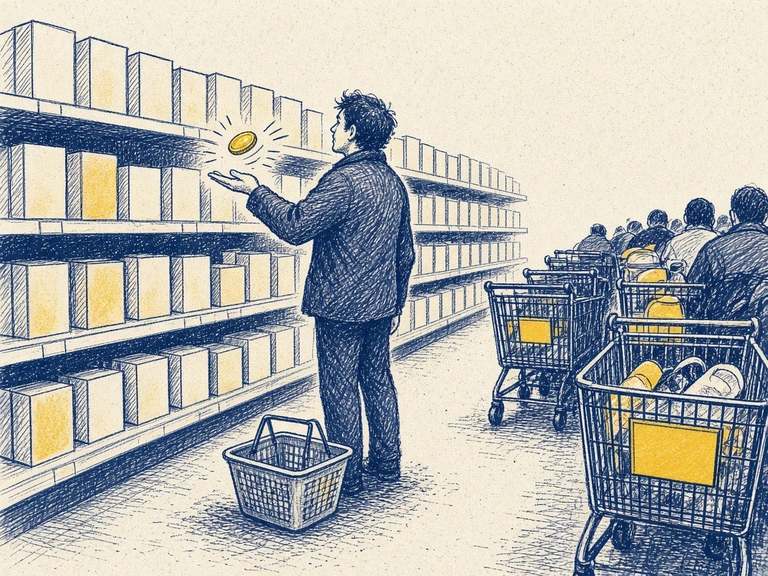
It’s 6:40pm. You’ve been standing in front of the open fridge long enough that it’s started beeping at you. There are eggs, some rice, half a bag of spinach, and the option of ordering something. All of them are fine. None of them is winning. Somehow the most likely outcome is eating crackers over the sink at 9.
Same thing at 8am with three nearly identical black shirts. Same thing at 2pm with a to-do list where every item is “kind of important.” The choices are tiny. The freeze is not.
Short answer: to get out of ADHD decision paralysis, stop making the same small choices fresh every day. Set defaults for the repeats (food, clothes, the first task), write if-then rules for the moments that usually stall you, and keep a dumb tie-breaker, like a coin, for options that are close. Do your real choosing when you’re fresh, not at 9pm.
If that’s you, nothing is broken about your willpower. ADHD decision fatigue is the drained, stuck feeling that builds when every small choice takes real effort, and the effort adds up over the day. The way to reduce it is mostly deciding less often.
TL;DR: Small choices aren’t small for a brain that has to hold every option in working memory to compare them. Stop making the same decisions fresh every day. Set defaults for the repeats (food, clothes, first task), write if-then rules for the moments that usually stall you, and keep a dumb tie-breaker for when options are close. Do your choosing in the morning or on Sunday, and give tired-evening-you a menu of one.
Is decision fatigue real?
Short answer: the freeze is real. The popular “willpower gas tank” story is the part that got knocked around.
Choosing costs something, and it adds up. In experiments by Vohs and colleagues (2008), people who made a long run of choices (picking between products, courses, and so on) afterward held their hand in ice water for less time, drank less of a gross-but-healthy drink, and procrastinated more on practice math than people who only looked at the same options without choosing. That’s the classic decision fatigue finding: a pile of small choices leaves you worse at the next hard thing.
The early explanation took some hits, and it’s fair to say so. Ego depletion (Baumeister and colleagues, 1998) said self-control runs on a limited fuel tank that every decision drains. It got famous fast. Then a preregistered replication across 23 labs (Hagger and colleagues, 2016) found an effect close to zero on the standard lab task. Job, Dweck and Walton (2010) found people who believed willpower wasn’t limited showed less of the drop. You might also have seen the viral “judges give harsher parole rulings before lunch” study. It exists, and other researchers have argued the effect comes mostly from how cases were ordered, so treat it as a fun fact with an asterisk.
What seems to survive is a “this is getting expensive” signal. Newer models (Kurzban and colleagues, 2013) describe mental effort as your brain constantly weighing whether the current task is worth it compared to everything else you could be doing. After a lot of hard thinking, effort starts to feel pricier. Wiehler and colleagues (2022) scanned people after a full day of hard mental work and found they shifted toward low-effort, right-now choices, with a chemical change in the part of the brain involved in control. It was one lab and about 40 people, so it’s a lead, not a verdict. The practical upshot matches 6:40pm in front of the fridge: the more you’ve decided, the more the next decision costs.
So treat “is decision fatigue real” as two different questions. The everyday freeze after a day of small calls is well documented and familiar. A fixed willpower fuel tank that empties with every choice is the part the big replication poked holes in. Either way, the practical move is the same: make fewer choices under load.
What causes decision fatigue?
Nobody has pinned it to one cause, but the same few things keep showing up, and they stack. In the Pignatiello review (more on it below), the triggers papers kept naming were a high volume of decisions, self-control already being spent on something else, and situational load like time pressure, noise, and too many options. Add a short night and a brain that has to work harder to compare things, and you get the 6:40pm fridge standoff.
ADHD adds a tax on the comparing part. To choose between options you have to hold them all in mind at once and weigh them. That leans on working memory, planning, and inhibition, and a 2005 meta-analysis by Willcutt and colleagues found people with ADHD tend to show weaknesses in exactly those areas. So “eggs or rice or takeout” means juggling three options in a working memory that’s already holding a text you forgot to answer, a worry about tomorrow, and a song from 2011.
Close options are the worst kind. When one option is clearly better, you pick it and move on. When they’re all about the same, there’s no tiebreaker, so the comparison keeps looping. The irony is that close options are the ones where picking “wrong” costs the least. A huge menu can make it worse, mostly when you don’t know what you want (more on choice overload below).
Short sleep makes it worse, in a specific way. In a review of sleep deprivation research, Killgore (2010) found that sleep loss reliably slows attention and alertness, while many rule-based reasoning and decision tasks hold up surprisingly well. What seems to suffer more is creative thinking and judgment that leans on emotional information. A lot of small daily choices are that second kind (“do I actually want this, or do I just want to be done?”). The flip side is good news: a default or an if-then rule turns a gut-feel choice into a rule-based one, which is the kind a tired brain still handles fine.
Decision fatigue symptoms
There is no official medical checklist for decision fatigue. It is not a DSM diagnosis. Still, the pattern shows up often enough that nursing researchers bothered to map what papers mean by the phrase.
Pignatiello, Martin and Hickman (2020) ran a concept analysis: they searched seven databases for “decision fatigue,” kept 17 relevant articles, and grouped what those papers attributed to it into three buckets. Behavioral (avoiding the choice, picking the default, asking someone else). Cognitive (fog, slower comparing, “I don’t care anymore”). Physiological (tiredness that shows up after mental work, not after a workout). Antecedents in the same review clustered around lots of decisions, already-taxed self-control, and situational load (time pressure, noise, too many options). The review also noted the literature was thin on clear consequences, so treat this as a map of how writers use the term, not a lab-proven syndrome.
In everyday life, that map looks like this:
- You can do the task once it’s decided, but you can’t get past choosing which one.
- You go with whatever’s easiest, or freeze and do nothing, especially later in the day.
- Small choices make you irrationally irritated (“I don’t CARE what we have for dinner”). If that tips into actually snapping at people, our ADHD anger guide covers why small things set it off.
- You ask other people to pick, then feel relief out of proportion to the stakes.
- Mornings feel fine and evenings fall apart, even on days that weren’t physically hard.
- Infinite menus (Netflix, DoorDash, a 40-item to-do list) turn into 40-minute scrolls with nothing picked.
If several of those land, cut the number of choices you make under load. That is what the rest of this page is for. If it has lasted for months and the job itself feels poisoned, read decision fatigue vs burnout first.
Decision fatigue vs burnout (and just being tired)
They all feel the same at 9pm on the couch. The difference is how long it’s been going on, and what fixes it.
Decision fatigue is a today problem. It builds over a day of choices, and sleep plus a quieter morning usually reset it. Clinician studies see it inside a single shift: more antibiotic prescriptions as a session wore on (Linder and colleagues, 2014).
Burnout is a months problem, and officially a work one. The WHO’s ICD-11 lists it as an occupational phenomenon from unmanaged chronic workplace stress, with three parts: exhaustion, cynicism about your job, and feeling less effective at it (World Health Organization, 2019). So “ADHD burnout” is an everyday use, not the official one. The cynicism and the “I’m bad at this now” feeling are what set it apart from being worn out (Maslach and Leiter, 2016).
Plain tired is a sleep problem. Sleep loss reliably slows attention and alertness (Killgore, 2010), so after a short night everything feels harder, choices included.
A few tells (our suggestion, not a test):
- Does a good night and an easy morning fix it? Then it’s probably decision fatigue or tiredness. Burnout doesn’t clear overnight.
- Is it only the choosing? If you’re fine once the task is picked, that’s decision fatigue. If you dread the job itself and feel cynical about it, that’s the burnout pattern.
- Did a vacation fix it for good? A meta-analysis of vacation studies found time off helps health and well-being a little, and the effect fades soon after people go back to work (de Bloom and colleagues, 2009). If it’s back a couple of weeks after the trip, the cause is still at work.
- Does it follow you everywhere? Flat mood on weekends and in things you used to enjoy isn’t the work-only picture. Read ADHD paralysis vs depression and talk to a doctor.
The fixes differ. For decision fatigue, decide less often: pre-decide the repeats and move choosing to the morning. For burnout, defaults help you limp through the week, but they don’t fix the cause. Cut the load first, as the burnout section of our task paralysis guide explains.
What is decision paralysis? (and is it the same as analysis paralysis?)
Decision paralysis is when you can’t make a choice, so you make none, and the not-choosing quietly becomes the choice. The fridge beeps. The cart sits full in the app for three days. The text about Saturday plans stays unanswered until Saturday is over. Like decision fatigue, it isn’t a clinical term. It’s what the freeze feels like from the inside.
Researchers call the behavior decision avoidance. Anderson (2003) reviewed work from several fields and sorted it into four patterns: putting the choice off, sticking with whatever you already have, preferring not to act over acting, and skipping a decent option because you already missed a better one. The drivers in his model will sound familiar: options that are hard to compare, expecting to regret picking wrong, and not being sure what you actually want.
That’s where ADHD comes in, and it’s worth being careful here. We couldn’t find a study that measures decision paralysis in ADHD by that name. What exists is the working memory and planning load from the section above (Willcutt and colleagues, 2005). Comparing options means holding them all in mind at once, and when that juggling act keeps dropping balls, every comparison takes longer and picking wrong starts to feel bigger. So “ADHD decision paralysis” is a fair name for a common experience, not a diagnosis.
Decision paralysis vs analysis paralysis vs task paralysis
Three names for getting stuck in three different places:
- Decision paralysis. You can’t pick between options, so you pick nothing. Three black shirts, or 40 minutes of Netflix tiles.
- Analysis paralysis. You keep researching instead of choosing. Fourteen tabs of vacuum reviews, a Reddit thread from 2019, and still no vacuum. It’s decision paralysis with a spreadsheet. (Is it ADHD, anxiety, or just overthinking? Next section.)
- Task paralysis. The decision is already made and you still can’t start. You know the next thing is the form. You’re still on the couch.
Naming which one you’re in matters, because the fixes are different. For the first two, shrink the comparison: a default, the tie-breaker below, or a research cap like “three reviews, then buy the one two of them liked.” Good enough is a skill here, not a cop-out (the maximizer research further down backs that up). For task paralysis, choosing isn’t the problem, so the get-unstuck steps start with your body instead of your options.
Is analysis paralysis ADHD, anxiety, or just overthinking?
Short answer: none of them owns it. Analysis paralysis isn’t a diagnosis, and it isn’t on the official symptom list for ADHD, anxiety, or OCD.
What psychologists do measure is a close cousin called indecisiveness: a lasting, across-the-board difficulty making decisions, not just one hard choice.
Indecisiveness shows up in a lot of places. When Frost and Shows (1993) built one of the first indecisiveness scales, high scores went with obsessional thinking, compulsive checking, perfectionism about mistakes, and procrastination. High scorers were also slower on a simple lab decision task.
The anxiety route is about uncertainty. Intolerance of uncertainty means really hating not knowing how something will turn out. Appel and Gerlach (2025) nudged it up in 301 people, and they got more indecisive about two real decisions in their own lives. For this crowd, more research rarely helps, because it was never going to make the future certain.
The ADHD route is about load. It’s the comparing problem from the ADHD decision-making section below: six vacuums don’t fit in a busy working memory, so you open a seventh tab, lose the first three, and start over.
And it’s often both. In a US national survey, 47.1% of adults with ADHD had an anxiety disorder in the past year, compared with 19.5% of adults without ADHD (Kessler and colleagues, 2006). “Is it ADHD or anxiety” can have the answer “yes.”
A rough way to tell which loop you’re in (our suggestion, not a test): ask what the next tab is for. “I need to be sure this won’t go wrong” leans uncertainty. “I can’t keep the options straight” leans ADHD load.
If checking never settles it and not checking feels unbearable, that’s worth bringing to a clinician.
Analysis paralysis vs the neighbors:
- vs overthinking. Overthinking is the umbrella. Analysis paralysis is aimed at a choice and ends when you pick. Rumination is aimed at yourself (“why am I like this”).
- vs procrastination. Researching can be procrastination in a trench coat: it feels productive and the choice still isn’t made. The ADHD side is in why people with ADHD procrastinate.
- vs decision fatigue. Decision fatigue is how many choices you’ve made today. Analysis paralysis is one choice getting way too much analysis. Fourteen tabs of vacuum reviews at 11pm is both.
- vs executive dysfunction. Executive dysfunction is the broad term for trouble planning, starting, and holding things in mind. Analysis paralysis is one way it shows up when the task is choosing.
Whichever loop it is, the practical fix is the same: decide when the research stops before you open the first tab. Three reviews or 20 minutes, then pick the option that wins on the one thing you care about most. If two are still tied, that’s a job for the tie-breaker.
Paradox of choice vs analysis paralysis (and is choice overload real?)
The paradox of choice, from Barry Schwartz’s 2004 book, is about the menu: so many options that you stall or like your pick less. Researchers call it choice overload. Analysis paralysis is about the process: too much research, even between two vacuums.
The famous evidence is the jam study. Iyengar and Lepper (2000) ran a tasting booth with either 24 or 6 jams, and about 3% of the people who stopped at the big display bought jam, against nearly 30% at the small one. It only partly holds up. Pooling 50 experiments, Scheibehenne, Greifeneder and Todd (2010) found an average effect close to zero. A later meta-analysis (Chernev, Böckenholt and Goodman, 2015) found big menus do cause overload when the choice is hard, the options are complex and people aren’t sure what they want. That’s a tired brain on a shopping app at 11pm.
The fix is the same for both (our suggestion): name your one must-have before you look, cut to three options, then run the research cap above. Streaming grids and delivery apps get their own section: when you keep scrolling the menu and never pick.
Does ADHD affect decision making? (and why it can make you indecisive)
On average, yes. The surprise is how.
The stereotype is that ADHD brains love risk: the impulse buy, the 2am “what if I just moved to Lisbon” tab. Lab studies seemed to agree. A 2016 meta-analysis by Dekkers and colleagues pooled 37 studies, about 1,200 people with ADHD and 1,200 without, and found the ADHD groups made riskier picks on gambling-style card tasks. The gap was small to medium.
Then the same team spotted a catch. In most of those tasks the risky deck is also the deck that loses money over time, so “picked the risky option” and “picked the worse option” were the same click. In a follow-up (Dekkers and colleagues, 2021) they re-ran the numbers on 48 comparisons and split the tasks by whether the risky choice was also the bad deal. People with ADHD only stood out when it was.
In a new experiment with 40 adults with ADHD and 40 without, the ADHD group made more poor-value choices but not more risky ones. When the risky option was actually the better bet, they took it less often than everyone else.
So the pattern looks less like “loves danger” and more like “loses track of which option is actually better.” The authors’ main explanation is the working memory load from earlier, plus the pull to grab a shortcut because the math takes effort. A separate meta-analysis of adults (Mowinckel and colleagues, 2015) found decision-making differences about as big as the attention differences ADHD is known for.
Where indecisiveness fits. If weighing options is the expensive part, there are two cheap ways out. Grab whatever feels good first, or don’t pick at all. That’s how the same person gets called impulsive on Tuesday and indecisive on Thursday. The authors themselves note that a card game is a long way from choosing an apartment, so treat this as the best current explanation, not a settled one.
One more honest caveat. Indecisiveness isn’t one of the official ADHD symptoms in the DSM-5. It is listed under depression (“indecisiveness, nearly every day”). If not being able to decide is new for you and showed up alongside low mood, sleep changes, or losing interest in things you used to like, that one is worth bringing to a doctor.
If it feels more like a recent slump than a lifelong thing, start with why you might be indecisive lately below.
How to make big decisions with ADHD
Small choices need defaults (next section). Big ones, like a job offer, a move, or whether to stay in the program, need the opposite: a slower, written process that does the comparing outside your head. This is our reading of the research above, not a tested program.
- Put two or three real options on paper, side by side. The step the lab work says gets dropped is holding everything in mind and updating it. Let the page hold it.
- Write the likely case for each one, not just the dream and the disaster. “Most likely: a 40-minute commute and a bit more money.” Picking the risky-but-worse option tends to happen when the best case is vivid and the normal case is blank.
- Set a decide-by date and tell one person. Without one, big choices drift into decision avoidance, where keeping what you already have wins by default (Anderson’s review above). A date plus a witness turns it into a task.
- Make the final call in the morning. Same idea as moving the choosing to when you’re fresh, with higher stakes.
If the options are honestly close after all that, you’re in tie-breaker territory. Close options are the ones where picking wrong costs the least.
Why am I so indecisive lately? (and how to stop being indecisive)
“Why am I so indecisive” usually comes with a tail: about everything, about food, lately, all of a sudden. The tail is the clue.
- About food, at 7pm. A full day of choices plus a menu with no edges. That’s the infinite menu problem, and a default dinner fixes most of it.
- Lately, or all of a sudden. Check the boring stuff first: short nights, a stressful stretch, a big change. If it arrived with low mood or losing interest in things, that’s the depression caveat above. Talk to a doctor.
- About everything, for as long as you remember. That’s closer to the lasting trait researchers call indecisiveness. We cover it in is analysis paralysis ADHD, anxiety, or just overthinking?
How to stop being indecisive, with what the research does and doesn’t show:
Set a “good enough” bar before you look. “Under $80, four stars, here by Friday.” Take the first option that clears it. People who chase the best option report more regret (the maximizer research below). That’s a correlation, but the experiment costs you nothing.
Make it final. Gilbert and Ebert (2002) had photography students pick which prints to keep. Students who could change their minds later liked their prints less than students whose pick was locked in. Most people still wanted the option to switch.
So returnable feels safer and tends to feel worse. Once you pick, close the other tabs.
For a big stuck choice, let the coin vote. In Levitt’s (2021) field experiment, people stuck on a decision flipped a coin. For big ones like quitting a job, those whose coin said “make the change” were more likely to change, and happier six months later, than those told to stay put.
His read is that people may be too cautious with life-changing choices. One experiment isn’t a rule, but it’s a decent case for letting the tie-breaker do its job.
1. Pre-decide the repeats
Most of your daily decisions are the same decisions. Breakfast, what to wear, which task opens the workday, what to do after dinner. Make each one once, on purpose, and stop re-deciding it every morning. Breakfast and outfit can be settled the night before, which is step 4 of our morning routine guide.
Defaults are powerful. Johnson and Goldstein (2003) found organ donor rates in Europe tracked with whether countries made donation the default or made people opt in. Whatever happens when you don’t choose is what usually happens. So set yours:
- Default breakfast and lunch. Two or three options you rotate, written on the fridge. Boring is the point.
- A few go-to outfits. You don’t need the full tech-founder turtleneck uniform. Three combinations that work together is enough.
- A fixed first task. “First 20 minutes of work is always the thing I starred last night.” This pairs well with time blocking, where the block already knows what it’s for.
- A default evening. One or two pre-picked options for tired nights, so the choice is “A or B” instead of “anything at all.”
2. Turn stuck moments into if-then rules
Look for the moments where you reliably stall, and write a rule for each. If-then plans (implementation intentions) are one of the better-supported tricks in behavior research. Gollwitzer and Sheeran’s 2006 meta-analysis found they helped people follow through across a wide range of goals.
- “If it’s 6pm and I haven’t planned dinner, I make eggs and rice.”
- “If I can’t pick between two tasks for more than a minute, I do the one someone is waiting on.”
- “If I’m in a store comparing more than two options, I buy the one with better reviews and leave.”
The rule doesn’t have to be the best possible choice. It has to be a choice you already made, so in the moment you’re following instead of deciding.
3. Keep a dumb tie-breaker for close calls
When two options are about equal, comparing them again won’t help. You need a rule that ends it:
- Coin flip. Bonus trick: if you feel a tiny “ugh” when it lands, pick the other one. You just found out which you wanted.
- Fewest steps wins. The meal with the least cleanup, the task with the smallest first action.
- Ask someone to pick without explaining. Partner, friend, group chat. You’re outsourcing the comparing, not the doing.
- Two-minute rule. Whatever you pick, start within two minutes so the decision doesn’t reopen.
The 2-minute task triage has more on this in its “too many good options” section, including the trick of capping your shortlist at two.
How to prioritize when everything feels urgent
It’s 2pm, there are eleven things on the list, and every one of them has a little red siren on it. The invoice. The “quick question” email from your manager. The form that closes Friday. The thing you promised a friend you’d look at. When everything feels urgent, nothing gets picked, and the afternoon goes to whichever notification arrived last.
Urgency is louder than importance, and part of it is a trick. In five experiments, Zhu, Yang and Hsee (2018) found people often chose a task with a smaller payoff over one with a bigger payoff when the small one merely looked urgent, for example because it came with an expiration window that didn’t really matter. They called it the mere urgency effect: an urgent-looking task gets picked partly because it looks urgent, even when the other option is plainly better. So the siren feeling mostly tells you which task is loudest.
Then the decision-fatigue part kicks in. Eleven loud options with no clear winner is exactly the close-call comparison that stalls a tired brain. So don’t compare. Look it up. First, ask one question of every siren: what actually happens if this waits until tomorrow? If the honest answer is “nothing much” or “someone is mildly annoyed,” it drops down the list. Then use a fixed order and stick it where you work:
- Anything with a real deadline in the next 24 hours. Real means something actually happens if it slips (a late fee, a person left stuck), not just a red badge.
- Anything another person is waiting on to do their part.
- The task with the smallest first step.
- Still tied? Coin flip.
Now “what next?” is something you look up. If the list itself is a 40-item swamp, that’s a triage problem first: get it down to today’s three, and the next-task choice shrinks to picking one of three. The same fixed-order idea works on a messy apartment: where to start cleaning a messy house. If you’ve picked and you still can’t make yourself begin, that’s a different problem with its own fixes: task paralysis.
Does the Eisenhower matrix work for ADHD?
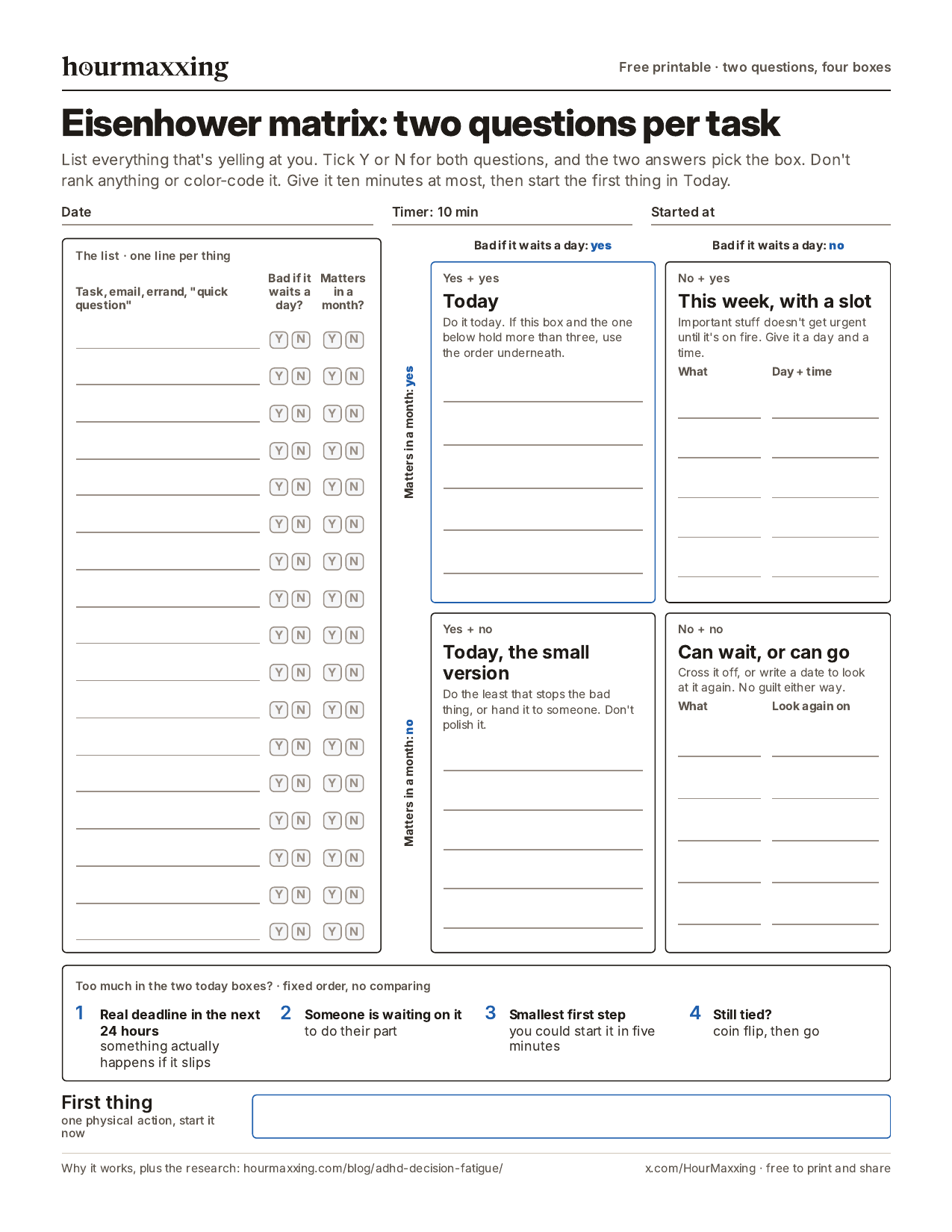
Partly. The urgent-vs-important split is worth keeping, but the grid asks you to rate the importance of every single task, which is the same comparing that freezes you, now with color-coding. Use it as two quick questions instead:
- Does something bad happen if this waits a day? Yes means it goes on today’s list.
- Will this matter in a month? If that’s the only yes, give it a time slot on the calendar this week.
Two no’s? It can wait, or it can go. The full method, with a regular four-box template, is in our Eisenhower matrix guide, and the ABCDE method is a gentler way to rank a long list.
A free printable ADHD Eisenhower matrix (PDF)
Want the two questions on paper? Download the ADHD Eisenhower matrix (PDF), free and with no email form. Page 1 gives every task one line and two yes-or-no ticks, and the answers pick its box, so nothing gets rated on a scale. Page 2 is a check for the afternoon pileup: what actually happens if each item waits until tomorrow. For your phone, save the image of page 1.
Move the choosing to when you’re fresh
Since decisions seem to cost more later, schedule your deciding for times you’ve got more in the tank.
- Sunday, 15 minutes: pick the week’s default meals and the three things that matter most this week. An ideal week sketch makes this a five-minute job.
- Night before, 3 minutes: star tomorrow’s first task and set out clothes. Yes, like a kid going on a field trip. It works for kids for a reason. At a desk job, fold this into a shutdown ritual.
- Morning: make any real decision of the day (the email you’re dreading, the plan for the weekend) before lunch if you can.
Evening-you then gets to run the plan instead of inventing it. That’s also a good defense against the “I’ll just scroll until I figure out what to do” spiral.
When you keep scrolling the menu and never pick
You open Netflix to unwind. Forty minutes later you’re still on the home screen, trailers half-watched, “My List” growing, and somehow the most likely outcome is closing the app and scrolling your phone instead. Same pattern with DoorDash, YouTube, Spotify, or the takeout PDF your group chat keeps sending. The fridge version at least has a finite shelf. These menus never end.
Browsing feels cheaper than committing. Each new thumbnail is a tiny hit of novelty, and picking one show means giving up the stream for a single fixed input. So the scroll continues, and you leave the app more drained than when you opened it.
Infinite menus are choice overload with the volume turned up. A streaming grid is dozens of near-substitutes, no clear winner, and a search box that invents more, which is exactly when big menus stall people (the jam study and what held up). Schwartz and colleagues (2002) found that people who chase the “best” option (maximizers) report more regret and less satisfaction than people who settle for “good enough.” On an infinite menu, “best” is unreachable, so that loop never closes.
Fatigue makes the freeze stickier. By evening you’ve burned through a day of small calls, and tired people shift toward low-effort, right-now choices (Wiehler and colleagues, 2022). Scrolling is the low-effort choice. Picking and sitting through something is the hard one.
So treat the menu like the fridge. Decide less in the moment:
- Keep a written list of five comfort picks. Shows, meals, playlists you already know are fine. When you open the app, choose only from that list. New discoveries happen on weekends, not at 9:40pm. A dopamine menu is the same trick for a whole free evening.
- Default to Continue Watching (or the last order). The row that already knows you is a built-in default. Use it on purpose.
- Run a 60-second timer. A phone timer works, or our visual timer set to 1 minute. Whatever is on screen when it beeps, you play it (or order it). The first few nights feel like picking wrong on purpose. That’s the point.
- Cap the shortlist at two, then flip a coin. If two titles both look fine, stop comparing and use the tie-breaker. Close options are where picking “wrong” costs the least.
- Outsource the pick. Partner, roommate, or group chat: “pick between A and B, don’t explain.” You’re outsourcing the comparing, not the watching.
If the real draw was the scroll itself, that’s useful information. Put the phone in another room and borrow a few tricks from how to stop doomscrolling, or pick from the five-item list before you unlock the screen. The goal isn’t a perfect night of entertainment. It’s getting past the menu so rest can actually start.
The low-energy version
If you’re too fried to set up any of this, do one thing: pick tomorrow’s breakfast and tomorrow’s first task right now, and write them on a sticky note. That’s two decisions your tired morning brain doesn’t have to make.
Tonight, if you’re stuck in front of the fridge, the answer is eggs. Or whatever your eggs are. Write it down so next time it’s already decided.
And if a choice really doesn’t matter and you’ve been circling it for ten minutes, that’s your signal. Flip the coin. The cost of picking wrong was always smaller than the cost of not picking.
Sources
- Vohs, K. D., Baumeister, R. F., Schmeichel, B. J., Twenge, J. M., Nelson, N. M., & Tice, D. M. (2008). Making choices impairs subsequent self-control: A limited-resource account of decision making, self-regulation, and active initiative. Journal of Personality and Social Psychology, 94(5), 883-898.
- Baumeister, R. F., Bratslavsky, E., Muraven, M., & Tice, D. M. (1998). Ego depletion: Is the active self a limited resource? Journal of Personality and Social Psychology, 74(5), 1252-1265.
- Hagger, M. S., Chatzisarantis, N. L. D., et al. (2016). A multilab preregistered replication of the ego-depletion effect. Perspectives on Psychological Science, 11(4), 546-573.
- Job, V., Dweck, C. S., & Walton, G. M. (2010). Ego depletion: Is it all in your head? Implicit theories about willpower affect self-regulation. Psychological Science, 21(11), 1686-1693.
- Kurzban, R., Duckworth, A., Kable, J. W., & Myers, J. (2013). An opportunity cost model of subjective effort and task performance. Behavioral and Brain Sciences, 36(6), 661-679.
- Wiehler, A., Branzoli, F., Adanyeguh, I., Mochel, F., & Pessiglione, M. (2022). A neuro-metabolic account of why daylong cognitive work alters the control of economic decisions. Current Biology, 32(16), 3564-3575.
- Pignatiello, G. A., Martin, R. J., & Hickman, R. L. (2020). Decision fatigue: A conceptual analysis. Journal of Health Psychology, 25(1), 123-135. (Published online 2018.)
- Killgore, W. D. S. (2010). Effects of sleep deprivation on cognition. Progress in Brain Research, 185, 105-129.
- Willcutt, E. G., Doyle, A. E., Nigg, J. T., Faraone, S. V., & Pennington, B. F. (2005). Validity of the executive function theory of attention-deficit/hyperactivity disorder: A meta-analytic review. Biological Psychiatry, 57(11), 1336-1346.
- Dekkers, T. J., Popma, A., Agelink van Rentergem, J. A., Bexkens, A., & Huizenga, H. M. (2016). Risky decision making in Attention-Deficit/Hyperactivity Disorder: A meta-regression analysis. Clinical Psychology Review, 45, 1-16. doi:10.1016/j.cpr.2016.03.001. 37 studies, 52 effect sizes; standardized mean difference .36.
- Dekkers, T. J., Agelink van Rentergem, J. A., Huizenga, H. M., Raber, H., Shoham, R., Popma, A., & Pollak, Y. (2021). Decision-making deficits in ADHD are not related to risk seeking but to suboptimal decision-making: Meta-analytical and novel experimental evidence. Journal of Attention Disorders, 25(4), 486-501. doi:10.1177/1087054718815572. Open access (PMC7783692). Meta-regression k = 48; experiment with 40 adults with ADHD and 40 controls.
- Mowinckel, A. M., Pedersen, M. L., Eilertsen, E., & Biele, G. (2015). A meta-analysis of decision-making and attention in adults with ADHD. Journal of Attention Disorders, 19(5), 355-367. doi:10.1177/1087054714558872.
- American Psychiatric Association. (2013). Diagnostic and Statistical Manual of Mental Disorders (5th ed.). Major depressive disorder, criterion A8.
- Anderson, C. J. (2003). The psychology of doing nothing: Forms of decision avoidance result from reason and emotion. Psychological Bulletin, 129(1), 139-167. doi:10.1037/0033-2909.129.1.139. Review of choice deferral, status quo bias, omission bias, and inaction inertia; drivers include selection difficulty, anticipated regret, and preference uncertainty.
- Frost, R. O., & Shows, D. L. (1993). The nature and measurement of compulsive indecisiveness. Behaviour Research and Therapy, 31(7), 683-692. doi:10.1016/0005-7967(93)90121-a. Indecisiveness Scale correlated with obsessionality, checking, maladaptive perfectionism and hoarding; indecisive participants scored higher on procrastination and took longer on a lab decision task.
- Appel, H., & Gerlach, A. L. (2025). Intolerance of uncertainty causally affects indecisiveness. British Journal of Clinical Psychology, 64(3), 806-816. doi:10.1111/bjc.12534. Preregistered experiment, N = 301.
- Kessler, R. C., Adler, L., Barkley, R., et al. (2006). The prevalence and correlates of adult ADHD in the United States: Results from the National Comorbidity Survey Replication. American Journal of Psychiatry, 163(4), 716-723. doi:10.1176/ajp.2006.163.4.716. Table 3: any 12-month anxiety disorder in 47.1% of adults with ADHD vs 19.5% without (OR 3.7).
- World Health Organization. (2019, May 28). Burn-out an “occupational phenomenon”: International Classification of Diseases. https://www.who.int/news/item/28-05-2019-burn-out-an-occupational-phenomenon-international-classification-of-diseases
- Maslach, C., & Leiter, M. P. (2016). Understanding the burnout experience: Recent research and its implications for psychiatry. World Psychiatry, 15(2), 103-111. doi:10.1002/wps.20311. Open access (PMC4911781).
- de Bloom, J., Kompier, M., Geurts, S., de Weerth, C., Taris, T., & Sonnentag, S. (2009). Do we recover from vacation? Meta-analysis of vacation effects on health and well-being. Journal of Occupational Health, 51(1), 13-25. doi:10.1539/joh.k8004. 7 studies; vacation effect d = +0.43, fade-out after work resumption d = -0.38.
- Iyengar, S. S., & Lepper, M. R. (2000). When choice is demotivating: Can one desire too much of a good thing? Journal of Personality and Social Psychology, 79(6), 995-1006.
- Chernev, A., Böckenholt, U., & Goodman, J. (2015). Choice overload: A conceptual review and meta-analysis. Journal of Consumer Psychology, 25(2), 333-358.
- Scheibehenne, B., Greifeneder, R., & Todd, P. M. (2010). Can there ever be too many options? A meta-analytic review of choice overload. Journal of Consumer Research, 37(3), 409-425.
- Schwartz, B. (2004). The Paradox of Choice: Why More Is Less. Ecco.
- Johnson, E. J., & Goldstein, D. (2003). Do defaults save lives? Science, 302(5649), 1338-1339.
- Gollwitzer, P. M., & Sheeran, P. (2006). Implementation intentions and goal achievement: A meta-analysis of effects and processes. Advances in Experimental Social Psychology, 38, 69-119.
- Schwartz, B., Ward, A., Monterosso, J., Lyubomirsky, S., White, K., & Lehman, D. R. (2002). Maximizing versus satisficing: Happiness is a matter of choice. Journal of Personality and Social Psychology, 83(5), 1178-1197.
- Gilbert, D. T., & Ebert, J. E. J. (2002). Decisions and revisions: The affective forecasting of changeable outcomes. Journal of Personality and Social Psychology, 82(4), 503-514. doi:10.1037/0022-3514.82.4.503. People who could change their minds liked their chosen prints less than people whose choice was final, but most wanted the option.
- Levitt, S. D. (2021). Heads or tails: The impact of a coin toss on major life decisions and subsequent happiness. The Review of Economic Studies, 88(1), 378-405. doi:10.1093/restud/rdaa016.
- Zhu, M., Yang, Y., & Hsee, C. K. (2018). The mere urgency effect. Journal of Consumer Research, 45(3), 673-690.
- Eisenhower, D. D. (1954, August 19). Address at the Second Assembly of the World Council of Churches, Evanston, Illinois. The American Presidency Project, UC Santa Barbara.
- Linder, J. A., Doctor, J. N., Friedberg, M. W., Reyes Nieva, H., Birks, C., Meeker, D., & Fox, C. R. (2014). Time of day and the decision to prescribe antibiotics. JAMA Internal Medicine, 174(12), 2029-2031. doi:10.1001/jamainternmed.2014.5225. Research letter: 21,867 acute respiratory infection visits, 204 clinicians, 23 practices; adjusted odds of prescribing in hours 2, 3 and 4 of a session vs hour 1 were 1.01, 1.14 and 1.26.
These are strategies, not treatment. If decision paralysis is getting in the way of work, school, or taking care of yourself, a clinician or ADHD coach can help, and asking is not dramatic.
Want one more of these each week?
One technique a week, the study behind it, and a low-energy version. Free, about a 3-minute read, unsubscribe anytime.
We use your address only to send the email, and you can unsubscribe in one click.
FAQ
What is decision fatigue?
It's the worn-out, foggy feeling after making a lot of choices, where even small decisions start to feel heavy and you drift toward the easiest option or no option at all. Vohs and colleagues (2008) found that people who had just made a long series of choices showed less self-control and persistence afterward than people who only looked at the same options. The exact mechanism is debated, but the experience is common and you can plan around it.
Is decision fatigue real?
Yes, as an experience: after a long run of choices, small ones start to feel heavy and you drift toward the easiest option or none at all. The early fuel-tank story is shakier. Ego depletion (Baumeister and colleagues, 1998) said self-control runs on limited fuel, and a preregistered replication across 23 labs (Hagger and colleagues, 2016) found an effect close to zero on the standard lab task. Newer accounts treat it as your brain raising the felt cost of effort after hard thinking, and Wiehler and colleagues (2022) found people who did a day of hard mental work shifted toward low-effort, right-now choices. The freeze is real. The gas-tank metaphor is oversimplified. The fix is the same: make fewer choices under load.
What are decision fatigue symptoms?
Common signs are stalling on which task to do next even when you can do it once decided, defaulting to the easiest option or scrolling, getting irrationally annoyed by tiny choices (especially later in the day), asking someone else to pick and feeling huge relief, and evenings falling apart on days that were not physically hard. A concept analysis by Pignatiello, Martin and Hickman (2020) grouped what papers call decision fatigue into behavioral, cognitive, and physiological themes after reviewing 17 articles. It is not a formal medical diagnosis, and there is no official symptom checklist, so treat the list as a pattern match, not a test.
Why does ADHD make small decisions so hard?
Choosing means holding options in mind and comparing them, which leans on working memory and other executive functions. Willcutt and colleagues' 2005 meta-analysis found people with ADHD tend to show weaknesses in exactly those areas. When options are close (two shirts, three leftovers, five tasks that all matter), there's no obvious winner, so the comparison keeps looping. That's an expensive process running on a system that's already busy, so it stalls.
Does ADHD affect decision making?
On average, yes, but probably not the way the stereotype says. A 2016 meta-analysis by Dekkers and colleagues (37 studies) found people with ADHD made riskier choices on gambling-style lab tasks. A 2021 follow-up by the same team showed that in most of those tasks the risky option was also the worse deal, and the ADHD difference only showed up when it was. In their new experiment, adults with ADHD made more poor-value choices but not more risky ones. The likely reason is that weighing options leans on working memory and effort, so shortcuts win.
Is indecisiveness a symptom of ADHD?
Not officially. Indecisiveness isn't in the DSM-5 list of ADHD symptoms, though many people with ADHD describe it, probably because comparing options leans on working memory and the cheap exits are picking fast or not picking at all. Indecisiveness is listed as a symptom of depression, so if it's new and came with low mood, sleep changes, or loss of interest, talk to a doctor.
How do I stop being indecisive?
Set a good-enough bar before you look and take the first option that clears it, since people who chase the best option report more regret (Schwartz and colleagues, 2002). Make the choice final where you can: in Gilbert and Ebert's 2002 study, people who could change their minds later liked their pick less than people whose pick was locked in. For a big choice you're stuck on, a coin can help. In Levitt's 2021 field experiment, people whose coin told them to make a big change were more likely to make it and were happier six months later.
How do I reduce decision fatigue with ADHD?
Make the repeat decisions once, ahead of time, and let defaults run the rest. Pick a default breakfast, a few go-to outfits, and a fixed first task for the workday. Write if-then rules for recurring moments, like 'if it's 6pm and I haven't planned dinner, I make the eggs.' Gollwitzer and Sheeran's 2006 meta-analysis found if-then plans reliably help people follow through. Johnson and Goldstein (2003) showed how strongly defaults steer behavior, so set yours on purpose.
How do I prioritize when everything feels urgent?
Stop comparing and use a fixed order instead: anything with a real deadline in the next 24 hours first (real means something actually happens if it slips), then whatever someone else is waiting on, then the task with the smallest first step, then a coin flip. Before you start, ask what actually happens if each thing waits until tomorrow, because urgency is a bad guide to importance. In five experiments, Zhu, Yang and Hsee (2018) found people often picked a lower-payoff task over a higher-payoff one just because the small one looked urgent. If the list is huge, cut it to today's three first.
Does the Eisenhower matrix work for ADHD?
The urgent-versus-important idea is useful. The full four-box grid often isn't, because it asks you to rate the importance of every task, which is the same comparing that causes the freeze. Use it as two quick questions instead: does something bad happen if this waits a day, and will it matter in a month? Yes to the first goes on today's list. Yes to only the second gets a time slot this week. No to both can wait or go.
What's the difference between decision fatigue and burnout?
Decision fatigue builds over one day of choices and usually clears with sleep and an easier morning. Burnout, as the WHO's ICD-11 describes it, comes from chronic work stress that hasn't been managed and has three parts: exhaustion, cynicism or distance from your job, and feeling less effective at it. A quick tell: if you're fine once a task is picked, it's decision fatigue. If you dread the job itself and a weekend doesn't help, it looks more like burnout, and the fix is cutting the load, not better defaults.
What is decision paralysis?
Decision paralysis is getting so stuck choosing between options that you choose nothing, and the not-choosing ends up deciding for you. It isn't a clinical term. Researchers study it as decision avoidance: a 2003 review by Christopher Anderson found people put choices off or stick with what they already have most when options are hard to compare, they expect to regret picking wrong, or they aren't sure what they want. ADHD can make it worse because comparing options leans on working memory. Defaults and a fixed tie-breaker cut it down.
New here? Start with the reading order → Rather use paper? Grab a free printable.