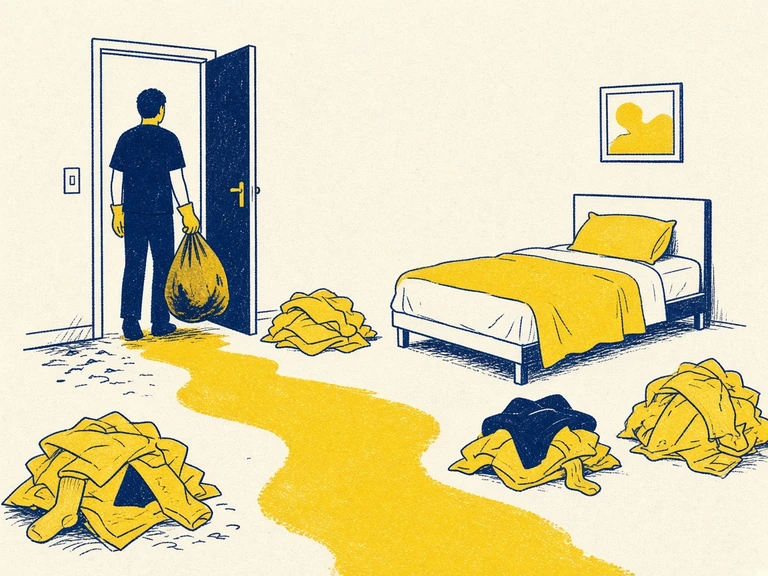
Short answer: to clean your room with ADHD, clean one category at a time. Walk the room once for trash only, then dishes, then laundry, then things that live in this room, then whatever has no home. Anything that belongs elsewhere goes in a box by the door, so you never leave mid-clean. Set a 25-minute timer and stop when the room works.
It’s Saturday, and you’ve been about to clean your room since you woke up. The chair stopped being a chair in August. There are four mugs on the nightstand, and one of them has grown a skin. A charging cable disappears under a pile of hoodies toward an outlet you haven’t seen in weeks. Last time you tried, you picked up one shirt, found a birthday card from 2022 under it, read it twice, and somehow ended up reorganizing the bathroom cabinet. At 6pm the bedroom looked exactly the same.
That afternoon has a pattern, and once you see it, it’s very fixable. A messy room asks you hundreds of tiny questions at once (keep it? where does it go? is this clean?), and every answer is a fresh chance to wander off. Here’s how to clean your room with ADHD step by step, using an order that deletes most of those questions, plus a checklist you can copy, where to start when the whole apartment is a mess, and a plan for keeping it from re-exploding by Wednesday.
Why is cleaning so hard with ADHD?
Cleaning a room looks like one task. It’s really a few hundred small decisions in a trench coat. Therapist KC Davis, author of How to Keep House While Drowning, described it in a 2022 Slate interview as “just this decision fatigue”: decide where to start, pick up an item, work out what it is, work out where it goes, maybe wander into the next room to put it away, then figure out what to do next (Onion, 2022). If you’ve read our decision fatigue guide, you know how that ends.
ADHD makes several of those steps harder, and the official criteria say so almost word for word. The DSM-5 gives “difficulty keeping materials and belongings in order” as an example of trouble organizing, lists failing to finish chores (“starts tasks but quickly loses focus and is easily sidetracked”), and names “doing chores” as the first example of everyday forgetfulness (American Psychiatric Association, 2013). The sidetrack is the birthday card. Every trip out of the room to return one hairbrush walks you past six more interesting things.
Then there’s the finish line, or the lack of one. “Clean my room” has no obvious first step and no obvious end, which is the exact recipe for task paralysis. So you wait to feel ready. Ready doesn’t show up, the pile grows, and a bigger pile is even harder to start. In surveys of three age groups of US adults, everyday procrastination explained a bigger share of clutter problems in each older group (Ferrari and Roster, 2018). Surveys can’t say which causes which, but the loop will sound familiar.
Do people with ADHD have messy rooms?
Often, yes, though nobody has walked into a few thousand bedrooms with a clipboard. The best evidence comes from hoarding research, which is the far end of the scale. In a study of 101 adults (39 with hoarding disorder, 26 with OCD, 36 with neither), Tolin and Villavicencio (2011) found that inattentive ADHD symptoms predicted how severe people’s clutter, difficulty discarding, and acquiring were. OCD symptoms didn’t, once general negative mood was accounted for.
A messy bedroom is not hoarding disorder, and those were small clinical samples. What seems to carry over is the inattention part, where things get put down “for a second” and stay there for a month. That’s a design problem you can work with. It says nothing about whether you’re a lazy person, and executive dysfunction isn’t the same thing as laziness anyway.
Why does a messy room give me anxiety? (does clutter cause anxiety?)
Clutter and stress show up together in the research, but nobody has shown that a messy room causes an anxiety disorder.
Clutter that bothers you goes with feeling worse at home. In a survey of 450 adults, people whose clutter got in the way more reported a weaker sense of home and lower life satisfaction (Swanson and Ferrari, 2022). A survey can’t say which came first.
Everything in view competes for attention, and each pile is an unfinished job. Objects shown at once compete for processing in the visual cortex (McMains and Kastner, 2011), and unfinished goals cause intrusive thoughts until you make a specific plan for them (Masicampo and Baumeister, 2011). Those were lab studies, not bedrooms, so applying them to a doom pile is our reading.
What helps:
- Plan before you clean. Write one line, like “Saturday 11am: trash pass, then dishes.” In Masicampo and Baumeister’s studies it was the plan, not the finished job, that quieted the thoughts.
- Shrink what you can see. Five minutes putting the floor stuff into one box is the 15-minute clean, cut down even further.
- Check whether it’s only the room. If the worry follows you into clean rooms too, most days, for months, take it to a doctor. Anxiety and ADHD loops need different fixes.
Why does cleaning give me anxiety? (and why do some people clean when they’re anxious?)
Dread that shows up the second you think about cleaning is different from a mess that bugs you. Nobody has studied cleaning dread directly, so here’s the nearby research and where we’re guessing.
The thought is the whole job at once. You picture every decision in the room at the same time, with no first step and no finish line, so the dread hits before you’ve touched anything (our reading).
Not starting feels better right now. How unpleasant a task feels is one of the strongest predictors of putting it off (Steel, 2007), and Sirois and Pychyl (2013) describe the delay as short-term mood repair: dodge the bad feeling now, bill later-you. Each skip makes the room bigger and the next thought of it worse.
The opposite: cleaning when you’re anxious. In one small lab study, 62 students expecting to give a speech cleaned an object with more repetitive, predictable movements than students with no speech to give (Lang and colleagues, 2015). The authors read it as anxiety pushing people toward ritual-like movements to regain a sense of control. It was about a minute of cleaning, so it can’t tell you whether stress cleaning works as a way to cope.
What helps:
- Make the first step smaller than the dread. Trash only, for 10 minutes, then you’re allowed to stop. That’s pass 1.
- Box the hard stuff. Guilt gifts and scary letters go in the dated bag from pass 5 for a calmer day.
- Bring company. A friend on a call is a body double, which plenty of people find makes the start less awful.
- Notice if the cleaning itself feels like a must. If you clean because something bad might happen otherwise and you can’t stop, see a doctor. The NHS lists cleaning and hand washing among common OCD compulsions (NHS, 2023).
What is clutter blindness? (and is it an ADHD thing?)
Clutter blindness is the internet’s name for no longer seeing the mess you live with. It’s the chair that stopped being a chair in August. It isn’t a diagnosis or a research term, but two well-studied things explain most of it.
Your brain tunes out what doesn’t change. That’s habituation: the response to something that keeps repeating fades (Rankin and colleagues, 2009). It’s why you stop hearing the fridge, and a pile that has sat in one spot for weeks is the fridge hum for your eyes (our reading).
You miss what you aren’t looking for. In the famous gorilla study, 46% of 192 people counting basketball passes never noticed a person in a gorilla suit walking through the video (Simons and Chabris, 1999). Hunting for your keys, you scan for keys, not the mug collection.
Is it an ADHD thing? Nobody has tested it. The closest finding is the one above: inattention predicted how severe people’s clutter was. Our guess is that putting things down “for a second” all day just gives your eyes more to tune out.
What helps:
- Photo from the doorway, once a week. The photo is new to your brain in a way the room isn’t (our reading), and comparing it with last week’s turns “is it bad?” into “is it better?”
- Borrow fresh eyes. A friend on a video call sees it in a second and doubles as a body double.
- Give piles an end date. A dated bag (like pass 5) can’t quietly blend in.
How to clean your room with ADHD, step by step
This order is KC Davis’s “five things” tidying method. Her idea is that any room only holds five kinds of thing (trash, dishes, laundry, things that have a place, and things that don’t), and you pick up one kind at a time while ignoring everything else (Davis, 2022; Segarra and Venkat, 2023). We think it’s the best starting point for ADHD brains, because each pass asks one yes-or-no question per object. Nobody has run a trial on it. It’s a therapist’s method that a lot of people swear by, so treat it as a strong default and adjust.
Before you start (3 minutes)
- Grab a trash bag, a laundry basket, and one empty box. The box goes by the door.
- Put on a podcast, audiobook, or playlist that you only allow yourself while cleaning. That’s called temptation bundling. In a field experiment, people whose audiobooks were locked to the gym went 51% more often at first, though the effect faded over time (Milkman, Minson and Volpp, 2014). Expect to need a fresh show in a few weeks, so park a couple of backups on a dopamine menu.
- Set a timer for 25 minutes and agree with yourself that you can stop when it rings. (The 25 is our pick, not a studied number.)
- Open the blinds. You can’t pick up what you can’t see.
Pass 1: Trash only
Walk the room with the bag and pick up only trash: wrappers, receipts, the empty bottle, the delivery box. If you grab a shirt by accident, put it back down. Don’t take the bag out yet. Davis’s reason, from NPR’s Life Kit: “The more times you leave that room, the more likely you are to get distracted on some different project.” Trash goes first because the floor starts showing up within a few minutes, and that’s a decent argument for doing pass 2.
Pass 2: Dishes
Every mug, plate, and stray fork goes in the basket. Don’t wash anything. Davis uses a laundry basket with no holes in the bottom for this.
Pass 3: Laundry
Everything fabric goes in the hamper, and this is where the chair finally dies. Don’t sort clean from dirty from “worn once, probably fine.” Davis’s own rule: “If it’s on the floor, it’s going into the hamper and getting washed.” Rewashing a clean shirt costs a few cents. Standing there sniffing a hoodie costs your momentum.
Pass 4: Things that have a place
Now put away anything whose home is in this room. Books to the shelf, chargers to the desk, shoes to the closet floor. Anything whose home is somewhere else goes in the door box. You stay in the room until the timer ends. That one rule is how the bedroom gets done and the bathroom cabinet gets left alone.
Pass 5: Things that don’t have a place
What’s left is the hard stuff: the cable you can’t identify, the paperwork, the gift you feel weird about. If you have energy, try Davis’s “cousins” question, where the stray scissors go wherever your other tools live. If you don’t, put it all in one bag, write today’s date on it, and set it out of the walkway. Add a calendar reminder to go through it within a week. Without the date, the bag tends to become a permanent roommate.
Then deliver, and stop
Take the trash out. Carry the dishes to the sink. Empty the door box into the right rooms in one trip, without fixing anything while you’re there. Start the laundry if you can. If the timer still has time on it, now you wipe surfaces and vacuum, because now you can see the floor.
Then stop, even if the room isn’t pretty. On a hard week the goal is a room that works: you can reach the bed, find clean socks, and put a glass down. Davis’s line that “care tasks are morally neutral” is worth remembering when the “a real adult would have done this weeks ago” voice starts up.
An ADHD room cleaning checklist you can copy
Paste this into your notes app as a checklist, or write it on a sticky note inside the closet door:
- Set a 25-minute timer
- Bag, basket, and a box by the door
- Cleaning-only podcast on
- Pass 1: trash only
- Pass 2: dishes only
- Pass 3: laundry only (on the floor = dirty)
- Pass 4: things that live in this room (other rooms go in the door box)
- Pass 5: no-home stuff into a dated bag
- Trash out, dishes to sink, laundry in
- Door box delivered in one trip
- Bonus if there’s time: surfaces, then floor
A free printable ADHD cleaning checklist (PDF)
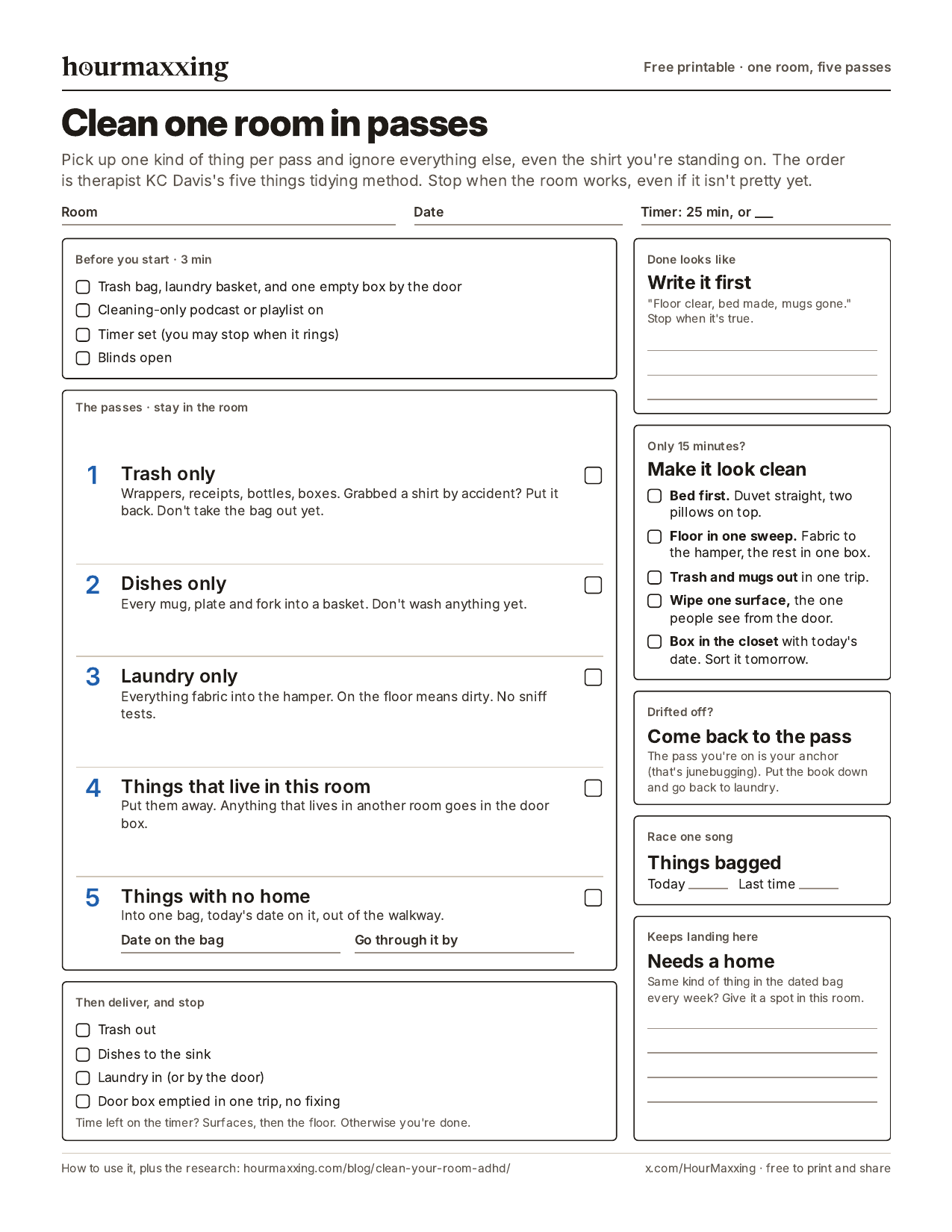
Download the ADHD cleaning checklist (PDF) if you’d rather tick real boxes. Page 1 is the list above, laid out for one room, and page 2 is a cleaning schedule. Free to print, no email form.
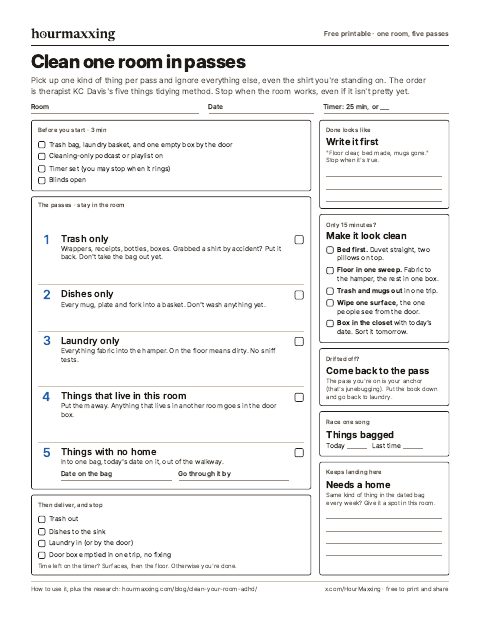
Each of the five passes gets its own box with the one rule that matters for it, and pass 5 has blanks for the date on the bag and the day you’ll go through it. Down the side is a “done looks like” box to fill in before you start (the specific-goals trick), the 15-minute version, a one-song race counter, and a few lines for whatever keeps showing up in the dated bag.
Page 2 is the schedule further down as a week you can tick off, plus the whole-house deep clean list with a date line per room. For a home you share, there’s a separate ADHD chore chart near the end of the guide.
On your phone? Save page 1 as an image and tick it off with your photos app’s markup tool.
What is junebugging, and does it help?
Junebugging started as a Tumblr post about how cleaning with ADHD is “an endless cycle” of abandoning one half-finished chore for the next. The fix it proposed: pick one specific spot, like “the bathroom sink” instead of “the bathroom,” and consider yourself tied to it “by a long mental bungee cord.” Wander, get distracted, make a sandwich, and keep coming back to the sink. The name comes from a June bug on a window screen: “remarkably persistent, but not very focused.”
Nobody has studied it. It fits ADHD anyway, because you’re going to drift regardless, and an anchor gives you somewhere to land. With the passes, make the current pass your anchor. Got distracted by a book during laundry? Fine. Put it down and go back to laundry.
How to clean your room without getting distracted
Most cleaning sessions die at the doorway: you carry a mug to the kitchen and come back 40 minutes later having reorganized the spice rack. The passes close those exits:
- Don’t leave the room. Everything that belongs elsewhere goes in the door box, delivered in one trip at the end.
- One question per object. During the trash pass the only question is “is this trash?” The birthday card stays put until pass 5.
- Sound on, phone away. Start the podcast, then put the phone face down across the room. “Just one thing” mid-pass is how 25 minutes becomes a two-hour scroll.
- Anchor to the current pass. When you notice you’ve drifted, put down what you’re holding and go back to the pass, the junebugging idea applied to categories.
- Get someone in the room. A friend on a video call folding their own laundry is body doubling.
- Let the timer end it. Permission to stop at 25 minutes leaves no time for “while I’m at it” side quests.
How to clean a messy room fast (the 15-minute version)
Your friend texts “omw, 15 min” and the room looks like a laundry basket exploded in it. The fastest way to clean a messy room is to stop trying to clean it. In 15 minutes you’re making it look clean, which is a different job with a different order.
- Bed first. Pull the duvet straight over whatever’s on the mattress and put two pillows on top. It’s the biggest flat thing in the room, so it does the most work per second. (That’s our reasoning. Nobody has measured it.)
- Floor second, in one sweep. Fabric goes in the hamper and everything else goes in one box, any box. No sorting and no deciding. You’re buying a visible floor.
- Trash and mugs out in one trip. Bag in one hand, mugs in the other. The mugs can sit in the sink.
- Clear one surface. Pick the one people see from the doorway, usually the desk or the nightstand, and wipe it. Leave the rest alone.
- Box into the closet, with a date on it. Yes, this is hiding stuff. That’s fine as long as the box comes back out, so write today’s date on it and do passes 4 and 5 from the box tomorrow.
Then open a window and switch on a lamp instead of the ceiling light, because lamps are very forgiving. If nobody’s coming and you have 25 minutes, do the full passes above. The fast version only moves the mess into one place, and a closet box nobody opens is a doom box in the making.
Where to start cleaning a messy house (when every room is a disaster)
Sometimes the bedroom is the least of it. Where to start cleaning a messy house comes down to one question: which room is stopping you from living here for the next 24 hours? Start there, and leave the worst-looking room for later.
Here’s the order we’d use. It’s our judgment call, not a tested method, and a fixed order means you aren’t deciding from scratch at every doorway (same trick as prioritizing when everything feels urgent):
- The kitchen, enough to eat. Wash the dishes you need for tonight and tomorrow and clear one counter. Leave the rest of the stack. Zero clean forks at 9pm is how takeout becomes a lifestyle.
- The bed, enough to sleep. Clear the mattress and do the laundry pass on the floor around it.
- Bathroom basics. Trash out, a clean towel, toilet paper where you can reach it. Scrubbing can wait a day.
- The walkways. A trash pass along the route from the front door to the bed and the kitchen, with a box for anything that lives somewhere else.
- Everything else, one room per session, using the passes above.
One easy win to start, then stop picking the easy ones. A quick trash pass gets you moving. The trap is staying in easy mode, wiping the coffee table again while the sink sits there. Do one easy pass, then go back to the list.
Finish one zone before you start the next. A bit of kitchen and a bit of bedroom gets you five half-done rooms and no finish line. People tend to speed up as a goal gets close: café customers bought coffee more often the nearer they got to a free one, and a 12-stamp card with 2 bonus stamps already filled in got finished faster than a plain 10-stamp card (Kivetz, Urminsky and Zheng, 2006). So make the goal small enough that the end is visible. “The sink” gets close fast. “The house” sits at two stamps out of four hundred all week.
How to deep clean your house with ADHD (a whole-house checklist)
Deep cleaning is a separate job from getting the house livable, so do the order above first. It’s everything under, inside and on top of things: fridge shelves, shower grout, baseboards. “Deep clean the house” has no edges, so give it some: one room per session, same order every time.
Top to bottom, then dry to wet. Dust the light and cabinet tops first, then wipe surfaces, then vacuum, then mop. Whatever you knock down lands on a floor you haven’t done yet.
Spray, then go do something else. Get visible gunk off with soap first, since CDC says to clean dirty surfaces before disinfecting. A disinfectant only works if the surface stays wet for the contact time on its label (the EPA’s example uses 10 minutes; CDC’s diluted bleach guidance says at least 1). So spray the shower, dust the bathroom light, and come back. The wait becomes a built-in task switch.
Never mix cleaners. Bleach plus ammonia (found in some glass cleaners and in urine, so toilets and litter boxes) makes chloramine gas. Bleach plus an acid like vinegar or toilet bowl cleaner gives off chlorine gas (Washington State Department of Health). Rinse the surface before you switch products and keep a window open.
Break before you’re wrecked. A meta-analysis of 22 samples found breaks of 10 minutes or less gave a small lift in energy and cut fatigue (Albulescu et al., 2022). Those were work and lab studies; about 5 minutes off every 30 to 45 is our pick, away from your phone.
A whole-house deep clean checklist, one room per session:
- Kitchen: toss anything expired, then wipe the inside of the fridge, the microwave, the stovetop and oven door, cabinet handles, the sink and drain, and the floor along the baseboards.
- Bathroom: spray the shower, tub, sink and toilet, dust the light and the top of the mirror while they sit, then scrub and rinse. Wash the bath mat and swap the towels.
- Bedroom: strip the bed and start the wash first so the machine works while you do. Dust top down, vacuum under the bed, wipe the light switch and door handle.
- Living room: dust shelves and the TV, vacuum the sofa including under the cushions (hello, missing hair tie), wipe the remote, then vacuum and mop.
- Everywhere, once: door frames, baseboards, light switches, and the trash cans themselves.
One room per day off is plenty, and the weekly schedule below keeps it from needing a sequel by spring.
If even the sink feels like too much, the next section shrinks it further, or get a friend on a call while you both clean (body doubling for chores).
How to clean your room when you’re depressed or overwhelmed
Cleaning your room (or your whole house) when you’re depressed or overwhelmed starts smaller than feels reasonable. Do pass 1 for 10 minutes and call it a win. Do pass 2 tomorrow. A room that gets clean over five days is still a clean room.
Borrow a person. A friend on FaceTime while you both tidy, or a “clean with me” stream, is body doubling, and there are free ways to do it online.
If you can’t even start the 10-minute version, use the task paralysis routine: stand up, put your shoes on, and make the first step “pick up three pieces of trash.”
If it’s been weeks, and the things you usually like feel flat too, the room may not be the main problem. Here’s how to tell ADHD paralysis from depression, and what to do about either.
How to clean your room when you have no motivation (or no energy)
From the couch, “no motivation” and “no energy” feel identical, but they get different fixes.
No motivation usually means the job looks huge and you’re waiting to feel like it. Shrink the job until it’s almost insulting (“put five things in the trash bag”), start the cleaning-only podcast, and give yourself real permission to stop after five.
No energy is more physical. Try a sit-down version: pass 1 from the bed with a bag in reach, laundry sorted on the mattress, every mug onto one tray for a single trip. In a small, old study of 18 volunteers, a brisk 10-minute walk raised energy for two hours, while a candy bar gave a quick lift and then more tiredness (Thayer, 1987). Treat it as a nudge, not a rule.
If you’ve had no energy for weeks, see a doctor. Long-running tiredness has plenty of causes, and some are easy to check.
Does cleaning your room help with depression?
Possibly, a little, if the pieces are small. Nobody has tested “clean your room” as a depression treatment. The nearest well-tested idea is behavioral activation, a therapy where you schedule small activities that matter to you and do them before you feel like it. A meta-analysis of 26 randomized trials found it clearly beat control conditions, though most trials were low quality with short follow-ups (Ekers and colleagues, 2014). It’s usually run with a therapist and built around what you care about. If a tidy room is one of those things, one trash pass counts.
If the mess arrived along with weeks of low mood and not enjoying things you usually like, that’s worth bringing to a doctor.
How to declutter with ADHD (when the problem is too much stuff)
Sometimes you do all five passes and the room is still full: stuffed drawers, a closet door that won’t close, a shelf already three books deep. That’s a volume problem, and new bins won’t fix it. You have to decide what goes, which is exactly the kind of decision ADHD brains put off. Make the decisions smaller:
- Don’t pick everything up. In experiments, simply touching an object made people feel it was more theirs and worth more (Peck and Shu, 2009). Those were buying and selling studies, so this is our extrapolation, but decide from where the thing sits, or have a friend hold up each shirt.
- Let the container decide. Give a category one drawer or one shelf and keep only what fits. You ask “which of these make the cut?” once instead of “do I love this?” a hundred times. (Our reasoning, untested.)
- Go one category, not one room. Every phone charger in the house on the bed at once makes “I have nine of these” obvious.
- Keep sessions short and boring. One drawer, 15 minutes, timer on. A closet is a three-day project, not a Saturday.
- Get the donate bag out the door today. Car trunk, or by the front door with your keys on top. A bag that sits in your room for a week gets re-adopted.
The dated bag from pass 5 is useful here too. If you haven’t opened it in a month and can’t name what’s inside, most of it can probably go.
What is a doom pile? (and how to deal with doom piles)
A doom pile is a heap of mixed stuff that got moved instead of put away. DOOM is a backronym for “Didn’t Organize, Only Moved.” It might be a stack on the chair, a tote bag of mail, or a box you’ve been “going through later” since spring.
It’s internet slang, not a diagnosis, and no study has looked at doom piles by name (Deering, 2026). Organizer Mindy Godding says “doom piles are universal.” ADHD probably makes more of them because a doom pile is basically pass 5 without a date: every item is a decision you put off (our read, not a finding).
The pile cleared a surface when you needed one, like the 15-minute clean. The trouble starts when it never gets sorted, since hidden items “often will be replaced or duplicated,” as Godding warns.
How we’d deal with one (adapted from the methods above, not tested on piles):
- Run the five passes on the pile itself. Trash first, then dishes, laundry, things with a home, and whatever’s left.
- Deadlines come out first. Any bill, letter or form with a date goes on the calendar before you sort anything else.
- One pile per session, timer on. Godding uses 20-minute “clutter sprints.” Stop when it rings, even mid-pile.
- Give the next pile a landing spot. Put a tray on that exact spot, the same trick as putting storage where the mess lands, and date whatever goes in it.
Does ADHD cause hoarding?
Not on its own, but the two are linked. In the study covered earlier on this page, inattentive ADHD symptoms predicted how severe hoarding symptoms were (Tolin and Villavicencio, 2011). Hoarding disorder means getting rid of things causes real distress and the clutter stops rooms being usable, like a bed you can’t sleep in.
It’s treatable and worth raising with a doctor or therapist. A meta-analysis of cognitive behavioral therapy for hoarding disorder found symptoms dropped a lot on average, especially difficulty discarding, though most people weren’t symptom-free at the end (Tolin and colleagues, 2015).
ADHD cleaning tips and tricks (and the reasoning behind each)
The passes above already cover the big ones (one category at a time, the door box, the cleaning-only podcast, junebugging). These are the extras we’d add, with where each one comes from.
Write down what done looks like before you start. “Clean my room” has no finish line. “Floor clear, bed made, mugs gone, trash out” does. In decades of workplace research, specific, challenging goals consistently beat “do your best” (Locke and Latham, 2002). Using it on a bedroom is our extrapolation. Put the list on a sticky note and stop when it’s ticked off.
Keep the supplies where the mess happens. Bags in the bottom of every bin, wipes under the bathroom sink, a small trash can by the bed and the couch, a hamper where clothes actually come off. At a cafeteria salad bar, moving a food about 10 inches further away, or swapping its spoon for tongs, cut how much people took by roughly 8 to 16% (Rozin and colleagues, 2011). That was lunch, not cleaning, but “the spray is in the kitchen” kills a lot of 30-second wipes.
Race something. Put on one song and see how much goes in the trash bag before it ends. Lyrics are fine here, since the studies where songs with words hurt focus were about reading. People with ADHD tend to discount delayed rewards more steeply (Jackson and MacKillop, 2016, a meta-analysis of money studies, so cleaning is our inference). A clean room pays off later; a beaten score pays off now.
Take a before photo. Ten minutes in, the room often looks worse, which is an easy moment to quit. Compare against the photo. In the coffee card study from the whole-house section, even fake progress made people finish faster, so real progress should help too (our guess).
How to keep your room clean with ADHD
The big clean is the easy part. Keeping it is harder, because there’s no before-and-after on a random Tuesday.
Do a 10-minute reset at the same moment every day. Tie it to something you already do: “After I brush my teeth at night, I do one trash pass and one laundry pass.” That’s an if-then plan, and across 94 tests Gollwitzer and Sheeran (2006) found these plans help people follow through, with a medium-to-large average effect.
It takes a while to stick: in a study of 96 volunteers, getting close to automatic took 18 to 254 days, but missing one day didn’t meaningfully set people back (Lally and colleagues, 2010). Our habits guide explains the setup, there’s a free printable habit tracker for ticking off the days, and our ADHD morning routine chains steps the same way.
Put the storage where the mess already lands. If clothes always end up on the chair, put an open basket or hooks there. Mugs on the nightstand? Keep a tray there and carry the tray. Lids, drawers and folding are extra steps, and every extra step is a place where “later” wins.
Treat the dated bag as data. If it fills up every week with the same kind of thing, like receipts or hair ties, that thing needs a home in the room.
The bar is a path to the bed that doesn’t involve stepping on a charger. Pinterest can keep the rest.
A simple ADHD cleaning schedule (that survives a bad week)
The usual printable schedule gives every day a room. Miss Tuesday and the whole week feels failed, and the chart goes in a drawer. Here’s a lighter version (our design, untested):
- Every day (about 10 minutes): the reset above, one trash pass and one laundry pass in the worst room, plus dishes to the sink before bed.
- Twice a week: one zone from the whole-house order, like kitchen counters or bathroom basics. Pick the days in advance, with a time attached.
- Once a week: change the sheets, open the dated bag, and get the donate bag out of the house.
- Once a month: one 15-minute declutter session on one category.
If you miss a day, skip it and do today’s rather than doubling up; in the habit study above, one missed day didn’t meaningfully slow people down. The schedule is also page 2 of the printable checklist.
A free printable ADHD chore chart for adults (PDF)
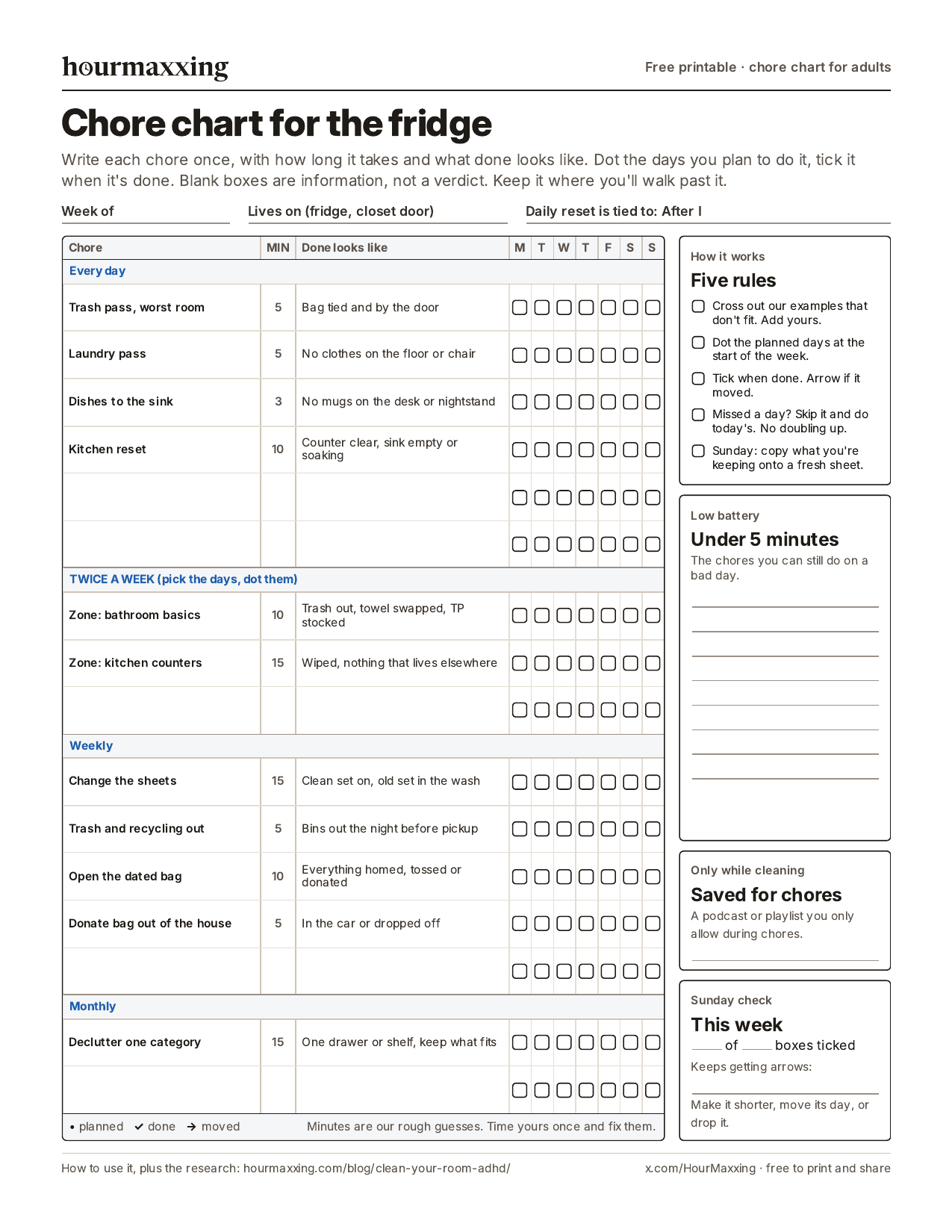
A schedule only works if you see it on a random Tuesday. The ADHD chore chart for adults (PDF) is built for the fridge door. Page 1 is a week of chores for one person, and page 2 splits them with a partner or housemates. Free, no email form.
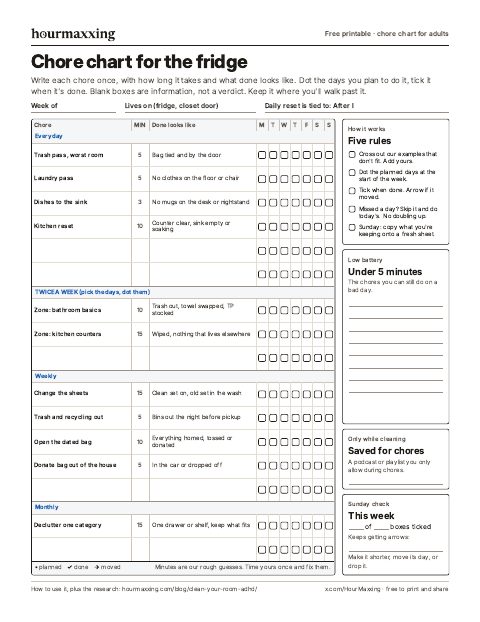
Each chore gets one line with its minutes and what done looks like. Dot the days you plan it, tick it when done, draw an arrow if it moves. We filled in the schedule above as examples with rough minute guesses, so cross out what doesn’t fit.
Writing down what done looks like is the specific-goals trick again. Down the side are chores under 5 minutes for bad days, a line for the podcast you only play while cleaning, and a Sunday check. If one chore keeps collecting arrows, shorten it, move it, or drop it.
Page 2 is for shared homes. Sociologist Allison Daminger interviewed 35 couples and found housework has a thinking half (anticipating, deciding, checking) that was often invisible and a frequent source of conflict (Daminger, 2019). So every chore on page 2 gets a name under “notices” and “checks” as well as “does it,” plus a “reminder set” box for a repeating phone reminder. Her study was about couples in general, not ADHD, and the columns are our design.
To use it on your phone, save page 1 as an image and mark it up in your photos app.
Sources
- American Psychiatric Association. (2013). Diagnostic and Statistical Manual of Mental Disorders (5th ed.). Criteria for attention-deficit/hyperactivity disorder.
- Davis, K. C. (2022). How to Keep House While Drowning: A Gentle Approach to Cleaning and Organizing. Simon Element.
- Onion, R. (2022, April 28). You don’t have to fold your laundry [Interview with K.C. Davis]. Slate. https://slate.com/technology/2022/04/kc-davis-interview-struggle-care.html
- Daminger, A. (2019). The cognitive dimension of household labor. American Sociological Review, 84(4), 609-633. https://doi.org/10.1177/0003122419859007
- Segarra, M., & Venkat, M. (2023, April 20). This 5-step method can quickly get a messy house back in order. NPR Life Kit. https://www.npr.org/2023/04/19/1170846100/how-to-keep-house-clean
- Ferrari, J. R., & Roster, C. A. (2018). Delaying disposing: Examining the relationship between procrastination and clutter across generations. Current Psychology, 37(2), 426-431. https://doi.org/10.1007/s12144-017-9679-4
- Deering, S. (2026, April 29). Organizers explain how “doom piles” can ruin your space. Good Housekeeping. https://www.goodhousekeeping.com/home/organizing/a71163617/doom-piles-organizing-tips/
- Tolin, D. F., & Villavicencio, A. (2011). Inattention, but not OCD, predicts the core features of hoarding disorder. Behaviour Research and Therapy, 49(2), 120-125. https://doi.org/10.1016/j.brat.2010.12.002
- Ekers, D., Webster, L., Van Straten, A., Cuijpers, P., Richards, D., & Gilbody, S. (2014). Behavioural activation for depression; an update of meta-analysis of effectiveness and sub group analysis. PLoS ONE, 9(6), e100100. https://doi.org/10.1371/journal.pone.0100100
- Thayer, R. E. (1987). Energy, tiredness, and tension effects of a sugar snack versus moderate exercise. Journal of Personality and Social Psychology, 52(1), 119-125. https://doi.org/10.1037/0022-3514.52.1.119
- Peck, J., & Shu, S. B. (2009). The effect of mere touch on perceived ownership. Journal of Consumer Research, 36(3), 434-447. https://doi.org/10.1086/598614
- Tolin, D. F., Frost, R. O., Steketee, G., & Muroff, J. (2015). Cognitive behavioral therapy for hoarding disorder: A meta-analysis. Depression and Anxiety, 32(3), 158-166. https://doi.org/10.1002/da.22327
- Kivetz, R., Urminsky, O., & Zheng, Y. (2006). The goal-gradient hypothesis resurrected: Purchase acceleration, illusionary goal progress, and customer retention. Journal of Marketing Research, 43(1), 39-58. https://doi.org/10.1509/jmkr.43.1.39
- Milkman, K. L., Minson, J. A., & Volpp, K. G. M. (2014). Holding the Hunger Games hostage at the gym: An evaluation of temptation bundling. Management Science, 60(2), 283-299. https://doi.org/10.1287/mnsc.2013.1784
- Gollwitzer, P. M., & Sheeran, P. (2006). Implementation intentions and goal achievement: A meta-analysis of effects and processes. Advances in Experimental Social Psychology, 38, 69-119.
- Lally, P., van Jaarsveld, C. H. M., Potts, H. W. W., & Wardle, J. (2010). How are habits formed: Modelling habit formation in the real world. European Journal of Social Psychology, 40(6), 998-1009. https://doi.org/10.1002/ejsp.674
- Locke, E. A., & Latham, G. P. (2002). Building a practically useful theory of goal setting and task motivation: A 35-year odyssey. American Psychologist, 57(9), 705-717. https://doi.org/10.1037/0003-066X.57.9.705
- Rozin, P., Scott, S., Dingley, M., Urbanek, J. K., Jiang, H., & Kaltenbach, M. (2011). Nudge to nobesity I: Minor changes in accessibility decrease food intake. Judgment and Decision Making, 6(4), 323-332. https://doi.org/10.1017/S1930297500001935
- Jackson, J. N. S., & MacKillop, J. (2016). Attention-deficit/hyperactivity disorder and monetary delay discounting: A meta-analysis of case-control studies. Biological Psychiatry: Cognitive Neuroscience and Neuroimaging, 1(4), 316-325. https://doi.org/10.1016/j.bpsc.2016.01.007
- Albulescu, P., Macsinga, I., Rusu, A., Sulea, C., Bodnaru, A., & Tulbure, B. T. (2022). “Give me a break!” A systematic review and meta-analysis on the efficacy of micro-breaks for increasing well-being and performance. PLoS ONE, 17(8), e0272460. https://doi.org/10.1371/journal.pone.0272460
- U.S. Environmental Protection Agency. Selected EPA-registered disinfectants: Directions for use (contact time). https://www.epa.gov/pesticide-registration/selected-epa-registered-disinfectants
- Centers for Disease Control and Prevention. Cleaning and disinfecting with bleach. https://www.cdc.gov/hygiene/about/cleaning-and-disinfecting-with-bleach.html
- Washington State Department of Health. Dangers of mixing bleach with cleaners. https://doh.wa.gov/community-and-environment/contaminants/bleach-mixing-dangers
- “Cleaning with ADHD is a nightmare” (junebugging), Tumblr post, reblogged by pippin4242, March 31, 2018. https://pippin4242.tumblr.com/post/172439909697/spotlessgloves-jumpingjacktrash
- Swanson, H. L., & Ferrari, J. R. (2022). Older adults and clutter: Age differences in clutter impact, psychological home, and subjective well-being. Behavioral Sciences, 12(5), 132. https://doi.org/10.3390/bs12050132
- McMains, S., & Kastner, S. (2011). Interactions of top-down and bottom-up mechanisms in human visual cortex. Journal of Neuroscience, 31(2), 587-597. https://doi.org/10.1523/JNEUROSCI.3766-10.2011
- Masicampo, E. J., & Baumeister, R. F. (2011). Consider it done! Plan making can eliminate the cognitive effects of unfulfilled goals. Journal of Personality and Social Psychology, 101(4), 667-683. https://doi.org/10.1037/a0024192
- Rankin, C. H., Abrams, T., Barry, R. J., Bhatnagar, S., Clayton, D. F., Colombo, J., Coppola, G., Geyer, M. A., Glanzman, D. L., Marsland, S., McSweeney, F. K., Wilson, D. A., Wu, C.-F., & Thompson, R. F. (2009). Habituation revisited: An updated and revised description of the behavioral characteristics of habituation. Neurobiology of Learning and Memory, 92(2), 135-138. https://doi.org/10.1016/j.nlm.2008.09.012
- Lang, M., Krátký, J., Shaver, J. H., Jerotijević, D., & Xygalatas, D. (2015). Effects of anxiety on spontaneous ritualized behavior. Current Biology, 25(14), 1892-1897. https://doi.org/10.1016/j.cub.2015.05.049
- Steel, P. (2007). The nature of procrastination: A meta-analytic and theoretical review of quintessential self-regulatory failure. Psychological Bulletin, 133(1), 65-94.
- Sirois, F., & Pychyl, T. (2013). Procrastination and the priority of short-term mood regulation: Consequences for future self. Social and Personality Psychology Compass, 7(2), 115-127.
- NHS. (2023). Symptoms: Obsessive compulsive disorder (OCD). https://www.nhs.uk/mental-health/conditions/obsessive-compulsive-disorder-ocd/symptoms/
- Simons, D. J., & Chabris, C. F. (1999). Gorillas in our midst: Sustained inattentional blindness for dynamic events. Perception, 28(9), 1059-1074. https://doi.org/10.1068/p281059
These are strategies, not treatment. If keeping your space livable is affecting your health, work, or relationships, a clinician or ADHD coach can help, and asking is not dramatic.
Want one more of these each week?
One technique a week, the study behind it, and a low-energy version. Free, about a 3-minute read, unsubscribe anytime.
We use your address only to send the email, and you can unsubscribe in one click.
FAQ
How do I clean my room with ADHD step by step?
Clean one category at a time. Walk the room once picking up only trash, then only dishes, then only laundry, then things that already have a home in that room, then whatever has no home (into one dated box). Anything that belongs in another room goes in a box by the door so you never leave mid-clean. This order is therapist KC Davis's 'five things' tidying method (Davis, 2022). Set a timer, put on a podcast you only allow while cleaning, and stop once the room works, even if it isn't pretty.
Where do I start when my room is so messy I'm overwhelmed?
Start with trash, and only trash. Grab a bag, walk the room, and ignore everything that isn't garbage, even the shirt you're standing on. It's the fastest visible change and asks you one yes-or-no question per object. If 25 minutes feels impossible, do just the trash pass for 10 minutes and call it a win. Tomorrow do dishes. A room cleaned over five days still counts.
Why is cleaning so hard with ADHD?
A messy room is hundreds of small decisions at once (keep it, where does it go, is it clean), and every trip out of the room to put something away is a chance to get sidetracked. The DSM-5 ADHD criteria list trouble keeping belongings in order, failing to finish chores because you get sidetracked, and forgetfulness in daily activities like chores (American Psychiatric Association, 2013). 'Clean my room' also has no clear first step or finish line, which makes it easy to freeze before starting.
Do people with ADHD have messy rooms?
Often, though nobody has measured ADHD bedrooms directly. The closest research is on hoarding: in 101 adults, inattentive ADHD symptoms predicted the severity of clutter, difficulty discarding and acquiring, while OCD symptoms didn't once mood was accounted for (Tolin and Villavicencio, 2011). A messy room is not hoarding disorder, but the inattention part (putting things down 'for a second') seems to carry over. It says nothing about your character.
How do I keep my room clean with ADHD?
Do a 10-minute reset tied to something you already do daily, like right after brushing your teeth at night. If-then plans like that help people follow through (Gollwitzer and Sheeran, 2006), and missing a day doesn't wreck a forming habit (Lally et al., 2010). Then put storage where the mess already lands: a basket or hooks where clothes pile up, a tray where mugs collect. Every lid, drawer and fold is one more step where 'later' wins.
Why does a messy room give me anxiety?
Nobody has shown that clutter causes an anxiety disorder, but the two are linked. In a survey of 450 adults, people whose clutter got in the way more reported a weaker sense of home and lower life satisfaction (Swanson and Ferrari, 2022). Lab work hints at why it nags: objects in view compete for attention in the visual cortex (McMains and Kastner, 2011), and unfinished goals cause intrusive thoughts until you make a specific plan for them (Masicampo and Baumeister, 2011). Writing down when you'll clean and boxing up what's on the floor are the quickest ways to turn the volume down.
What is clutter blindness?
Clutter blindness is internet slang for not noticing the mess you live with anymore. It isn't a diagnosis, but it lines up with habituation, where the response to something that never changes fades (Rankin and colleagues, 2009), and with inattentional blindness, where 46% of viewers in one study missed a person in a gorilla suit or a woman with an umbrella because they were counting basketball passes (Simons and Chabris, 1999). A photo of your room from the doorway is the easiest way to see it fresh.
How do I clean a messy room fast?
With 15 minutes, make it look clean and leave the real sorting for tomorrow. Make the bed first, since it's the biggest surface in the room. Then clear the floor in one sweep: fabric into the hamper, everything else into one box. Take trash and mugs out in a single trip, wipe the one surface people see from the doorway, and put the box in the closet with today's date on it. Sort the box the next day, or it slowly turns into furniture.
Where do I start cleaning when my whole house is a mess?
Start with whatever stops you from living there in the next 24 hours. That usually means enough clean dishes and one counter to eat, a clear bed to sleep in, bathroom basics (trash out, a clean towel, toilet paper), then the walkways. One easy pass first is fine to get moving, then go back to that order. Finish one zone before starting the next, since people tend to speed up as a goal gets close (Kivetz, Urminsky and Zheng, 2006).
How do I clean my room when I have no motivation or energy?
If it's motivation, make the job tiny (five things into the trash bag), put on a podcast you only allow while cleaning, and allow yourself to stop after that. Waiting until you feel like it is part of the trap. If it's energy, start sitting down: trash from the bed, laundry sorted on the mattress, mugs onto one tray. A short walk first may help too. In a small study, a brisk 10-minute walk raised people's energy for two hours, while a candy bar gave a quick lift and then more tiredness (Thayer, 1987).
What is a doom pile?
A doom pile is a heap of mixed stuff that got moved instead of put away. DOOM stands for 'Didn't Organize, Only Moved.' It's internet slang that got linked to ADHD on social media, not a clinical term, and no study has looked at it by name. Each item is a decision you put off. To clear one, run the five cleaning passes on the pile itself (trash, dishes, laundry, things with a home, the rest), pull out anything with a deadline first, and put a dated tray where the pile keeps forming.
Is there a free printable ADHD cleaning checklist?
Yes. Our ADHD cleaning checklist is a free two-page PDF, and you don't need to give an email. Page 1 is a one-room checklist built on therapist KC Davis's five things method (trash, dishes, laundry, things with a place, things without one), with a box to write what done looks like and a 15-minute version for emergencies. Page 2 is a weekly cleaning schedule with a daily 10-minute reset, two zone days, the weekly and monthly jobs, and a one-room-per-session deep clean list. There's a PNG of page 1 for phones too.
New here? Start with the reading order → Rather use paper? Grab a free printable.