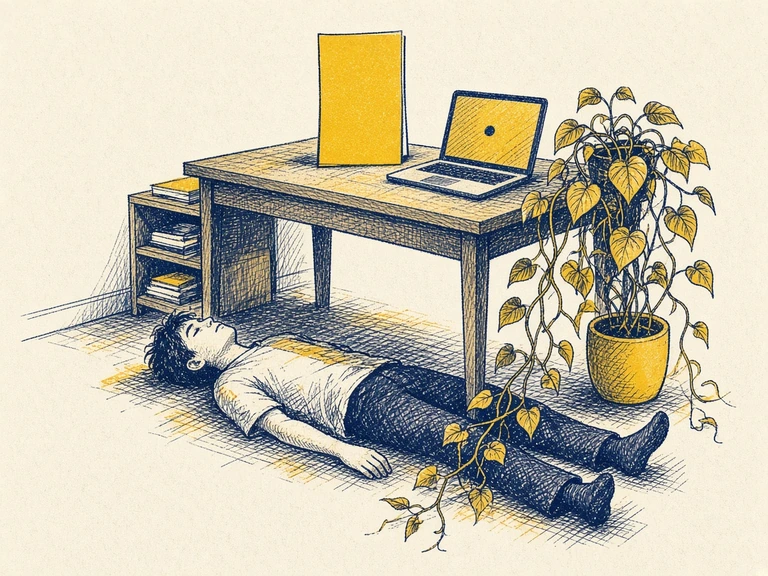
Short answer: to get out of ADHD task paralysis right now, move your body first, then shrink the first step until it’s a little embarrassing, like opening the email and typing the person’s name. Set a 10-minute timer you’re allowed to quit at. If you still can’t start, write down exactly when and where you will, then rest for real until then.
It’s 2:40pm. The email you need to send has been “next” since 10am. You’ve opened the draft twice and closed it twice. You haven’t done anything else either. Lunch was a handful of crackers. The show you meant to watch is still paused on the opening credits. Mostly it’s been the couch, the phone, and a low hum of “I should be doing it” that makes even the scrolling feel bad.
That’s the cruel part of task paralysis. You aren’t working and you aren’t resting. You’re stuck in the lobby between them, paying for both.
If that’s a regular afternoon for you, here’s what causes it, how to get out of ADHD task paralysis right now, and what to try depending on which kind of stuck you are.
What task paralysis is (and isn’t)
“Task paralysis” isn’t a clinical term, and you won’t find it in the DSM. What you will find in the official ADHD criteria are lines like “often has difficulty organizing tasks and activities” and “often avoids, dislikes, or is reluctant to engage in tasks that require sustained mental effort” (American Psychiatric Association, 2013). Task paralysis is what those feel like from the inside. You know the task and you want it done, and your body stays on the couch anyway.
It usually gets filed under executive dysfunction, the broad name for trouble with planning, starting, switching, and holding things in mind. A 2005 meta-analysis by Willcutt and colleagues found people with ADHD tend to show weaknesses in exactly those areas. Paralysis is the starting part.
It’s a bit different from regular procrastination. Procrastination often means doing something else instead, like deep-cleaning the kitchen to avoid one form. Paralysis is when you can’t do the task and can’t really do anything else either. If it happens before an appointment, it’s a cousin of waiting mode.
It’s also not the same as decision paralysis, where you’re stuck choosing which thing to do. With task paralysis, the choice is made and the start is what won’t come.
And it isn’t proof you’re lazy. Lazy people are relaxed. You are clearly not relaxed.
What does task paralysis feel like?
There’s no official symptom list, so this is the pattern people keep describing, plus an early study that caught it while it was happening.
It feels heavy and wired at the same time. Your body won’t get up, but your brain won’t settle either, so you can’t nap and you can’t enjoy the show. You can see the first step, sometimes in high definition (open the laptop, type “Hi Sam,”), and your hands just don’t go. So you orbit the task instead. You open the draft and close it, refill the water glass you filled ten minutes ago, and check whether anyone answered the text you sent four minutes ago. The phone ends up in your hand without a decision being made. And time goes strange. It was 11am, then it’s 2:40pm, and you couldn’t say where the middle went.
Then there’s the commentary track: “it’s five minutes, just do it, what is wrong with you.” That voice is usually louder than the task is hard, and it’s a big part of why the scrolling doesn’t feel like a break.
In one of the first live measurements, a pager study, Pychyl and colleagues (2000) beeped 45 undergraduates eight times a day in the five days before a deadline. The tasks they were putting off got rated as unpleasant and stressful, whatever they did instead got rated as more pleasant, and yet procrastinating didn’t line up with a better mood. That’s the lobby from the top of this page, in data form.
If you searched for “ADHD paralysis physical symptoms,” there isn’t a measured list to give you. The heavy, restless, foggy feeling is real, it just hasn’t been studied under that name. If the heaviness shows up most days, even for things you used to enjoy, or comes with changes in sleep or appetite, tell a doctor, because that’s also how depression can look. If it’s one email and a bad afternoon, the unstick routine below is built for exactly this.
ADHD paralysis vs laziness: how do you tell the difference?
“Lazy” isn’t a diagnosis either, so no test cleanly separates the two. There are some honest tells, though, and you can check them on yourself this afternoon.
- Do you want it done? Everyday laziness is not wanting to do a thing and being mostly fine with skipping it. Paralysis is wanting it done, sometimes badly, and still not starting.
- How does skipping it feel? If leaving the dishes feels like a nice night off, that’s a preference. If it feels like the 2:40pm couch at the top of this page, guilty and buzzy and unable to enjoy the show, that’s the stuck loop.
- Do fun things get stuck too? Paralysis doesn’t care whether you like the task. People freeze on texting back a friend they adore, or booking a trip they’ve been excited about for months.
- Does a deadline or something new flip the switch? Plenty of people with ADHD can do the “impossible” task at 11pm the night before, or right away when it’s shiny and new. That fits the reward-timing research in what causes task paralysis a lot better than it fits a character flaw.
Executive dysfunction vs procrastination vs laziness. People use these like three names for one thing. They aren’t, and the difference is mostly about intent. Here’s a rough way to sort them (our framing, not a diagnostic rule):
- Laziness is not wanting to do it and being fine with that. No plan is being broken. It isn’t a research term either, which is part of why it gets thrown around so freely.
- Procrastination is a gap between plan and action. Piers Steel’s 2007 review defines it as choosing to “voluntarily delay an intended course of action despite expecting to be worse off for the delay.” You meant to do it, and you know waiting will cost you.
- Executive dysfunction is the skill side underneath: trouble planning, starting, stopping, switching, and holding the plan in mind (more on that below). It’s broader than delay. It’s also losing your place halfway, or forgetting the plan existed.
The last two overlap a lot: in Steel’s meta-analysis, impulsiveness, distractibility and organization were among the strongest predictors of procrastination, which reads like an executive function checklist. So if you’re asking “do I have executive dysfunction or am I just lazy,” ask one question: did you mean to? If you did and you’re stuck anyway, lazy is the wrong word.
The “you’re just lazy” voice may be the culture’s line read in your voice. When 805 adults in Brazil gave their first words for “ADHD,” stigma was one of the big clusters, with or without ADHD (Costa et al., 2026).
Getting stuck a lot doesn’t prove ADHD on its own, though. Depression, anxiety, burnout, bad sleep, and heavy phone use can all look similar, which is why a proper evaluation matters if the tells above sound like your whole life. Meanwhile, calling yourself lazy has never once sent the email.
ADHD freeze mode: is it a real freeze response?
You may have seen “ADHD freeze mode” or “functional freeze” going around social media, the idea that a survival freeze is why the laundry has lived on the chair since Tuesday. Those are internet terms. PubMed has nothing on “functional freeze,” and ADHD plus the freeze response only turned up rodent studies (we checked in October 2026).
The freeze response itself is real: Karin Roelofs’ 2017 review describes a brake under rising threat, body still, heart rate slower, ready to move, and barely studied in people. But real freezing is short and set off by danger. The couch version lasts all afternoon and runs on dodging a bad feeling, the mood-repair loop in what causes task paralysis.
The part worth borrowing is that a brake is waiting for a clear signal to go. “Do the taxes” is too big to count as one. “Stand up and walk to the kitchen” counts, which is why step 1 starts with your body. If you go still or numb mostly when you’re scared, or around reminders of something bad that happened, bring that to a therapist. That’s a different problem from an unsent email.
ADHD shutdown: why do I shut down when I’m overwhelmed?
“Shutdown” is another internet word, not a diagnosis. People use it for the moment everything is too much at once: your brain goes blank, you stop answering messages, and the most you can manage is lying down and scrolling.
It’s usually a crash after overload, not being stuck before one task. No study measures an “ADHD shutdown” as such (we checked in October 2026), but nearby research explains a lot.
Stress hits the thinking part of your brain hardest. Amy Arnsten’s 2009 review in Nature Reviews Neuroscience calls the prefrontal cortex the region most sensitive to stress: even mild stress you can’t control quickly knocks out working memory and steering your attention, so whatever is loud or bright wins and old habits keep running. That’s opening the same app ten times while the problem sits there.
Feeling in control seems to protect you. The same review notes that people who felt in control, even when it was an illusion, were often not impaired. Our reading: one tiny next step you choose beats a pep talk.
ADHD can mean more load coming in. A 2014 review put impairing emotion dysregulation at about 30 to 70% of adults with ADHD (Shaw et al.), and a Dutch study of 116 adults with ADHD found more sensory sensitivity than in norm groups, especially for sound (Bijlenga et al., 2017). If sound is the main thing that tips you over, here’s what helps with ADHD noise sensitivity.
ADHD shutdown vs autistic shutdown. The word comes mostly from autistic communities. If your shutdowns come with strong sensory overload, a need for total quiet and a long recovery, and that’s been true since childhood, ask about an autism assessment too.
- Cut the input first. Headphones on, lights down, phone face down (our suggestion, not a tested protocol).
- Pick one thing you control. Drink some water, stand up, or write the next step on paper. Same idea as shrinking the first step.
- Say you’re offline, not gone. A one-line “overloaded, back in an hour” text stops the silence from becoming a second problem.
- Empty your head once you’re back. A quick brain dump gets the open loops out of working memory.
- If it lasts weeks, look wider. Shutting down for weeks or months is worth checking against depression and burnout.
Is executive dysfunction real? (task paralysis vs executive dysfunction)
The struggle is real. The label is a description, though, and that trips people up. Executive function is psychology’s umbrella name for the skills that get you from “I should” to done: planning, starting, stopping yourself, switching gears, and holding the plan in mind while you work. Executive dysfunction just means those are hard for you.
It isn’t a diagnosis on its own. CHADD, the big US ADHD nonprofit, says executive function issues aren’t a medical diagnosis recognized by the APA or the WHO, and that “executive dysfunction” is shorthand for them (Heller and Cooper-Kahn, 2022). So it isn’t in the DSM, and there’s no diagnosis code for it alone. A clinician will look for what’s behind it.
The weaknesses do show up in lab data. Willcutt and colleagues (2005) pooled 83 studies, about 3,700 people with ADHD and 3,000 without. The ADHD groups did worse on every executive function task, with medium-sized gaps that were clearest for stopping an action, staying alert, working memory, and planning.
Is executive dysfunction a symptom of ADHD? Often, and less universally than the internet says. The same meta-analysis found the gaps didn’t show up in everyone with ADHD, and the authors called executive weaknesses “neither necessary nor sufficient” to explain every case.
Can you have executive dysfunction without ADHD? Yes. A meta-analysis of 113 studies found people with major depression did reliably worse on executive function tests (Snyder, 2013), and CHADD’s list adds autism, anxiety, learning disabilities, some medical conditions, and plain temporary stress.
So task paralysis is one moment inside the bigger category: the plan is clear and the start won’t come. That’s why every fix on this page aims at starting. If it’s been everywhere since childhood, an ADHD evaluation is worth it (CHADD notes treating the ADHD can ease the executive problems too). If it showed up recently with low mood, read ADHD paralysis vs depression first.
What causes task paralysis?
Nobody has studied “task paralysis” under that name yet. PubMed has zero papers with the phrase in a title or abstract (we checked in October 2026). The closest research is on procrastination and ADHD, and it points at a few causes that stack on top of each other.
Starting feels bad, so your brain picks feeling better now. Steel’s 2007 meta-analysis of procrastination research found that how unpleasant a task feels, how far away its payoff is, and impulsiveness were among the strongest predictors of putting it off. Sirois and Pychyl (2013) describe procrastination as short-term mood repair: dodge the bad feeling now and send the bill to future you. Freezing is the same move with none of the fun.
ADHD seems to turn the dial up. In a small study of 54 university students, Niermann and Scheres (2014) found that inattention symptoms in particular tracked with general procrastination. It’s preliminary, and the students weren’t all diagnosed, but it matches what people with ADHD describe all the time.
About the “low dopamine” thing. There’s something real under it. Volkow and colleagues (2009) found lower levels of some dopamine markers in reward areas in 53 unmedicated adults with ADHD than in 44 without, and delay aversion models (Sonuga-Barke, 2003) describe ADHD brains as extra pulled toward sooner rewards. One scan study can’t explain your couch at 2:40pm, though. The useful part is the shape: far-off rewards barely pull, so make the start smaller and the payoff sooner.
The “should” keeps looping. Unfinished goals hang around. Masicampo and Baumeister (2011) found an unfinished goal caused intrusive thoughts and worse performance on unrelated tasks, and that making a specific plan for it made those effects go away. That’s why paralysis is so tiring. You’re re-deciding whether to start, over and over, without starting.
Shame makes the next round worse. Wohl, Pychyl and Bennett (2010) followed 119 first-year students across two midterms: heavy procrastinators who forgave themselves after the first exam procrastinated less before the second (correlational, so a strong hint). Beating yourself up feels like taking it seriously, but it adds one more bad feeling to avoid.
Is procrastination a symptom of ADHD? (and why people with ADHD procrastinate)
Not officially. The word “procrastination” doesn’t appear in the DSM-5 criteria for ADHD. The closest line is one of the nine inattention symptoms, often avoiding, disliking, or being reluctant to take on tasks that need sustained mental effort. For adults, the examples given are “preparing reports, completing forms, reviewing lengthy papers” (American Psychiatric Association, 2013).
So procrastinating a lot isn’t proof of ADHD, but people with ADHD report far more of it. Altgassen, Scheres and Edel (2019) compared 29 adults with ADHD and 24 without: on a standard procrastination questionnaire the ADHD group averaged about 68 against 40, and over six days they carried out about 52% of their own plans against 81%.
Why? Two answers have some data behind them.
The plan doesn’t come back at the right moment. In the Altgassen study, how many of their own plans people carried out partly explained the link between ADHD symptoms and procrastination. Only four people with ADHD used reminders at all.
Far-off payoffs barely pull, and doubt pulls hard. In an online survey of 202 adults, Netzer Turgeman and Pollak (2023) found more ADHD symptoms went with more procrastination, partly through impulsiveness (a reward days away counts for very little) and partly through low expectancy, which is not really believing you’ll finish the thing well.
Both studies are small and mostly self-report, and neither tested a fix. Our read: if forgetting is part of your pattern, put the reminder at the moment, with the action written in it, like the alarm in step 5. If doubt is the bigger part, make the first step so small that you know you can do it (step 2).
Is it a sign of anxiety or depression instead? It isn’t a listed symptom of those either. Our rough guide, not a diagnostic rule: ADHD starts before age 12 and shows up in more than one setting, a recent slump with flat mood points toward depression, and putting things off out of fear of doing them wrong sounds more like anxiety. More than one can be true, so let a clinician sort it out.
Can you have task paralysis without ADHD?
Yes. ADHD seems to make it worse, but the freeze itself is a very ordinary human move. In a 1996 survey of 211 adults at community meetings, about 1 in 5 called themselves chronic procrastinators (Harriott and Ferrari, 1996). That’s old and self-reported, and nobody in that room was screened for ADHD.
It also travels with mood. A 2025 review pooled 88 studies of generally healthy people, over 63,000 participants in 17 countries, and found procrastination moderately linked with depression, anxiety, and stress (r = 0.34, Nie and colleagues, 2025). The few long-term studies in it hint the link runs both ways. Feeling low makes starting harder, and the pile of unstarted things doesn’t exactly cheer you up.
Autistic people describe a version too. In focus groups with 32 autistic adults, Buckle and colleagues (2021) heard about “autistic inertia,” trouble starting, stopping, or switching activities that didn’t feel under conscious control. A prompt from outside helped, and so did a matching activity already going on around them, which sounds a lot like body doubling. Stress made it worse. (Time itself can feel slippery for autistic people too, and the research on that is in time blindness without ADHD.)
So the steps below work without a diagnosis. If you’re stuck most days and want real help, CBT is the treatment with the best evidence for procrastination so far. A 2018 meta-analysis of randomized trials found a small effect for psychological treatments overall and a moderate one for CBT, though only three CBT trials fed that number (Rozental and colleagues, 2018). And if the freeze comes with flat mood for weeks, read ADHD paralysis vs depression.
How to get out of task paralysis right now
Go in order. Stop at whichever step gets you moving.
1. Move your body before your brain
Stand up. Switch chairs or carry the laptop to the kitchen table, and maybe put your shoes on. Lots of people with ADHD swear by tricks like “never sit down when you get home.” We don’t know of a study testing this exact move, so treat it as a cheap experiment. The point is to change the scene, so you stop re-arguing with the same couch.
2. Shrink the first step until it’s a little embarrassing
“Do my taxes” is a project. “Open the tax folder and find last year’s PDF” is a first step. “Reply to the landlord” becomes “open the email and type the landlord’s name.” Bandura and Schunk (1981) found kids who were struggling with math made faster progress, and got more interested, when they worked toward small near-term goals instead of one far-off goal. Make the step so small that skipping it feels sillier than doing it.
3. Set a 10-minute timer and mean the quit option
You can stop when it rings, and you actually let yourself. That lowers the cost of starting, which is the stuck part. Often you’ll keep going, and if not, 10 minutes still beats zero. (Ten is our pick, five works too.) If seeing the time helps, our visual timer shows it as a shrinking disc.
If a 25-minute Pomodoro has never worked for you, this is the smaller version on purpose. Here’s why Pomodoro doesn’t work for some ADHD brains, and what to try instead. If you want to try it again anyway, the Pomodoro guide has a free timer and Cirillo’s trick of beating your last unbroken stretch by a minute each round.
4. Borrow a person
Text a friend “starting the email now, check on me at 3.” Or join a coworking stream, or just go sit near someone doing their own thing. Body doubling is a go-to starting trick in ADHD communities (here is what the early research says), and there are free options online if nobody’s around. And if needing someone there just to start feels a little embarrassing, it isn’t codependency. Here’s the difference.
5. Still frozen? Schedule the start, then rest for real
People skip this one, and it’s the one we’d tell a friend first. If nothing above worked, stop trying to start right now. Write a specific plan instead: “At 4:15 I sit at the kitchen table, open the draft, and type the first sentence.” Set an alarm with that exact text. Then go do something restful with your whole attention (a walk, a shower, a nap, one episode you actually watch) until 4:15.
This leans on the Masicampo and Baumeister finding: a concrete plan let people stop chewing on the unfinished goal. If-then plans also have solid evidence for follow-through (Gollwitzer and Sheeran’s 2006 meta-analysis). Half-resting while feeling guilty is the worst deal available. A planned start plus real rest beats it easily.
6. Forgive the morning
Say it out loud if that helps: “Okay, the morning’s gone. That happens. What’s the next small thing?” Going by the Wohl study, this is practical as well as kind. Less guilt now means less to avoid at 4:15.
Match the fix to the kind of stuck
“Stuck” has flavors, and each one has a better first move.
| If you’re stuck because… | Try this first | More here |
|---|---|---|
| It’s boring | A tiny first step, plus a treat you only get while doing it | When you hate the task |
| It’s scary, or you might do it wrong | A deliberately ugly first draft nobody sees | When you hate the task |
| There are too many tasks | Brain dump (with prompts if you go blank), then pick 3, or a 1-3-5 list | The 2-minute task triage |
| You can’t pick which one | A fixed tie-breaker: due soonest, then whoever’s waiting | ADHD decision fatigue |
| Something’s happening later today | A leave alarm and a small task with a clear end | Waiting mode |
| You only work with someone around | A body double, in person or online | Body doubling 101 |
| Your phone keeps winning | Phone in another room for the 10 minutes | How to make your phone boring |
| The task is a whole messy room | Trash only, for 10 minutes, then you may stop | How to clean your room with ADHD |
| You have zero energy | A version you can do sitting down, or a 10-minute walk first | Cleaning with no energy |
| Even thinking about cleaning makes you anxious | Pick a start time, then trash only for 10 minutes | Why cleaning gives you anxiety |
The “treat only while doing it” idea is called temptation bundling. Milkman, Minson and Volpp (2014) let people listen to audiobooks they wanted only at the gym, and gym visits went up. Your version might be the good playlist, only during the boring form. A dopamine menu files these under sides, with a list to steal from.
How to stop procrastinating with ADHD (the long game)
The routine above gets you through one stuck afternoon. This part is for the pattern, the one where “I’ll do it Thursday” has been running your calendar since roughly 2009.
No ADHD, or not sure? The general version, with a 5-minute unstick script and the treatment research, is our guide to how to stop procrastinating. It also comes as a free one-page procrastination worksheet (PDF) you can print and fill in.
Write the plan as an if-then. “Tuesday after dinner, I open the expense form.” If-then plans with a time and a place have a solid track record for follow-through (Gollwitzer and Sheeran, 2006), and step 5 is the emergency version.
Put the reminder where the task happens. In the Altgassen study, adults with ADHD forgot their own plans far more often, and almost none of them used reminders. Write the action into the reminder (“open the tax folder,” at 4:15) or stick the note on the laptop lid. A reminder that just says “taxes” is very easy to swipe away.
Get a smaller, earlier deadline from a real person. “Draft to you by Wednesday at 6, even if it’s bad.”
One honesty note: the famous 2002 Ariely and Wertenbroch deadline study was retracted by Psychological Science in September 2026, after a replication found deadlines made a negligible difference (Hyndman and Bisin, 2026) and sleuths found signs of data tampering (Retraction Watch, 2026). So the deadline alone isn’t the fix. What we’d keep (our read) is the person expecting the draft, plus an if-then plan and a body double.
If this runs your life, get CBT built for adult ADHD. Safren and colleagues (2010) randomly assigned 86 medicated adults with ADHD who were still struggling to 12 sessions of CBT or a relaxation comparison, with one optional session on procrastination. About twice as many responded to CBT (67% vs 33%), with gains held at 12 months. It’s the best-tested route we know of, and the same program behind our ADHD to-do list advice.
The ADHD procrastination cycle (and where to break it)
Plenty of people with ADHD will recognize some version of this loop.
- The task feels bad and the payoff is far away. That’s the reward-timing problem from earlier.
- You put it off and feel better right away. The relief is real, and it’s the reward that keeps the loop going (Sirois and Pychyl’s mood repair, again).
- Later looks roomy. “I’ll have loads of time on Thursday.” Therapists who run CBT for adult ADHD watch for this exact thought. Sprich and colleagues (2010) write that clients often “overestimate their ability to accomplish a task or complete it within a specified time,” and then feel awful about themselves when it doesn’t happen.
- Panic shows up and the task gets done at 11pm. Mostly. Your brain files this under “I work best under pressure.”
- Crash, then shame. That makes the next task feel worse, and you’re back at step 1.
You can cut in anywhere. At step 1, make the first move tiny (step 2 above). Step 3 needs a plan built from what last time actually took, which is how you beat the planning fallacy. Step 4 gets the smaller, earlier deadline with a person attached. Step 5 is where forgiving yourself pays off, going by the Wohl study.
A sneaky ADHD variant swaps step 2 for something that looks useful, like rebuilding your whole Notion. That’s productive procrastination, and planning is its favorite disguise (when making the plan becomes the procrastination).
Do people with ADHD work better under pressure?
It feels that way, and the 11pm sprint is real. The research is less flattering.
The closest ADHD evidence is lab work on pace: a 2012 meta-analysis of go/no-go studies found that when trials came fast, the gap in impulsive mistakes between people with and without ADHD grew (Metin and colleagues). It’s a millisecond reaction-time test, but it looks a lot like deadline night: the speed shows up, and so do the typos.
The general claim has been tested on students, not on ADHD. Tice and Baumeister (1997) found procrastinators were less stressed early in the term, then more stressed and sicker late in it, and they got lower grades on all the assignments.
So why does pressure feel like it works? Our read, built on the delay aversion idea above, is that a deadline tonight is the first reward close enough to pull. Pressure gets you started. It doesn’t seem to make the work better, so borrow that pull earlier, in smaller doses.
How to get out of bed with ADHD (or off the couch)
This version is rough because the bed or couch is warm, close, and asks for zero decisions.
- Feet on the floor, nothing else. That’s the whole first step. The next one can wait 30 seconds.
- Make the second step a non-task. Walk to the kitchen and drink a glass of water standing up. Being upright is the hard part, and the task is easier to face from the kitchen.
- Charge the phone across the room. Then getting up is required to scroll, which is annoying in a helpful way.
- Open the curtains, or stand outside for a few minutes. Morning light is one of the main signals that pulls your body clock earlier, and a lot of ADHD body clocks run late (more on that just below). It also gives you a reason to stand up that has nothing to do with the task.
- If it’s first thing in the morning, sleep inertia is part of it. The alarm-to-upright tricks are built for that. Once you’re up, an ADHD morning routine checklist keeps the next steps from needing any decisions.
Why is it so hard to get out of bed with ADHD?
Sleep inertia hits everyone. With ADHD there’s often a second problem stacked on top: a body clock that runs late. In a Dutch study of 40 adults with ADHD, 31 had long-running trouble falling asleep, and that group’s evening melatonin rise, the body’s “night has started” signal, came later than healthy controls’ (Van Veen et al., 2010). A 2019 review put delayed sleep phase at 73 to 78% of people with ADHD (Bijlenga et al., 2019). That’s a high estimate from a team arguing for sleep’s place in ADHD, so read it as “very common.” Our read: if your clock runs late, an early alarm lands in what is still night as far as your body is concerned.
Morning light is the tested lever. In a small pilot with no placebo group, adults with ADHD who used a 10,000-lux light box for 30 minutes each morning for two weeks shifted their body clocks earlier, and those who shifted most tended to report bigger symptom drops (Fargason et al., 2017). Curtains open or a few minutes outside is the free version (our extrapolation, untested in ADHD), plus a wake time that doesn’t swing by three hours on weekends. If getting up has been this hard every day for weeks and you’ve stopped enjoying things, jump to how to tell ADHD paralysis from depression. A late body clock can also be a sleep disorder a doctor can check for.
Up but foggy or snapping at everyone for the first hour? See ADHD morning anger, anxiety and brain fog (all day is closer to ADHD anger). If your whole clock runs hours late, here’s how to fix your ADHD sleep schedule.
When your routine broke and won’t come back
A sick week, a vacation, two weeks of houseguests, a move, and suddenly the old routine feels like it belongs to someone else. Trying to “get back on track” makes it a test you’re already failing.
Start a smaller version 2 instead, on a date that feels like a fresh page. Dai, Milkman and Riis (2014) found people were more likely to start goal behaviors, like gym visits, after landmarks such as the start of a week or month, a birthday, or a holiday. So pick Monday or the 1st, and make version 2 tiny: the first 25 minutes of the workday, same task, same spot. Pre-decide that first task the night before so morning-you only has to follow it (decision fatigue has more on defaults).
If the change itself left you more rattled than it deserved, here’s why routine disruptions hit so hard, and when it’s worth asking about autism or anxiety.
ADHD paralysis vs depression (and burnout)
If you’ve been frozen most days for weeks, it’s fair to wonder whether this is still task paralysis. Depression and burnout can look a lot like it from the couch, and they need different help. Nobody can sort that out for you from a web page (us included), but a few questions get you most of the way to the right appointment.
How to tell ADHD paralysis from depression
These are rough tells from us, not a diagnostic rule:
- How long has it been like this? ADHD symptoms start before age 12, so the stuckness is usually old news: school projects, tax forms, the same pile for years. Depression is a change. A major depressive episode means at least two weeks of feeling down or losing interest most of the day, nearly every day, plus other shifts like sleep, appetite, energy, or concentration (American Psychiatric Association, 2013).
- Do the fun things still work? With ADHD paralysis, the form is impossible but the game, the group chat, or a new hobby can still eat four hours. Depression tends to flatten those too. Losing interest or pleasure in things you usually like is one of its two core symptoms.
- What unsticks it? ADHD paralysis often breaks with a deadline, a person in the room, or two minutes of a tiny first step. Depression-stuck usually doesn’t lift because the task got more interesting or someone sat down next to you.
- Where does the bad feeling point? Paralysis guilt is mostly about the task and the pile. Depression tends to aim it at you and at the future: worthless, hopeless, nothing is going to change.
Both at once is common, so “which one is it” can have the answer “yes.” In a US national survey, 18.6% of adults with ADHD had major depression in the past year, compared with 7.8% of adults without ADHD (Kessler and colleagues, 2006). Treating one doesn’t rule out the other. And if the frozen hours mostly vanish into your phone, we wrote up phone addiction vs depression too.
If you want a place to start, doctors often open with the two questions of the PHQ-2 screener (Kroenke, Spitzer and Williams, 2003). Over the last two weeks, how often have you been bothered by:
- Little interest or pleasure in doing things?
- Feeling down, depressed, or hopeless?
If the honest answer to either one is “more than half the days,” bring it up with a doctor. A screener isn’t a diagnosis. It’s a way to start the conversation without having to explain everything from scratch.
And if you’ve had thoughts of not wanting to be here, that one doesn’t wait for an appointment. In the US, call or text 988. Anywhere else, your local emergency number or crisis line.
ADHD paralysis vs burnout
Officially, burnout is a work thing. The WHO’s ICD-11 describes it as the result of chronic workplace stress that hasn’t been managed: exhaustion, feeling cynical about your job, and feeling less effective at it (World Health Organization, 2019). “ADHD burnout” is an internet term, usually meaning a crash after months of compensating, and you won’t find it in the DSM or the ICD.
The tell is the timeline. Burnout-stuck shows up after a long overloaded stretch and eases with real rest and less on your plate. ADHD paralysis was there before the overload and comes back on a quiet week. That changes the fix. Tiny steps and timers help paralysis, but if you’re burned out, more tricks just squeeze an empty tank. Cut the load first (say no to new stuff, talk to your manager about the pile), then use the unstick routine for the few things that can’t wait.
Burnout and depression also overlap a lot, enough that a review of 92 studies called the line between them shaky (Bianchi, Schonfeld and Laurent, 2015). So if a few weeks of rest isn’t helping, go back to the two questions above.
If what drains you is mostly the choosing, not the work, decision fatigue vs burnout sorts those two apart.
If you take ADHD medication and the freeze seems tied to when it kicks in or wears off, ask your prescriber about the timing.
The low-energy version
Right now: stand up, write the tiny first step on a sticky note, and set a 10-minute timer.
Too much? Write “4:15, kitchen table, type the first line,” set the alarm, and go lie down without guilt until it rings. That counts.
Sources
- American Psychiatric Association. (2013). Diagnostic and Statistical Manual of Mental Disorders (5th ed.). Criteria for attention-deficit/hyperactivity disorder and for major depressive disorder.
- Willcutt, E. G., Doyle, A. E., Nigg, J. T., Faraone, S. V., & Pennington, B. F. (2005). Validity of the executive function theory of attention-deficit/hyperactivity disorder: A meta-analytic review. Biological Psychiatry, 57(11), 1336-1346. https://doi.org/10.1016/j.biopsych.2005.02.006
- Heller, C. A., & Cooper-Kahn, J. (2022, April). Executive function issues and ADHD. Attention (CHADD). https://chadd.org/attention-article/executive-function-issues-and-adhd/
- Snyder, H. R. (2013). Major depressive disorder is associated with broad impairments on neuropsychological measures of executive function: A meta-analysis and review. Psychological Bulletin, 139(1), 81-132. https://doi.org/10.1037/a0028727
- Steel, P. (2007). The nature of procrastination: A meta-analytic and theoretical review of quintessential self-regulatory failure. Psychological Bulletin, 133(1), 65-94.
- Sirois, F., & Pychyl, T. (2013). Procrastination and the priority of short-term mood regulation: Consequences for future self. Social and Personality Psychology Compass, 7(2), 115-127.
- Pychyl, T. A., Lee, J. M., Thibodeau, R., & Blunt, A. (2000). Five days of emotion: An experience sampling study of undergraduate student procrastination. Journal of Social Behavior and Personality, 15(5), 239-254.
- Niermann, H. C. M., & Scheres, A. (2014). The relation between procrastination and symptoms of attention-deficit hyperactivity disorder (ADHD) in undergraduate students. International Journal of Methods in Psychiatric Research, 23(4), 411-421.
- Altgassen, M., Scheres, A., & Edel, M.-A. (2019). Prospective memory (partially) mediates the link between ADHD symptoms and procrastination. ADHD Attention Deficit and Hyperactivity Disorders, 11(1), 59-71. https://doi.org/10.1007/s12402-018-0273-x
- Netzer Turgeman, R., & Pollak, Y. (2023). Using the temporal motivation theory to explain the relation between ADHD and procrastination. Australian Psychologist, 58(6), 448-456. https://doi.org/10.1080/00050067.2023.2218540
- Volkow, N. D., Wang, G.-J., Kollins, S. H., et al. (2009). Evaluating dopamine reward pathway in ADHD: Clinical implications. JAMA, 302(10), 1084-1091.
- Sonuga-Barke, E. J. S. (2003). The dual pathway model of AD/HD: An elaboration of neuro-developmental characteristics. Neuroscience & Biobehavioral Reviews, 27(7), 593-604.
- Masicampo, E. J., & Baumeister, R. F. (2011). Consider it done! Plan making can eliminate the cognitive effects of unfulfilled goals. Journal of Personality and Social Psychology, 101(4), 667-683.
- Wohl, M. J. A., Pychyl, T. A., & Bennett, S. H. (2010). I forgive myself, now I can study: How self-forgiveness for procrastinating can reduce future procrastination. Personality and Individual Differences, 48(7), 803-808.
- Bandura, A., & Schunk, D. H. (1981). Cultivating competence, self-efficacy, and intrinsic interest through proximal self-motivation. Journal of Personality and Social Psychology, 41(3), 586-598.
- Gollwitzer, P. M., & Sheeran, P. (2006). Implementation intentions and goal achievement: A meta-analysis of effects and processes. Advances in Experimental Social Psychology, 38, 69-119.
- Milkman, K. L., Minson, J. A., & Volpp, K. G. M. (2014). Holding the Hunger Games hostage at the gym: An evaluation of temptation bundling. Management Science, 60(2), 283-299.
- Dai, H., Milkman, K. L., & Riis, J. (2014). The fresh start effect: Temporal landmarks motivate aspirational behavior. Management Science, 60(10), 2563-2582.
- Harriott, J., & Ferrari, J. R. (1996). Prevalence of procrastination among samples of adults. Psychological Reports, 78(2), 611-616. https://doi.org/10.2466/pr0.1996.78.2.611
- Nie, Y., Wang, W., Zhou, F., Wang, T., Li, S., Liu, C., & Gao, J. (2025). The association between procrastination and negative emotions in healthy individuals: A systematic review and meta-analysis. Frontiers in Psychiatry, 16, 1624094. https://doi.org/10.3389/fpsyt.2025.1624094
- Buckle, K. L., Leadbitter, K., Poliakoff, E., & Gowen, E. (2021). “No way out except from external intervention”: First-hand accounts of autistic inertia. Frontiers in Psychology, 12, 631596. https://doi.org/10.3389/fpsyg.2021.631596
- Roelofs, K. (2017). Freeze for action: Neurobiological mechanisms in animal and human freezing. Philosophical Transactions of the Royal Society B: Biological Sciences, 372(1718), 20160206. https://doi.org/10.1098/rstb.2016.0206
- Arnsten, A. F. T. (2009). Stress signalling pathways that impair prefrontal cortex structure and function. Nature Reviews Neuroscience, 10(6), 410-422. https://doi.org/10.1038/nrn2648
- Shaw, P., Stringaris, A., Nigg, J., & Leibenluft, E. (2014). Emotion dysregulation in attention deficit hyperactivity disorder. American Journal of Psychiatry, 171(3), 276-293. https://doi.org/10.1176/appi.ajp.2013.13070966
- Bijlenga, D., Tjon-Ka-Jie, J. Y. M., Schuijers, F., & Kooij, J. J. S. (2017). Atypical sensory profiles as core features of adult ADHD, irrespective of autistic symptoms. European Psychiatry, 43, 51-57. https://doi.org/10.1016/j.eurpsy.2017.02.481
- Costa, Í. M., Melo, C. F., Gontijo, D. F., Dourado, S., Tavares, L. L. P., & Bezerra, C. M. (2026). “Lazy, strange, disorganized, and diagnosed”? Mental representations of ADHD in people with and without a diagnosis. Journal of Attention Disorders. Advance online publication. https://doi.org/10.1177/10870547261469218
- Rozental, A., Bennett, S., Forsström, D., Ebert, D. D., Shafran, R., Andersson, G., & Carlbring, P. (2018). Targeting procrastination using psychological treatments: A systematic review and meta-analysis. Frontiers in Psychology, 9, 1588. https://doi.org/10.3389/fpsyg.2018.01588
- Van Veen, M. M., Kooij, J. J. S., Boonstra, A. M., Gordijn, M. C. M., & Van Someren, E. J. W. (2010). Delayed circadian rhythm in adults with attention-deficit/hyperactivity disorder and chronic sleep-onset insomnia. Biological Psychiatry, 67(11), 1091-1096. https://doi.org/10.1016/j.biopsych.2009.12.032
- Bijlenga, D., Vollebregt, M. A., Kooij, J. J. S., & Arns, M. (2019). The role of the circadian system in the etiology and pathophysiology of ADHD: Time to redefine ADHD? ADHD Attention Deficit and Hyperactivity Disorders, 11(1), 5-19. https://doi.org/10.1007/s12402-018-0271-z
- Fargason, R. E., Fobian, A. D., Hablitz, L. M., Paul, J. R., White, B. A., Cropsey, K. L., & Gamble, K. L. (2017). Correcting delayed circadian phase with bright light therapy predicts improvement in ADHD symptoms: A pilot study. Journal of Psychiatric Research, 91, 105-110. https://doi.org/10.1016/j.jpsychires.2017.03.004
- Tice, D. M., & Baumeister, R. F. (1997). Longitudinal study of procrastination, performance, stress, and health: The costs and benefits of dawdling. Psychological Science, 8(6), 454-458. https://doi.org/10.1111/j.1467-9280.1997.tb00460.x
- Metin, B., Roeyers, H., Wiersema, J. R., van der Meere, J., & Sonuga-Barke, E. (2012). A meta-analytic study of event rate effects on Go/No-Go performance in attention-deficit/hyperactivity disorder. Biological Psychiatry, 72(12), 990-996. https://doi.org/10.1016/j.biopsych.2012.08.023
- Safren, S. A., Sprich, S., Mimiaga, M. J., Surman, C., Knouse, L., Groves, M., & Otto, M. W. (2010). Cognitive behavioral therapy vs relaxation with educational support for medication-treated adults with ADHD and persistent symptoms: A randomized controlled trial. JAMA, 304(8), 875-880. https://doi.org/10.1001/jama.2010.1192
- Sprich, S. E., Knouse, L. E., Cooper-Vince, C., Burbridge, J., & Safren, S. A. (2010). Description and demonstration of CBT for ADHD in adults. Cognitive and Behavioral Practice, 17(1), 9-15. https://doi.org/10.1016/j.cbpra.2009.09.002
- Hyndman, K., & Bisin, A. (2026). Replication of “Procrastination, deadlines, and performance: Self-control by precommitment.” Psychological Science, 37(8), 557-571. https://doi.org/10.1177/09567976261460772
- Psychological Science. (2026). Retraction: Procrastination, deadlines, and performance: Self-control by precommitment. Psychological Science, 37(9), 665. https://doi.org/10.1177/09567976261488042
- Travis, K. (2026, September 3). Procrastination study by Duke’s Dan Ariely retracted after sleuths find signs of data tampering. Retraction Watch. https://retractionwatch.com/2026/09/03/procrastination-study-duke-dan-ariely-psychological-science-data-colada-tampering-retraction/
- Kessler, R. C., Adler, L., Barkley, R., et al. (2006). The prevalence and correlates of adult ADHD in the United States: Results from the National Comorbidity Survey Replication. American Journal of Psychiatry, 163(4), 716-723. https://doi.org/10.1176/ajp.2006.163.4.716
- Kroenke, K., Spitzer, R. L., & Williams, J. B. W. (2003). The Patient Health Questionnaire-2: Validity of a two-item depression screener. Medical Care, 41(11), 1284-1292. https://doi.org/10.1097/01.MLR.0000093487.78664.3C
- World Health Organization. (2019, May 28). Burn-out an “occupational phenomenon”: International Classification of Diseases. https://www.who.int/news/item/28-05-2019-burn-out-an-occupational-phenomenon-international-classification-of-diseases
- Bianchi, R., Schonfeld, I. S., & Laurent, E. (2015). Burnout-depression overlap: A review. Clinical Psychology Review, 36, 28-41. https://doi.org/10.1016/j.cpr.2015.01.004
These are strategies, not treatment. If getting stuck is affecting your work, school, or taking care of yourself, a clinician or ADHD coach can help, and asking is not dramatic.
Want one more of these each week?
One technique a week, the study behind it, and a low-energy version. Free, about a 3-minute read, unsubscribe anytime.
We use your address only to send the email, and you can unsubscribe in one click.
FAQ
What is ADHD task paralysis?
It's the stuck feeling of knowing what you need to do, wanting it done, and still not being able to start, often while also not being able to enjoy anything else. It isn't a clinical term, but it lines up with official ADHD criteria like difficulty organizing tasks and avoiding tasks that take sustained mental effort (American Psychiatric Association, 2013). It usually comes from a mix of the task feeling bad right now, a fuzzy first step, and the 'I should be doing it' thought looping in your head.
How do I get out of ADHD paralysis right now?
Move your body first: stand up, change rooms, or put shoes on. Then shrink the first step until it's almost silly, like opening the email and typing the person's name. Set a 10-minute timer and let yourself stop when it rings. If you can, borrow someone with a text check-in or a body doubling session. If you still can't start, write an exact plan ('4:15, kitchen table, type the first line'), set an alarm, and rest for real until then. Masicampo and Baumeister (2011) found that making a specific plan for an unfinished goal stopped it from intruding on other tasks.
What causes task paralysis?
Nobody has studied it under that name yet, but procrastination research points to a few causes that stack. The task feels bad right now and its payoff is far away (Steel, 2007), so avoiding it works as quick mood repair (Sirois and Pychyl, 2013). Meanwhile the unfinished 'should' keeps looping and wearing you out (Masicampo and Baumeister, 2011). ADHD seems to make sooner rewards pull harder, and shame about being stuck adds one more bad feeling to avoid.
Is task paralysis a symptom of ADHD?
Not officially by that name, but it's closely tied to two listed inattention symptoms: often having difficulty organizing tasks and activities, and often avoiding or being reluctant to start tasks that need sustained mental effort (American Psychiatric Association, 2013). In a small study of 54 university students, Niermann and Scheres (2014) found inattention symptoms in particular tracked with general procrastination. Plenty of people without ADHD get stuck too, especially with anxiety, depression, or burnout.
How do I stop procrastinating with ADHD?
For one stuck afternoon, shrink the first step and set a 10-minute timer. For the long run, write plans as if-then statements with a time and place, put reminders where the task happens with the action written in them, and get a smaller, earlier deadline from a real person. If it runs your life, CBT built for adult ADHD is the best-tested option. In one trial, 40 of 43 people in the CBT group used its optional procrastination session (Safren et al., 2010).
Can you have task paralysis without ADHD?
Yes. About 1 in 5 adults in a 1996 community survey called themselves chronic procrastinators (Harriott and Ferrari, 1996), and a 2025 review of 88 studies in generally healthy people found procrastination moderately linked with depression, anxiety, and stress (Nie et al., 2025). Autistic adults describe a similar stuckness they call autistic inertia (Buckle et al., 2021). The same unstick steps apply with or without a diagnosis. If it keeps happening, CBT has the best evidence so far as a treatment for procrastination, from a small number of trials (Rozental et al., 2018).
What's the difference between task paralysis and procrastination?
Procrastination usually means doing something else instead, like cleaning the whole kitchen to avoid one form. Task paralysis is when you can't do the task and can't really do anything else either, so you end up half-resting and feeling guilty. Both seem to run on the same short-term mood repair: avoid the bad feeling of starting now and let future you pay for it (Sirois and Pychyl, 2013).
Is ADHD paralysis just laziness?
No. Laziness usually means not wanting to do something and feeling fine about skipping it. ADHD paralysis is wanting it done and still not being able to start, usually with a lot of guilt, and it can hit tasks you'd enjoy too. 'Lazy' is also one of the most common stereotypes about ADHD: when 805 Brazilian adults free-associated on the word 'ADHD', stigma and put-downs formed one of the four main themes, with and without a diagnosis (Costa et al., 2026). Only a proper evaluation can tell whether it's ADHD, depression, anxiety, or something else.
Is task paralysis the same as executive dysfunction?
Task paralysis is one way executive dysfunction shows up. Executive dysfunction is the broad name for trouble with planning, starting, switching, and holding things in mind, and Willcutt and colleagues' 2005 meta-analysis found people with ADHD tend to show weaknesses in those areas. Task paralysis is the starting part, felt from the inside.
How do I get out of bed with ADHD?
Make the first move tiny and physical: feet on the floor, then walk to some light, like opening the curtains or standing outside for a few minutes, before you think about the day. Put the alarm across the room and name the first action the night before, so half-asleep you doesn't have to decide anything. Grogginess right after waking (sleep inertia) happens to everyone, and many adults with ADHD also have a body clock that runs late, so an early alarm can land in what is still night for their body (Van Veen et al., 2010). If it's every day for weeks and nothing feels enjoyable anymore, check in with a doctor.
Is it ADHD paralysis or depression?
Look at the timeline and the fun stuff. ADHD paralysis is usually long-running (ADHD symptoms start before age 12), hits boring or hard tasks, and lets go with a deadline, a person in the room, or a tiny first step, while games and hobbies still pull you in. Depression is a change from your usual: two weeks or more of feeling down or losing interest most of the day, nearly every day, often with sleep or appetite changes. They also travel together: in a US survey, 18.6% of adults with ADHD had major depression in the past year vs 7.8% without (Kessler et al., 2006). If the depression side fits, talk to a doctor.
New here? Start with the reading order → Rather use paper? Grab a free printable.