Short answer: the Pomodoro technique is a way to work in timed rounds. Pick one task and work on only that for 25 minutes (or 50 for heavy work). When a distraction shows up, write it down and keep going. When the timer rings, mark an X and take a 3 to 5 minute break away from the screen. After four rounds, take a longer break of 15 to 30 minutes.
You open the doc, it’s 2:14, and by 2:31 you’ve answered three texts, reorganized a playlist and read about a shipwreck. The doc still has the title you typed at 2:14.
The Pomodoro technique is the cheapest fix for that afternoon. You work on one thing for 25 minutes, take 5 off, and do it again. After four rounds you take a longer break.
That much fits on a sticky note. The rules that make it work are in the inventor’s original guide, and most summaries skip them.
So this page has both: the short version, the rules, what the research actually found, and a free Pomodoro timer below that runs in your browser.
Free Pomodoro timer (25/5 or 50/10, no signup)
Pomodoro timer
25:00
Round 1 of 4
0 of 4 done
The timer needs JavaScript. A kitchen timer or the timer on your phone works the same way.
How it runs: 25 minutes of work, then 5 off, four times, then a 15-minute long break. The 50/10 setting gives a 30-minute long break after four rounds instead. Each finished round gets an X in a box, the way Cirillo marks them on paper.
It keeps time even if you switch tabs, and the tab title shows the minutes left. The chime plays only at the end of a round. Hiding the countdown helps if you catch yourself checking how much time is left every few minutes. Nothing is saved, and there’s a full-page version for its own tab.
What’s the best Pomodoro timer?
Cirillo’s answer is still a wind-up kitchen timer. His guide lists what a timer needs: you wind it yourself, which counts as deciding to start, it shows the time left, it ticks, and it rings clearly when time is up (2006 guide, section 3.10).
A phone timer does most of that, but every time you check it you’re one swipe from the feed. If your work is on a laptop anyway, a browser timer like the one above keeps the phone out of reach. In a shared room, Cirillo suggests something that flashes or beeps softly so you don’t annoy everyone around you.
What is the Pomodoro technique?
The Pomodoro technique is a time management method where you work in fixed rounds, usually 25 minutes, with a short break after each and a longer break after every four. Each round is called a pomodoro.
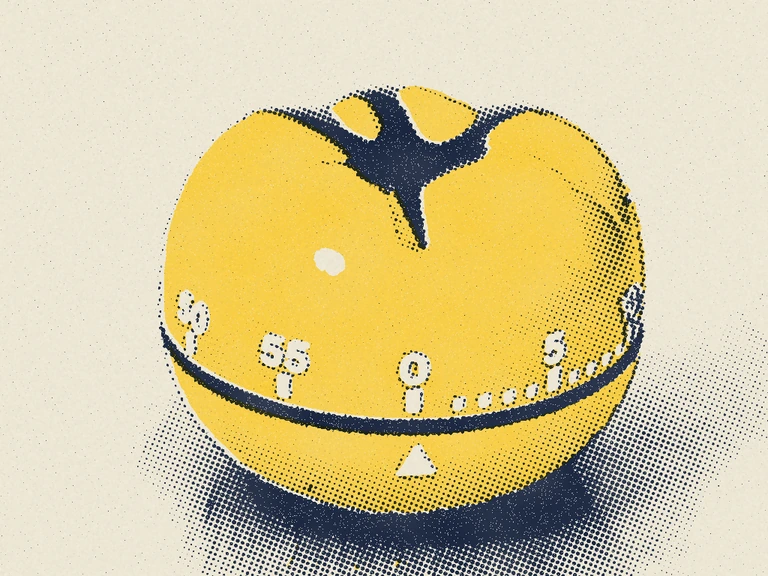
Why is it called Pomodoro? Francesco Cirillo started it in the late 1980s as a university student, using a tomato-shaped kitchen timer to hold himself to short stretches of focus. Pomodoro is Italian for tomato. The picture at the top of this page is our two-colour print of his photo of that kind of timer.
The 25-minute timer is the part everyone knows. Cirillo’s guide describes a whole system around it: a list of everything you need to do, a short list for today, a mark for every round you finish and every interruption you get, and a few minutes at the end of the day looking at what the marks say. The timer is maybe a third of it.
How does the Pomodoro technique work? (step by step)
- Choose one task and write it down. Cirillo uses two sheets of paper: an Activity Inventory with everything, and a To Do Today sheet with what you’ll actually work on today, in order. A notes app is fine. One task per round.
- Set the timer for 25 minutes. Or use the timer above.
- Work on that task and nothing else. If a thought pops up (“reply to Sam”, “is the dentist on Tuesday?”), write it on the list and go back. More on that below.
- When it rings, mark an X next to the task. The X is the record. It tells you how many rounds the task really took.
- Take a 3 to 5 minute break. Stand up. Don’t open the inbox.
- After four rounds, take 15 to 30 minutes off. Then start the next set.
If you finish the task with time left on the clock, keep going on the same task until it rings. Cirillo’s rule is “if a Pomodoro begins, it has to ring.” He suggests using the spare minutes to review what you did, make small fixes, and note what you learned (2006 guide, section 2.1.3).
The rules most Pomodoro guides leave out
These are from Cirillo’s own rules list at the back of his 2006 guide:
- A Pomodoro is indivisible. There’s no such thing as half a round. If you stop to deal with something, the round doesn’t count and you start a new one after a short break.
- If it takes more than 5 to 7 Pomodoros, break it down. “Write the report” becomes “outline”, “draft section 1”, and so on. Smaller tasks are easier to estimate and easier to start.
- If it takes less than one Pomodoro, add it up. Three tiny tasks (book the dentist, pay the parking fine, reply to the landlord) share one round instead of each getting their own.
- The next Pomodoro will go better. A ruined round isn’t a ruined day. Void it and wind the timer again.
The breaking-down rule is the same idea as turning a brain dump into tasks you can actually start.
What do you do when a Pomodoro gets interrupted?
This is the part of the method that does the most work, and the part most timer apps don’t mention. Cirillo splits interruptions into two kinds.
Internal interruptions are the ones you start yourself. The sudden need to check email, look something up or get a snack. His fix: put an apostrophe (’) on your sheet, write the urge on your list (under “unplanned and urgent” if it really can’t wait), and keep working until the ring (section 2.2.1).
The point is to notice the urge without obeying it. Plenty of what felt urgent at minute 12 looks optional by the end of the round, and some of it you’ll just cross off.
External interruptions come from other people. A coworker at your desk, a call, a notification. Cirillo’s rule is inform, negotiate, call back: say you’re in the middle of something, agree on when you’ll get back to them, write that down with a dash (-) on your sheet, then actually get back to them when you said you would (section 2.2.3).
He writes that true emergencies are rare and that a 25-minute or two-hour delay almost always works. Today that mostly means notifications off and the phone face down before you press start. He said the same about email in 2006: turn off the sound for new messages.
If you have to stop, void the round. A real emergency happens, or you give in. Don’t count the round, take a short break, start fresh.
If you can’t get through a single round, Cirillo’s suggestion is to keep the 25-minute timer and try to beat your last unbroken stretch: 10 minutes without an interruption this round, 11 the next (section 3.8). If even that is hard, start with a much shorter timer. That’s the 10-minute timer trick from the task paralysis guide.
Why does the Pomodoro technique work? (what the research says)
Less research exists than the number of Pomodoro apps suggests, and it doesn’t all agree.
The direct tests are small and mixed. Three experiments with Dutch university students compared fixed breaks with breaks taken whenever the student wanted. In the first, with 87 students, fixed breaks left people less tired and distracted, and both groups got the same amount done (Biwer et al., 2023). In the second, with 94 students, the groups came out about even (Smits et al., 2025). In the third, with 176, the free-break group reported more energy and focus, with the same test scores (Göksu et al., 2026).
The big positive review is thinner than it sounds. A 2025 scoping review counted 32 studies, said 88% reported positive outcomes, and concluded that structured Pomodoro breaks improved focus and reduced fatigue (Ogut, 2025). But only three of the 32 were randomized trials, and the randomized results it reports add up to 87 students. Most of the rest were observational.
Short breaks help how you feel more than how you score. A meta-analysis of 22 samples (2,335 people) found that breaks of 10 minutes or less gave a small boost in energy and a small drop in fatigue. The overall effect on performance was too small to rule out chance (Albulescu et al., 2022).
The “breaks reset your attention” theory is contested. In a 2011 lab study, people who briefly switched to another task during a long, dull watching task didn’t show the usual drop in accuracy, and the authors argued that briefly letting go of the goal and coming back to it keeps it from fading (Ariga & Lleras, 2011). A larger follow-up with 498 people found brief switches didn’t prevent the drop at all (Helton & Russell, 2012).
So what’s left? This next part is our opinion, since no study has tested it: the timer helps most with starting and stopping. Agreeing to 25 minutes is easier than agreeing to “the report”, the ring gives you a clean place to stop before you burn out, and the X marks show what a task really costs. How that plays out for studying is further down.
Is 25 minutes the right length? (25/5 vs 50/10)
Cirillo didn’t treat 25 as fixed. His 2006 guide calls 20 to 35 minutes ideal and 40 the most, and says the teams he mentored tried an hour, two hours, 45 minutes and 10 before most of them settled on 30 (section 3.2).
The timer above has 25/5 and 50/10 because those are the two people search for. A quick way to pick:
| Setting | Work | Short break | Long break (after 4 rounds) | Good for |
|---|---|---|---|---|
| 25/5 | 25 min | 5 min | 15 min | Reading, email, flashcards, anything you can put down and pick up |
| 50/10 | 50 min | 10 min | 30 min | Writing, code and problem sets, where the first 10 minutes go to loading the problem back into your head |
Go shorter if you can’t start at all. A 10-minute round is still a round. Going longer for exam prep? Our study timer has a 90/20 setting as well as these two.
The research on Pomodoro length (and the 52/17 rule)
No study we could find has tested 25/5 against 50/10. The three student experiments above each pitted fixed breaks against breaks whenever. Here’s what comes closest.
Halving the round didn’t change how much got done. In Biwer et al. (2023), students on 24 and 6 and students on 12 and 3 finished about the same amount of work, and both fixed groups felt less tired and distracted than the choose-your-own group. Having a schedule mattered more than which numbers it used.
Longer breaks did more for performance. In the 2022 break meta-analysis, performance gains grew with break length, and every break in it was 10 minutes or less (Albulescu et al., 2022). That’s the best argument for 50/10 on heavy work: the 10-minute break has more room to do something.
The 52/17 rule comes from app data, not an experiment. In 2014, the time-tracking company DeskTime looked at the top 10% of its users by its own productivity score over one workday and found they averaged 52 minutes on and 17 off. Its reruns keep moving (80/17 before the pandemic, 112/26 in 2021, 75/33 in 2024), which describes how one app’s top users worked that year, not a rhythm that made them productive.
How to pick yours (our suggestion, built from the above, not a tested protocol):
- Can’t start? 10 to 15 minutes. The round’s only job is getting you in, and you can keep going once you’re there.
- Reading, email, flashcards: 25 and 5. The default is fine for work you can put down and pick back up.
- Problem sets, writing, code: 50 and 10. Long enough to load the problem, with a break long enough to count.
- Every two hours or so, a real break. That’s about four short rounds or two long ones. Take 15 to 30 minutes away from the screen.
Then run one length for a week before you switch. Swapping timers every day is the planning becoming the procrastination all over again.
Flowtime vs Pomodoro (does the timer break your flow?)
The timer rings at 25 just as the sentence finally comes out right. Somewhere, a study video is promising a version of this with no bell at all.
That version is the Flowtime technique. It went up on Medium in August 2016 from a writer going by Urgent Pigeon (usually credited as Zoë Read-Bivens), as part two of a series called “Abandoning Pomodoros.” The rules fit on a sticky note:
- Pick one task with an end in sight. One task at a time is the only rule the post calls hard and fast.
- Write down the start time. No timer for the work.
- Stop when you need a break. Attention slipping, mentally tired, frustrated: any of those counts. Write down the stop time.
- Size the break to the work. The post suggests about 5 minutes after under 25 minutes of work, 8 after 25 to 50, 10 after 50 to 90, and 15 after that. It also says those aren’t rules. The break is the only part with a timer.
Flowmodoro is the same idea in study videos and apps, with the break set to a fifth of the time you worked.
Does Flowtime beat Pomodoro? Not in the one experiment that tested it by name. Smits, Wenzel and de Bruin (2025) gave 94 students two hours of study with Pomodoro, breaks whenever, or Flowtime (breaks capped at 10 minutes).
Flowtime students took about three breaks to Pomodoro’s four. Motivation slid faster with both than with breaks whenever, but by the end the three groups didn’t differ on fatigue, motivation, productivity, task completion or flow.
Does the Pomodoro timer break flow? It’s the most common complaint, and plenty of fixed-break students in Göksu et al. (2026) made it. But in Smits et al., flow was about the same and middling in all three groups (around 4 of 7). The authors’ guess is that coursework is often harder than students’ skill, so the bell isn’t the only thing between you and flow. The task is too.
The ADHD catch. Flowtime runs on step 3, noticing that you need a break. Hyperfocus is the state where that signal goes quiet, and it isn’t the same thing as flow. “Stop when you’re tired” can turn into stopping at 4 pm with no lunch.
Nobody has tested Flowtime in people with ADHD, so this is our suggestion, not a tested protocol:
- Pomodoro to start, Flowtime once you’re in. Let a short timer get you going. If you’re rolling when it rings, write down the time and keep going without a countdown. It’s the write-the-next-step rule above, plus a log.
- Give Flowtime a ceiling. Set one alarm for the longest you’re willing to go, say 90 minutes, or for whatever is next on the calendar. That’s the exit you build before you go in.
- Keep the log even if you drop the method. A week of start and stop times shows how long you actually focus on each kind of work. That’s the number the planning fallacy says you’re bad at guessing.
How to plan a day in Pomodoros
This is the step Cirillo adds once the basics feel normal, and it’s the most useful thing in the method for anyone who’s always surprised by how long things take.
- Estimate in rounds, not hours. Next to each task on today’s list, draw one empty box for each round you think it needs. Whole rounds only, so 5 and a half becomes 6 (section 2.3).
- Count your available rounds. His sample day has eight. Don’t plan past that number (section 2.3.1).
- Fill in a box with an X each time the timer rings. If you run out of boxes, keep going and draw the extra ones in a different colour.
- At the end of the day, compare boxes with X’s. That gap is your estimating error, and it shrinks with practice. People routinely underestimate how long their own tasks take (the planning fallacy), which is why our time blocking guide adds 50% to every estimate. To check your gap in a few minutes instead of a few days, try the guess-then-time-it task check.
How many Pomodoros a day? Fewer than the study-with-me videos suggest. Cirillo calls one uninterrupted round on day one “an excellent result,” and says reaching 10 to 12 a day takes training (section 3.7). His example eight-hour day has 12 work rounds plus 2 for planning and admin (section 2.5.1).
The math fits a workday. At 25 and 5 with a long break after every four, one set takes a little over two hours, and an 8-hour day holds three full sets with time left for lunch.
He also says some teams start with “no more than 2-3 Pomodoros actually dedicated to work per day” because meetings, calls and email take the rest (section 2.2.4). If that’s you, give the admin its own rounds instead of letting it leak into every one.
Our suggestion, again not a tested protocol: plan one set of four on the hardest thing, count only uninterrupted rounds, and add a second set once four feels normal for a week. On a tired day, Cirillo’s fix is shorter sets of three with longer breaks.
Learning the method takes from 7 to 20 days of daily use, by his count (section 3.1).
How to use the Pomodoro technique for studying and for work
For studying, Cirillo suggests spending the first 3 to 5 minutes of a round repeating what you’ve learned so far, and the last 3 to 5 reviewing what you just did (section 2.4.1). That’s close to retrieval practice, one of the two study methods with the best evidence.
Our version: close the book for the last 5 minutes and write what you remember on a blank page, then check. Spread the rounds for one subject over several days. How to study with ADHD has an exam schedule to copy, and it works the same without ADHD. If the rounds keep getting hijacked by your phone or your laptop, our guide on how to focus on studying without getting distracted covers the setup around the timer.
For work, the interruption rules matter more than the timer. Block out one round a day for email and calls, as Cirillo suggests for “organizational” work, and push the “quick question” pings into it.
On a calendar, a Pomodoro set fits inside a time block. A 90-minute block holds three 25-minute rounds with breaks. That’s covered in time blocking vs Pomodoro.
When do people go looking for this? In our analysis of ten years of Wikipedia views, the Pomodoro Technique article gets 48% more readers on a typical Tuesday than on a Saturday, and 47% more in January than in July, a pattern that looks a lot like the school year.
Is the Pomodoro technique effective for studying? (and why it works when it does)
For studying, the timer changes how the hour feels more than how much you learn. Göksu and colleagues (2026), the only one of the three studies that tested learning directly, found fixed-break and free-break groups scored the same on the reading test.
What you do inside the round matters more. A big 2013 review of ten popular study techniques gave its top rating to just two, practice testing and spreading study out across separate sessions (researchers call that distributed practice). Rereading and highlighting, the two most students say they lean on, landed in the bottom tier (Dunlosky et al., 2013). So four Pomodoros on one chapter in one evening is still cramming, just with snack breaks.
The break research above says short breaks lift energy more than scores, and performance clearly improved only after clerical and creative work, not mentally demanding tasks like most studying (Albulescu et al., 2022).
Why it doesn’t work for some people:
- The ring lands mid-thought. The fix is the write-the-next-step rule above.
- The round is too short for the material. Try 50 and 10 for proofs and problem sets, and keep 25 and 5 for flashcards and reading.
- The round is all rereading. The timer can’t rescue a technique that doesn’t work.
A study round that pulls its weight (our suggestion, built from the studies above, not a tested protocol):
- About 20 minutes from the material. Read, work problems, make the cards.
- The last 5 minutes from memory. Close everything and do blank-page recall on what you just covered, then check what you missed.
- A break away from the screen. Water, window, stairs.
- The next round on that chapter goes on a different day. Put it in the weekly planner so the spacing actually happens.
How far apart those days should be, and a plan for an exam 1 day to 1 month away, is in how to study with ADHD.
What to do on a Pomodoro break
Cirillo’s own list for the short break is very low-tech: stand up and walk around the room, have a drink of water, daydream about your next vacation, breathe slowly or stretch, or trade a joke with whoever’s nearby (2006 guide, section 2.1.1).
Nothing on it takes real thinking. Work talk, important emails, urgent calls and replaying the round you just finished go on your task list and get a Pomodoro of their own.
Pomodoro break ideas for 5 minutes:
- Walk somewhere. Another room, the far bathroom, the mailbox. Moving is the first thing on Cirillo’s list.
- Refill your water. Cheap, physical, and it has a built-in ending.
- Stretch whatever has been hunched. In the 2022 break meta-analysis, studies with stretching and exercise breaks were linked with less fatigue (Albulescu et al., 2022).
- Look at something green. In one experiment, 150 students who looked at a photo of a flowering green roof for 40 seconds made fewer attention slips afterward than students shown a concrete roof (Lee et al., 2015).
- Do nothing on purpose. Sit, breathe, stare. It’s allowed, and it’s the original advice.
What to do on a long Pomodoro break (15 to 30 minutes): this is where Cirillo puts the slightly bigger stuff. Tidy your desk, get a coffee, listen to voicemail, check email, take a quick walk, or rest (section 2.1.2). Still nothing complex.
Set a timer for the long break too (section 3.3).
What not to do on a Pomodoro break: start a new task, open the work chat, or open a feed. The 2022 meta-analysis couldn’t say which activity works best, only that “any type of decoupling activity” helped (Albulescu et al., 2022). A phone break might not count: in a 2019 experiment with 414 students, people who spent the break on a phone were as slow afterward as people who took no break, and that break was a shopping list, not a feed (Kang & Kurtzberg, 2019).
With ADHD, our suggestion (not a tested protocol): pick the break before the round starts and write it on a sticky note by the timer. If breaks keep turning into forty minutes, put the break timer across the room so getting up to stop it ends the break.
What to do instead of the feed is in what to do instead of doomscrolling.
Does the Pomodoro technique work for ADHD?
Nobody has checked. None of the PubMed papers that mention Pomodoro include people with ADHD, and the three student experiments above don’t agree with each other: fixed breaks came out ahead in one, it was a tie in the second, and free breaks came out ahead in the third.
What follows is our reasoning for ADHD brains, not a tested protocol:
- Use it to get started. If starting is the hard part, set it for 10 minutes (or Cirillo’s original two) and actually let yourself quit when it rings. That’s the 10-minute timer trick from the task paralysis guide wearing a tomato costume.
- If it rings mid-flow, write the next step and keep going. Cirillo’s rule is to stop at the ring, and we’d bend it here. With ADHD, getting into focus is usually the expensive part, and you’ve already paid for it. Jot the next line so you can get back in, then put a hard alarm on anything with a real deadline, like school pickup, so a good hour doesn’t eat the whole afternoon.
- Make the break boring. Asked what to do on a break, Cirillo says: nothing. Five minutes on a feed is how one round turns into zero, and a phone break may barely count as a break. Refill your water, look out a window, come back. More Pomodoro break ideas below.
- Change the length without guilt. The three studies used three different schedules and none of them won outright. Try 25 and 5 for a week. If minute four keeps sending you to your phone, go shorter. If the ring keeps landing mid-sentence, try 50 and 10. More on picking a Pomodoro length below.
If the quiet inside a round is what sends you wandering, steady noise is worth a one-week test. Here’s how to test brown noise for ADHD focus, and the free player in that guide has a 25-minute timer.
Why doesn’t Pomodoro work for ADHD? (and Pomodoro alternatives)
Nobody has studied why, because nobody has tested Pomodoro on people with ADHD at all (see above). So this is our reading of where it breaks, not a finding:
The timer becomes the thing you watch. A countdown on screen is a tiny break your brain can take any time it wants. Checking it at minute four is still checking. Fix: hide the numbers. Use a timer that only rings, turn the phone face down, or put a kitchen timer across the room.
The ring breaks focus you paid a lot to get. In the Göksu study, plenty of fixed-break students said the timer kept breaking their flow. With ADHD, getting in is the expensive part. Fix: the write-the-next-step rule above, or Flowtime.
The break doesn’t end. Five minutes has no natural ending, and time blindness loves a gap with no ending. Fix: a break with a built-in finish, like refilling your water, and a timer on the break too.
Starting was the problem, not staying. A round asks you to sign up for 25 minutes before you’ve done a single thing. If you can’t start, the timer just sits there. Fix: a shorter first round (see below).
25 is the wrong size for you. Cirillo didn’t think 25 was sacred either. Here’s how to pick a Pomodoro length.
Pomodoro alternatives for ADHD (our picks; none has been tested against Pomodoro in ADHD):
- Flowtime. Work until focus fades, then take a break that scales with the stretch. Good if the ring is your problem. Flowtime vs Pomodoro.
- A 10-minute start timer. Good if starting is your problem. It’s the 10-minute timer trick, and you’re allowed to quit when it rings.
- Body doubling. Someone else working nearby, in person or on a call. Good if the quiet is your problem. Here’s whether body doubling works for ADHD.
- One timebox for the whole task. “Inbox, 30 minutes, then stop,” with no rounds inside. Good if the rounds feel like admin. Timeboxing vs Pomodoro.
Pick one, use it on the same kind of task for a week, and keep the one you actually started with most often.
Two settings on the timer at the top of this page came out of this list: hide the countdown, and keep the chime on so the end of a break actually announces itself.
Common Pomodoro mistakes (and why it stops working)
Using it for fun. Cirillo says not to use it for anything you do in your free time, like reading for pleasure, because a timer turns it into a goal (section 3.15).
Cutting the long break short because you’re behind. He calls shortening breaks under pressure “a serious mistake” (section 3.3). The same goes for “I’ll just work late tonight to catch up.” He calls it the Five More Minutes Syndrome, and says it lowers results the next day and the day after (section 2.5).
Treating the ring as a deadline to rush. If every tick sounds like “am I going fast enough?”, Cirillo’s fix is to stop judging the speed and just record the X’s for a while (section 3.7). The point is to see how you work, and speed comes later.
Letting the break run. Breaks that keep running past 30 minutes risk breaking the rhythm, he warns. Set a timer for the break too, which the timer above does on its own.
Switching timers instead of starting. Four apps, two extensions, no rounds done. Pick one and use it for a week. If the timer isn’t the problem and you keep putting the work off anyway, try our 5-minute unstick script first.
Sources
- Cirillo, F. (2006). The Pomodoro Technique (paper, version 1.3). Sections cited: 2.1.1 (short-break activities and what to avoid), 2.1.3 (“If a Pomodoro begins, it has to ring”; reviewing until the ring), 2.2.1 (internal interruptions, the apostrophe mark), 2.2.3 (external interruptions; inform, negotiate, call back; the dash mark; true emergencies are rare), 2.2.4 (“no more than 2-3 Pomodoros actually dedicated to work per day” in some teams; one round a day for organizational work), 2.3 and 2.3.1 (estimating in whole Pomodoros; break down above 5 to 7, add up below 1; a sample day with eight available Pomodoros), 2.4.1 (first and last 3 to 5 minutes for repetition and review), 2.5 (the Five More Minutes Syndrome), 2.5.1 (8-hour day: 12 operational plus 2 organizational Pomodoros), 3.1 (7 to 20 days to master), 3.2 (ideal length 20 to 35 minutes, 40 at most; teams settled on 30), 3.3 (breaks of 3 to 5 and 15 to 30 minutes; breaks over 30 minutes break the rhythm; shortening breaks under pressure is “a serious mistake”), 3.5.2 (quiet timers for shared rooms), 3.7 (one uninterrupted Pomodoro “an excellent result”; 10 to 12 a day takes training), 3.8 (constant internal interruptions), 3.10 (kitchen timer requirements), 3.15 (not for free time), Appendix 1 (rules).
- Cirillo, F. (2018). The Pomodoro Technique: The Acclaimed Time-Management System That Has Transformed How We Work. Currency. The book version of the method.
- Cirillo, F. The Pomodoro Technique. pomodorotechnique.com, checked October 2026. Started in the 1980s as a university student, challenging himself to focus for a short period with a tomato-shaped kitchen timer; Activity Inventory and To Do Today sheets.
- Biwer, F., Wiradhany, W., oude Egbrink, M. G. A., & de Bruin, A. B. H. (2023). Understanding effort regulation: Comparing ‘Pomodoro’ breaks and self-regulated breaks. British Journal of Educational Psychology, 93(S2), 353-367. https://doi.org/10.1111/bjep.12593. 87 students, one day of self-study; 24/6 and 12/3 fixed breaks vs self-regulated.
- Smits, E. J. C., Wenzel, N., & de Bruin, A. (2025). Investigating the effectiveness of self-regulated, Pomodoro, and Flowtime break-taking techniques among students. Behavioral Sciences, 15(7), 861. https://doi.org/10.3390/bs15070861. 94 students, 2-hour session; no group differences in overall fatigue, motivation, productivity, task completion or flow.
- Göksu, A., Wiradhany, W., & de Bruin, A. B. H. (2026). When to take a break: Comparing effects of systematic short (Pomodoro) and self-regulated breaks on subjective experience and actual learning. Behavioral Sciences, 16(7), 1158. https://doi.org/10.3390/bs16071158. 176 students, same reading task, 12/3 schedule.
- Ogut, E. (2025). Assessing the efficacy of the Pomodoro technique in enhancing anatomy lesson retention during study sessions: A scoping review. BMC Medical Education, 25, 1440. https://doi.org/10.1186/s12909-025-08001-0. 32 studies (N = 5,270): 3 randomized trials (n = 87), 5 quasi-experimental, 24 observational or comparative; 88% reported positive outcomes; none in anatomy courses.
- Albulescu, P., Macsinga, I., Rusu, A., Sulea, C., Bodnaru, A., & Tulbure, B. T. (2022). “Give me a break!” A systematic review and meta-analysis on the efficacy of micro-breaks for increasing well-being and performance. PLoS ONE, 17(8), e0272460. https://doi.org/10.1371/journal.pone.0272460. 22 samples, N = 2,335; breaks of 10 minutes or less: vigor d = .36, fatigue d = .35, overall performance d = .16 (not significant).
- Ariga, A., & Lleras, A. (2011). Brief and rare mental “breaks” keep you focused: Deactivation and reactivation of task goals preempt vigilance decrements. Cognition, 118(3), 439-443. https://doi.org/10.1016/j.cognition.2010.12.007.
- Helton, W. S., & Russell, P. N. (2012). Brief mental breaks and content-free cues may not keep you focused. Experimental Brain Research, 219(1), 37-46. https://doi.org/10.1007/s00221-012-3065-0. 498 participants; brief task switches did not prevent the vigilance decrement.
- Urgent Pigeon [usually credited as Zoë Read-Bivens] (2016, August 17). The Flowtime technique (Abandoning Pomodoros part 2). Medium (medium.com/@UrgentPigeon/the-flowtime-technique-7685101bd191). Unitasking as the one hard rule; record start and stop; break when attention slips, tired or frustrated; suggested breaks 5 / 8 / 10 / 15 minutes for under 25 / 25 to 50 / 50 to 90 / over 90 minutes of work, “aren’t rules.”
- DeskTime. Does the 52-17 rule really hold up? DeskTime Blog (desktime.com/blog/52-17-updated/), checked October 2026. 2014 analysis of the top 10% of users by DeskTime’s productivity rating over one workday (52/17); rerun at 80/17 (February 2020) and 112/26 (2021).
- Strelca, A. (2025, May 26). Post-pandemic productivity: Study reveals employees now have a more balanced work-break ratio. DeskTime Blog (desktime.com/blog/post-pandemic-productivity/). Top 10% of users (about 6,000 people), January to December 2024 data: 75/33.
- Dunlosky, J., Rawson, K. A., Marsh, E. J., Nathan, M. J., & Willingham, D. T. (2013). Improving students’ learning with effective learning techniques: Promising directions from cognitive and educational psychology. Psychological Science in the Public Interest, 14(1), 4-58. doi:10.1177/1529100612453266. Ten techniques; high utility: practice testing, distributed practice; low utility: summarization, highlighting, keyword mnemonic, imagery for text, rereading.
- Lee, K. E., Williams, K. J. H., Sargent, L. D., Williams, N. S. G., & Johnson, K. A. (2015). 40-second green roof views sustain attention: The role of micro-breaks in attention restoration. Journal of Environmental Psychology, 42, 182-189. doi:10.1016/j.jenvp.2015.04.003. 150 university students; a 40-second view of a flowering meadow green roof image vs a concrete roof; fewer omission errors and steadier responding after the green view.
- Kang, S., & Kurtzberg, T. R. (2019). Reach for your cell phone at your own risk: The cognitive costs of media choice for breaks. Journal of Behavioral Addictions, 8(3), 395-403. doi:10.1556/2006.8.2019.21. 414 participants, anagram task; phone breaks as slow as no break on the second half and fewer anagrams solved than paper or computer breaks.
- Picture: our two-colour print adapted from Francesco Cirillo’s photo of a Pomodoro kitchen timer (“Il pomodoro.jpg”, Wikimedia Commons, uploaded via Italian Wikinews by Erato), licensed CC BY-SA 3.0 (creativecommons.org/licenses/by-sa/3.0/). The adaptation is shared under the same licence.
Want one more of these each week?
One email a week, short enough to read on a 5-minute break. One technique a week, the study behind it, and a low-energy version. Free, about a 3-minute read, unsubscribe anytime.
We use your address only to send the email, and you can unsubscribe in one click.
FAQ
What is the Pomodoro technique?
A way of working in timed rounds. You pick one task, set a timer for 25 minutes, work on only that task until it rings, mark an X on paper, and take a 3 to 5 minute break. After four rounds you take a longer break of 15 to 30 minutes. Francesco Cirillo came up with it as a university student in the late 1980s and named it after his tomato-shaped kitchen timer. Pomodoro is Italian for tomato.
How does the Pomodoro technique work, step by step?
1. Write down the one task for this round. 2. Set the timer for 25 minutes. 3. Work on that task only. If something else comes to mind, write it down and keep going. 4. When it rings, mark an X next to the task. 5. Take a 3 to 5 minute break away from the work. 6. After every four rounds, take a 15 to 30 minute break. Cirillo's own guide adds two rules most summaries drop: a round that gets interrupted doesn't count, and a round that has started has to finish.
What happens if I get interrupted during a Pomodoro?
If the interruption is your own urge (check email, look something up), Cirillo says to mark an apostrophe on your sheet, write the urge down, and keep working. If it's another person, tell them you're busy, agree on when you'll get back to them, write that down, and call them back as promised. He calls that inform, negotiate, call back. If you have to stop for real, the round is void. Don't count it, take a short break and start a fresh one.
Is the Pomodoro technique scientifically proven?
Not in the way the internet suggests. The few experiments, mostly with university students, found that fixed breaks felt better than breaks whenever in one study, made no difference in another, and felt worse than free breaks in a third, and none of them found students got more done or learned more. A 2025 review that counted 32 studies as mostly positive included only three randomized trials. The research on short breaks in general finds a small lift in energy and a small drop in fatigue, with no clear effect on performance.
Is 25 minutes the right length for a Pomodoro?
It's the classic length, not a magic one. Cirillo's own 2006 guide calls 20 to 35 minutes ideal and 40 the maximum, and says the teams he mentored usually ended up at 30. No study has compared 25/5 with 50/10 head to head. Use 25/5 for work you can put down and pick up, and try 50/10 for writing, code or problem sets that take a while to load into your head.
How many Pomodoros should I do in a day?
Fewer than you think at first. Cirillo calls one uninterrupted Pomodoro on your first day an excellent result, and says it takes practice to reach 10 to 12 a day. His example eight-hour day has 12 work rounds plus 2 for planning and admin. Start with one set of four on your hardest task.
What should I do on a Pomodoro break?
Something that takes no thinking: stand up, walk around, get water, stretch, look out the window. Cirillo's guide says to skip work talk, important emails and urgent calls during a short break, and to stop thinking about the round you just did. The phone is the classic way a 5-minute break becomes 25.
What is the best Pomodoro timer?
One you'll actually start. Cirillo still prefers a wind-up kitchen timer because winding it is a small decision to begin, it shows the time left, and it rings without opening an app. A browser timer, like the free one on this page, is the next best thing if your work is on a screen anyway. Turn on the chime so you don't have to watch it.
Does the Pomodoro technique work for ADHD?
Nobody has tested it on people with ADHD, so no study can say. The common failure points are a countdown that becomes something to check, a ring that breaks focus that was hard to get, and a break with no ending. This guide covers fixes and alternatives, like a 10-minute start timer, body doubling and Flowtime.
Why doesn't Pomodoro work for ADHD?
Nobody has tested Pomodoro on people with ADHD, so no study can say. Our reading is that it breaks in a few predictable places: the countdown turns into something to check, the ring cuts off focus that took a long time to build (plenty of students in a 2026 fixed-break study complained about exactly that), the five-minute break has no natural end, or the real problem was starting, not staying. Each has a fix: hide the timer, write the next step and keep going, give the break a built-in finish, or start with 10 minutes instead of 25.
Flowtime vs Pomodoro: which is better?
Neither, in the one experiment that tested Flowtime by name. In Smits, Wenzel and de Bruin (2025), 94 students studied for two hours with 25 and 5 Pomodoros, breaks whenever, or Flowtime, where you work until focus fades and the break grows with how long you worked (5 minutes after under 25, 8 after 25 to 50, 10 after more). Motivation dropped faster with Pomodoro and Flowtime and fatigue rose faster with Pomodoro, but by the end fatigue, motivation, productivity, task completion and flow didn't differ. With ADHD, our suggestion is a short Pomodoro to get started, Flowtime once you're rolling, and one alarm as a ceiling, because hyperfocus can switch off the 'I need a break' signal Flowtime depends on.
What is the 52/17 rule?
It's a work rhythm of 52 minutes on and 17 minutes off. It comes from a 2014 analysis by the time-tracking company DeskTime of the top 10% of its users by its own productivity score over one workday, not from an experiment. DeskTime's later reruns found different numbers: 80/17 just before the pandemic, 112/26 in 2021 and 75/33 in its 2024 data. It describes how the top users of one app worked, not a schedule proven to make anyone more productive.
New here? Start with the reading order → Rather use paper? Grab a free printable.