
Short answer: to turn a brain dump into a to-do list, sort it in one pass. Do anything under 2 minutes now, put anything with a date on the calendar, shrink anything too big into its next step, pick 3 for today, and park the rest in a backlog. The first sort takes about 10 minutes, later ones about 3.
Your brain is a terrible to-do list. It remembers the wrong things at 2am, forgets the dentist, and replays “reply to that email” on loop without ever actually replying to the email.
The fix isn’t a fancier app. It’s a short, repeatable sort that turns the mess in your head into a short list you can act on. This takes about 10 minutes the first time and 3 minutes once it’s a habit. If you’ve ever done a brain dump, stared at the page of chaos, and closed the notebook, this is the missing step: what to do with the dump once it exists.
What is a brain dump, and does it actually help?
A brain dump is what it sounds like. You set a timer and write down everything rattling around in your head on one page: tasks, worries, errands, the half-idea you had in the shower. You don’t sort it, and you don’t explore any of it the way you might in a journal. Each thing gets one line and you move on. Sorting comes after, and that’s what the rest of this guide is for.
Nobody has run a trial on “the brain dump” as a named technique. There is research on the pieces, though, and two findings make the case:
- Unfinished tasks nag you until you make a plan. In 2011, psychologists E.J. Masicampo and Roy Baumeister found that unfinished goals kept intruding on people’s thoughts, but simply making a specific plan for them made that interference drop. You don’t have to finish the thing to quiet it. You have to decide what happens to it.
- Writing a to-do list can help you fall asleep. A 2018 sleep-lab study led by Michael Scullin found that people who spent five minutes writing a to-do list before bed fell asleep faster than people who wrote about tasks they’d already completed. The more specific the list, the faster they fell asleep.
With ADHD, working memory is often already maxed out, so every open loop you carry around in your head costs more. Getting it onto paper (or a notes app) frees up room for actually doing stuff.
What is a brain dump for students?
Students run into the word in two places, and they’re different exercises.
The study version is retrieval practice. Teachers use “brain dump” for free recall: close the book and write down everything you can remember about a topic. Cognitive scientist Pooja Agarwal, who runs retrievalpractice.org, describes it as a few silent minutes, ungraded, with bullet points or messy concept maps allowed. In class, a timer on the projector keeps those minutes visible to everyone.
The research behind this one is solid. In Roediger and Karpicke’s 2006 experiments, students read a short prose passage and then either took free-recall tests on it or reread it. Rereading won on a test five minutes later. Two days and a week later, the recall group remembered more, even though rereading had made students more confident they’d remember.
So for exam prep, dump with the book shut, then open it and fill the gaps in a different color. The gaps are your study list. If your phone keeps winning the study session, the phone guide shows how to lock your phone to one study app.
The pre-exam worry dump is shakier. A widely shared 2011 Science paper by Gerardo Ramirez and Sian Beilock found that students who spent 10 minutes writing about their worries right before a high-stakes test scored better, especially the ones who usually got anxious about tests. In 2018, Colin Camerer and colleagues re-ran 21 experiments from Nature and Science, this one included, and it was among the 8 that didn’t replicate. Ten minutes of writing out your nerves is cheap, so keep it if it settles you. Just don’t count on it for points the way you can count on the retrieval version.
How to organize a brain dump, step by step
1. Dump everything (5 minutes)
Set a timer. Write down every task, worry, errand, and “I should really…” in one list. Don’t sort, don’t judge, don’t fix the spelling. Big and small go together: “renew passport” sits right next to “buy oat milk.”
If your mind goes blank the second the timer starts, that’s normal. The prompts below will shake things loose. If you’d rather dump on paper, the free brain dump worksheet further down has them printed in the margin.
Brain dump prompts (for when your mind goes blank)
Ten minutes ago your head was yelling at you. Now the timer’s running and it has nothing to say. Your list didn’t get shorter. Nothing has pointed at the stuff yet.
There’s a classic memory experiment on exactly this. In 1966, Endel Tulving and Zena Pearlstone had 929 Toronto high school students listen to word lists sorted into categories (“weapons: bomb, cannon”), then write down every word they could remember. Half got a blank sheet. The other half got a sheet with the category names printed on it.
The category group recalled more on all nine lists. On the longest one, 48 words from 48 different categories, they recalled 126% more. And when the blank-sheet group got the category names on a second try, they remembered words they had “forgotten” a few minutes earlier. The words were still in there. They needed a hook.
A prompt list is that hook for your to-do list. (The study used word lists, so applying it to life admin is our extrapolation.)
The famous version is David Allen’s Incompletion Trigger List from Getting Things Done, the sheet for what he calls a mind sweep. It’s two pages of categories, one for work and one for the rest of your life, all under the question “What has your attention?” It’s thorough, and it still lists faxes.
Here’s a shorter one for people whose open loops live in group chats:
- Work/school: What did I promise someone? Which emails am I avoiding? What’s due in the next two weeks?
- Home: What’s broken, running out, or needs to go back to the store?
- Money: Any bills, subscriptions to cancel, or that refund I never chased?
- People: Who do I owe a reply? Any birthdays or plans coming up?
- Body: Appointments, prescriptions, the doctor I keep meaning to call?
- Digital: Passwords, backups, the 4,000 unread notifications, the photos eating my storage?
- Waiting on: Packages, replies, someone else’s decision? (These get their own spot in step 6.)
- The vague stuff: What’s been bugging me that isn’t a task yet? “Is the car making a noise?” counts. Write it as a question and sort it later.
Morning version (2 minutes): What has a time attached today? What’s the one thing that would make today feel handled? What am I already dreading?
End-of-workday version: What did I leave half done? What did I say I’d do in a meeting? What’s the first thing I need tomorrow morning?
If you have ADHD, treat the headings as a quick scan. Read one, write whatever pops up, and move on after about 20 seconds even if nothing does. If a heading starts a spiral, write one line and keep going. (The 20 seconds is our rule of thumb.)
Looking for brain dump journal prompts? This list is built for getting tasks out of your head. If it’s worries keeping you up, the bedtime version below gives each one a next step.
2. Under 2 minutes? Do it now.
This is David Allen’s two-minute rule from Getting Things Done: if a task takes less time to do than it would take to track, just do it. Reply “yes, works for me.” Pay the bill. Put the form in your bag.
Guardrail: do the 2-minute tasks after the dump, not during it. Otherwise “quickly reply to one text” turns into 40 minutes in the group chat and the list never gets finished. And cap it: if you’ve got 20 tiny tasks, do 5 now and batch the rest into one admin block.
The other two-minute rule: David Allen vs James Clear (Atomic Habits)
If you searched “two-minute rule” and found a totally different rule, you’re not imagining it. There are two, and they do different jobs.
- David Allen’s, from Getting Things Done: “If it takes less than two minutes, then do it now.” It’s a sorting rule. It decides whether a task gets tracked or just gets done.
- James Clear’s, from Atomic Habits (chapter 13): “When you start a new habit, it should take less than two minutes to do.” It’s a starting rule. “Read before bed” becomes “read one page.” “Fold the laundry” becomes “fold one pair of socks.” Clear credits Allen’s version in a footnote, so it’s a remix, not a rivalry.
Allen’s rule lives right here in step 2. Clear’s belongs in step 4: it’s “shrink it” pushed until it feels a little silly, which is the same move as shrinking past dignity for a task you hate.
With ADHD, both versions share one trap. Allen’s can eat a whole afternoon if every tiny task “only takes a sec,” which is why the cap above exists. Clear’s only works if you’re honestly allowed to stop after the one page. If the two minutes is secretly a trick to make yourself do forty, your brain catches on fast and stops falling for it. (That last bit is our read, not a study.)
On the habit side, the best real-world data is slower than the internet’s “21 days.” In a 2010 study by Phillippa Lally and colleagues, 96 volunteers picked one daily eating, drinking or activity habit tied to a cue like “after breakfast” and rated how automatic it felt for 12 weeks. The time to get close to their plateau ranged from 18 to 254 days, with a median of 66. The useful part: missing one day didn’t materially set anyone back. So the two-minute habit you skipped on Tuesday isn’t ruined. Read the one page on Wednesday.
3. Has a date? Calendar, not list.
Anything tied to a specific day or time (appointments, deadlines, “call before Friday”) goes on your calendar, with a reminder. Your to-do list is for things you could do any time. Mixing the two is how deadlines get buried under “organize closet.” If deadlines keep sneaking up on you anyway, set the reminder for when you need to start, not when it’s due (why that helps with time blindness). Not sure what earns a calendar slot? Here’s time blocking vs a to-do list.
4. Too big? Shrink it.
“Do taxes” isn’t a task, it’s a project wearing a task costume. Rewrite anything vague as the very next physical action: “find last year’s tax login,” “download the W-2.” If you can’t picture yourself doing it in one sitting, it needs shrinking.
5. Pick 3 for today.
Choose three things. Not twelve. A good mix: one that matters (moves something important forward), one that’s urgent (has consequences if skipped), and one easy win (to build momentum). Not sure which one is the one that matters? The most important task method is a whole guide on picking it.
If you finish all three, great, pick more. It feels way better to beat a short list than to fail a long one. If every item is screaming to be in the three, here is how to tell real urgency from loud urgency. For a whole week’s list, the Eisenhower matrix sorts it into four boxes first. On roomier days, try the Ivy Lee method (six tasks, ranked, done in order) or the 1-3-5 rule (one big, three medium, five small).
6. The rest is a backlog.
Everything else goes into a single “later” list. It’s not a list of failures. It’s a parking lot. Things will sit there. Some will quietly stop mattering, and that’s fine, deleting them is a valid outcome. If you’d rather see the next few tasks and what you’ve already started, a personal kanban board puts them in columns with a limit of three in progress.
Waiting-for items get their own mini-park. If a task is stuck because you’re waiting on a reply, a package, a review, or someone else’s decision, don’t leave it as a fake “to-do” that nags you all day. Write one line: waiting on X for Y, check Friday 2pm. That specific plan is often enough to quiet the open loop (same idea as Masicampo & Baumeister above). Mute the thread until the check time, then either follow up or rewrite the next action.
How to make a to-do list that works with ADHD
Most ADHD to-do lists die the same way. There’s one in Notes, one in the planner you bought in a burst of optimism, three sticky notes on the monitor, and a “remind me” text to yourself from last Tuesday. None of them is the real list, so you trust none of them, and the actual plan moves back into your head.
The steps above are our version of the fix, and they line up closely with what the best-tested adult ADHD therapy teaches. In a JAMA trial, 86 adults who were already on ADHD medication but still struggling got 12 sessions of either cognitive behavioral therapy or relaxation training with ADHD education (Safren et al., 2010).
The first four CBT sessions trained a calendar and task list system, plus breaking overwhelming tasks into steps. By the end, 67% of the CBT group counted as responders on the ADHD rating scale, against 33% with relaxation, and the gains held at 12 months.
That result is for the whole program, so it can’t tell you the list did the work by itself. The team behind it does call the calendar and task list “the foundation” for everything else in the treatment (Sprich et al., 2010). Their setup is pleasantly boring.
- One calendar, one list. Every appointment and deadline goes in the calendar. Every to-do goes in one task list. Paper, Notes, Todoist, a Google Doc, whatever. Nobody has tested one app against another here, so the best ADHD to-do list app is the one you’ll actually open.
- Look at it once a day, at a set time. The client in their demo picked “when she first arrives at work.” Hook it to something you already do, like the first coffee or opening the laptop.
- Rate the priorities. Their client kept doing low-priority stuff first and then noticing she’d missed something important. Rating items is their fix. Our version is step 5, the daily 3.
- Write steps, not projects. Overwhelming items get broken into smaller steps in the same module. That’s step 4 above.
The bit that’ll sound familiar is about what goes wrong. The therapists write that many clients “make a task list, but then never refer back to it,” and some find looking at it “upsetting and overwhelming” because it’s a reminder of everything at once. People see the whole pile, feel like they have to do all of it right now, and then avoid the important stuff entirely.
Their answer is a reframe. The list exists to show you “the possible ways they could spend their time,” and you get to choose. Not looking at it is worse, because then the forgotten deadlines show up on their own schedule. This is also why we hide the backlog. A list you’re scared to open does nothing for you.
An ADHD to-do list template you can copy
Put these headings at the top of one note or one notebook page and rewrite the today part every morning. Once the backlog exists, it takes about two minutes.
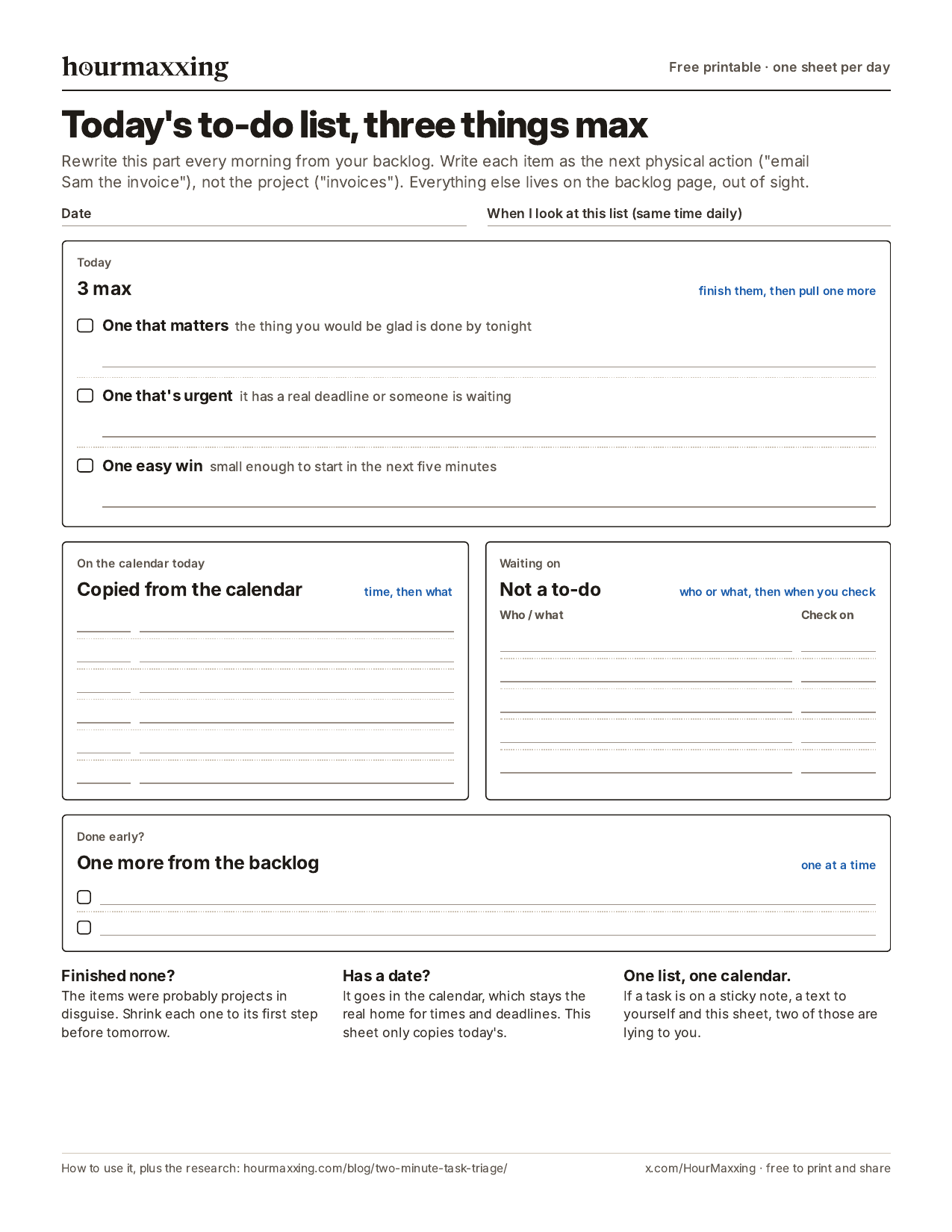
- Today (3 max): one that matters, one that’s urgent, one easy win. Each written as the next physical action.
- On the calendar today: a copy of today’s appointments and deadlines, so you see them next to the 3. The calendar stays the real home for anything with a date.
- Waiting on: who or what, plus when you’ll check. “Landlord, leak photo, check Thursday.”
- Backlog: everything else, on a separate page or a collapsed section so opening the list shows you 3 things and not 47. Scan it once a week.
If you finish the 3 early, pull one more from the backlog. If you finish none, the items were probably projects in disguise, so shrink them before tomorrow.
A free printable ADHD to-do list (PDF)
Prefer paper? Here’s the same template as a printable: download the ADHD to-do list (PDF). It’s free, and you don’t have to give us an email.
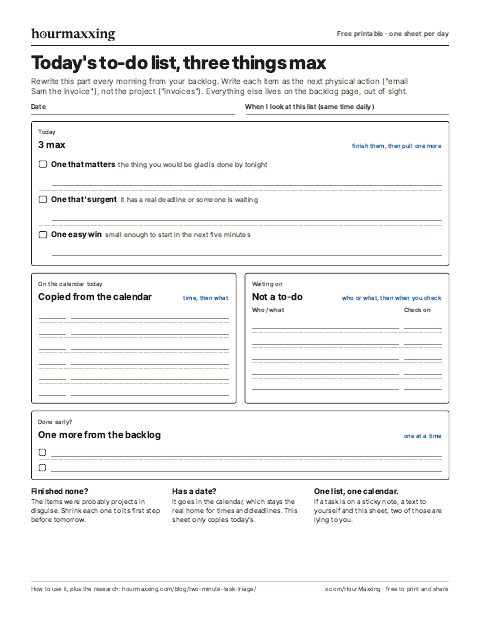
Page 1 is the daily sheet. Today’s 3 each get a labelled line (one that matters, one that’s urgent, one easy win), and there’s room to copy today’s calendar plus a waiting-on column with a check date. Want the hours laid out too? Pair it with the time-blocked ADHD daily planner.
Up top is a blank for when you’ll look at the list each day. That one comes straight from the CBT program above, where the therapist and client agree on a consistent daily time to check the list (“when she first arrives at work each day,” in Sprich et al., 2010).
Page 2 is the backlog. Print it once and keep it behind the daily sheet, so it stays out of sight until the weekly scan. Print page 1 as often as you need it. If you’d rather keep it on your phone, save the image of the daily sheet and write on it with the markup tool in your photos app.
If your head is too full to pick 3, do the brain dump worksheet first and copy its T lines onto this sheet.
How to do a brain dump before bed (with a template)
It’s 11:40pm. The lights are off, and your brain picks this exact moment to remember the library book, the email to your landlord, and something weird you said in a meeting in March. This is when a lot of people go looking for a brain dump, and the bedtime version works a little differently from the daytime sort above.
The research is unusually friendly here. In Scullin’s 2018 sleep-lab study, people who spent five minutes writing a specific to-do list before lights out fell asleep faster than people who wrote about what they had already finished, and the more specific the list, the faster they dropped off. A smaller study of college students with insomnia (Carney & Waters, 2006) had people write down their worries plus possible solutions for five nights. Their pre-sleep mental arousal went down compared with a group that only wrote out the worries. Harvey’s (2002) cognitive model of insomnia puts this exact in-bed worry loop near the middle of why people lie awake. So get it on paper, and staple a next step to every worry while you’re there.
The bedtime version is shorter and stricter:
- Do it sitting up, not under the covers. Kitchen table, desk, edge of the couch, in the last half hour before bed. You want the dump finished before your head touches the pillow.
- Five-minute timer, then stop. Same length as the sleep-lab version. Anything that doesn’t make it onto the page can wait for the morning dump.
- Give every worry one next step, even a tiny one. “Landlord email” becomes “send landlord the leak photo, 9am.” “Is Sam mad at me?” becomes “text Sam at lunch.” Deciding what happens to a thing is what quiets it (the Masicampo and Baumeister effect from earlier), and you don’t have to solve it tonight.
- Skip the 2-minute tasks after dark. The daytime rule flips. “Quickly” answering one message means picking up the phone, and the phone at midnight is a whole separate fight. Write it down and leave it.
- Circle tomorrow’s first move, then close the notebook. One physical action, small enough to do half-awake. If mornings are the hard part, tie it to the alarm like we suggest in the alarm-to-bed section of the time-blindness guide.
A brain dump template you can copy
Paste these headings into a note, a Google Doc, a Notion page, or the back page of a notebook. Paper works fine. What matters is using the same five headings every night so you don’t have to design anything at 11:40pm.
- On my mind: everything, unsorted. Tasks, worries, “I should really…” thoughts.
- Has a date: anything that needs to go on the calendar tomorrow morning.
- Worry and next step: the worry, then one small action. “Ask my manager Monday” counts.
- Waiting on: who or what you’re waiting for, and when you’ll check.
- Tomorrow’s first move: one line, circled.
In the morning, the “On my mind” pile goes through steps 2 to 6 of the triage above. Tonight’s only job is getting it out of your head and onto something that isn’t your pillow.
If what keeps you up is mostly dread and not tasks, or you lie awake most nights for weeks, a list won’t cover it. That’s worth raising with a doctor.
A free printable ADHD brain dump worksheet (PDF)
We put this template and the daytime sort on two printed pages: download the brain dump worksheet (PDF). It costs nothing, and there’s no email form.
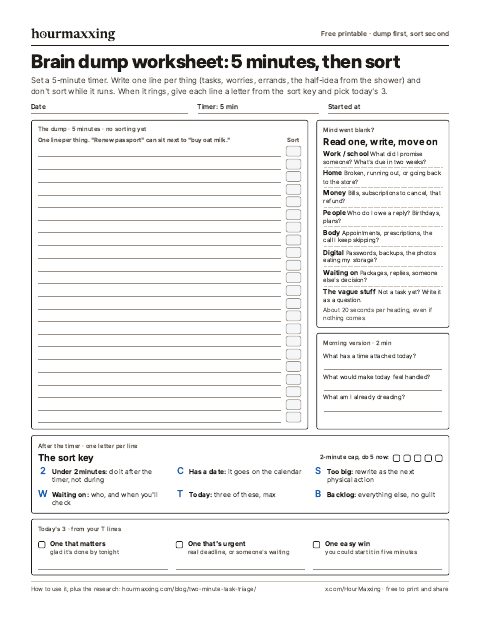
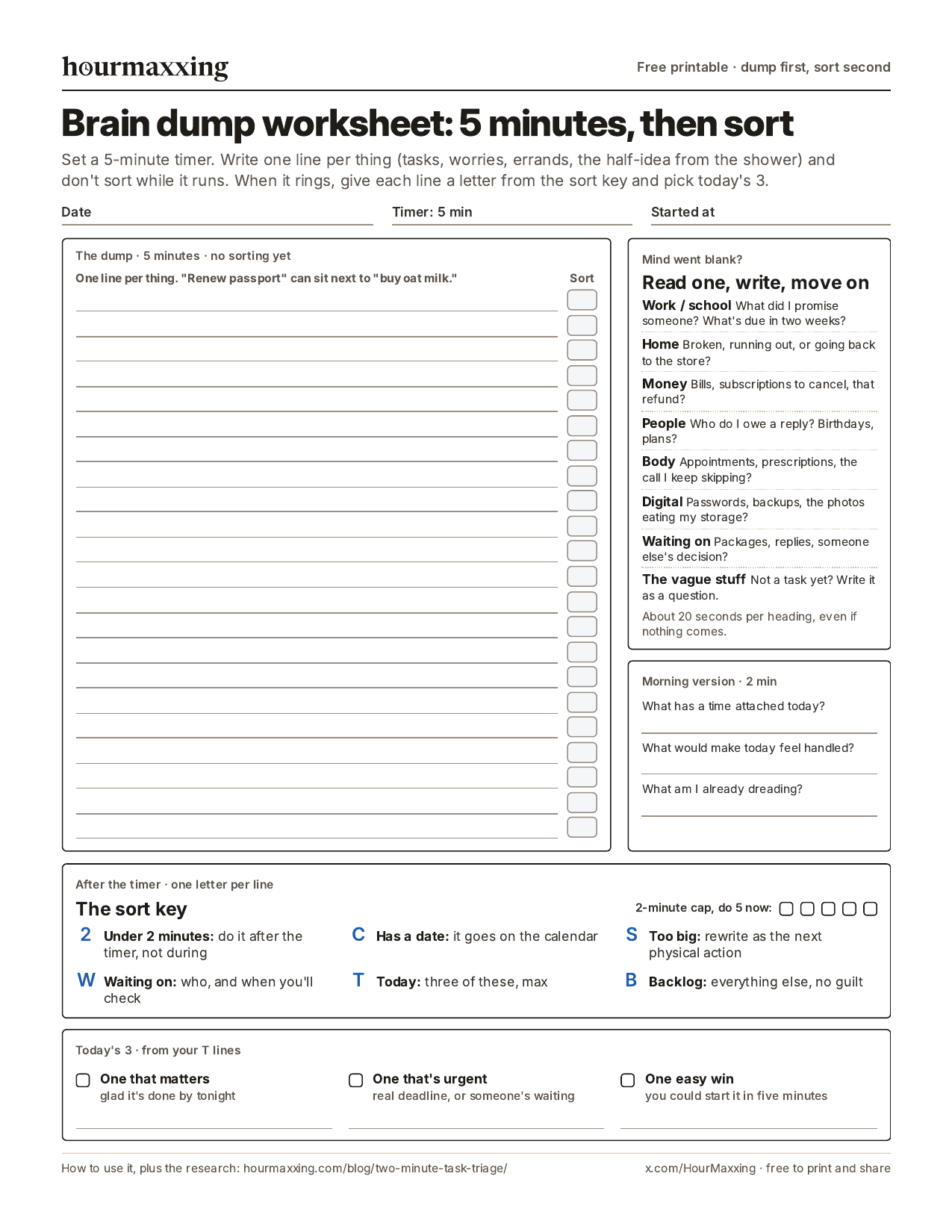
Page 1 is for the daytime dump. Each line has a small box next to it, and you leave the boxes empty until the timer rings. Then every line gets one letter: 2 for under two minutes, C for calendar, S for shrink it, W for waiting on, T for today, B for backlog. Those are steps 2 to 6 as a code you can write in a second.
The prompt list is printed in the margin, along with the 2-minute morning version. That’s the Tulving and Pearlstone finding put to work. A category printed on the page gives your memory something to grab. Today’s 3 go in the boxes along the bottom.
Page 2 is the bedtime version, with the five headings above. Each worry gets a next-step column right beside it, so nothing goes on the page without a move attached.
The top of the sheet nudges you to write specifically, because in Scullin’s sleep-lab study the people with more specific lists fell asleep faster. Keep a few copies on the kitchen table. The nightstand is too close to the pillow.
For your phone, save the image of page 1 and mark it up in your photos app. Once the dump is sorted, the to-do list printable is where today’s 3 and the backlog live.
When the shiny wears off
You know the arc: day one of a project, everything is interesting, tabs multiply, you’re weirdly good at it. Day four, the same project feels like wet cardboard, and you still care about finishing it. That gap between wanting it done and wanting to do it is where half-finished folders go to die.
This isn’t a character flaw. ADHD research on task persistence finds that staying on a task often fails for motivational reasons, not because the skill vanished. In one study, kids with ADHD lost performance over time on a working-memory task, and stronger external reinforcement (including a game-like version) normalized that persistence, while weak feedback did not (Dovis, van der Oord, Wiers, & Prins, 2012). The shiny start is free reinforcement. The middle is unpaid labor. Your brain notices.
So don’t wait for the original motivation to come back. Rebuild a smaller version of day-one conditions:
- Rewrite the next action, not the project. “Finish the website” is a guilt object. “Export the hero image at 1200px” is a task. Same shrink move as step 4 above.
- Schedule a tiny restart, not a heroic catch-up. Fifteen or twenty-five minutes on the calendar beats “I’ll do it this weekend.” If your days never hold still, park it in a flexible time block.
- Add external reinforcement on purpose. A body double for the boring middle, a visible timer, a one-line check-in to a friend (“I’ll text you Done at 7:40”). You’re not bribing yourself into being virtuous. You’re replacing the novelty that already left.
- If it’s dead for real, park or delete it. Some projects stop mattering. Write parked, review Friday or delete the line. An honest backlog beats a fake active list.
The goal isn’t to feel day-one excitement again. It’s to make the next ten minutes obvious enough that starting doesn’t require a pep talk.
When you hate the task (and hyperfocus will not show up)
There is a specific flavor of stuck that triage alone does not fix: the deadline is real, today’s 3 is correct, and your brain would rather paint flowers on the ceiling than open the file. Waiting to “get into it” is how next week arrives with the same untouched task and a louder panic.
You cannot usually force hyperfocus onto work you despise. Hyperfocus arrives when something is novel, urgent, or personally interesting. Aversive admin rarely qualifies. (And when it does show up, it tends to land on the wrong thing and eat the whole afternoon.) A big meta-analysis of procrastination (Steel, 2007, pooling hundreds of correlations) found task aversiveness among the strongest predictors of delay, alongside impulsiveness and how far away the reward sits. Later work frames the delay as short-term mood repair: we put the task off because starting feels bad right now, and Future You inherits the cost (Sirois & Pychyl, 2013). So the goal is not to manufacture joy. It is to make starting cheap enough that mood repair does not have to win.
Wondering whether you can hyperfocus on command instead? Mostly you can’t, but you can set up the conditions it tends to follow.
A triage move for hated work:
- Name the hate in one line. “Boring,” “scary I’ll do it wrong,” “too big,” or “someone will judge it.” Each one gets a different shrink. Boring wants a tinier first step. Scary wants an ugly draft nobody sees. Too big wants a smaller slice. Judgment wants a body double or a send-to-one-person rule.
- Shrink past dignity. Not “work on the report.” Open the doc and write the title. Or paste the brief into a blank note. Or set a 10-minute timer and promise yourself you can stop when it rings. The first action should feel almost too small to count.
- Borrow structure you do not feel. A body double, a library seat, or a silent call where someone else just sits there doing their own thing (basically grown-up parallel play). Interest is optional. Presence often is not.
- Calendar the ugly first version, not the masterpiece. Put “bad draft of section 1, 25 min” on a real block. If your days never hold still, park it inside a flexible theme block. Finished-and-rough beats perfect-and-imaginary.
- Pair the aversive with a small allowed reward after, not before. Tea, a walk, one episode, or a short pick from your dopamine menu. Bribing yourself before starting usually becomes the whole activity.
If today’s 3 are all hate-objects, pick the one with the nearest consequence and run only steps 2 and 4 for ten minutes. You are not trying to feel locked in. You are trying to move the file one inch so tomorrow’s brain has something to continue instead of something to dread.
If it’s every task and not just the hated one, and you’re frozen on the couch unable to start anything at all, that’s task paralysis, and it has its own routine. (It’s not only an ADHD thing, either.)
When there are too many good options
Sometimes the list is fine and the problem is that three things all look like the right first move. That’s a decision problem, not a list problem. Pick by a dumb rule (whichever is first on the page, or a coin) and start the 10-minute version. Our decision paralysis guide has more tie-breakers.
What is ADHD object permanence (out of sight, out of mind)?
You stand up to get the stapler. In the hallway you forget why you left. You open the fridge and stare. You walk into the bedroom for socks and come back with a charger and no socks. The task was clear in the chair. The doorway ate it.
Online, a lot of people with ADHD call this object permanence: out of sight, out of mind, whether the “object” is a stapler, a half-finished email, or a friend you have not texted in a month. As a nickname, it is useful. As a diagnosis, it is not. (If the forgotten friend is the part that hurts, the time blindness guide has a way to explain it that doesn’t sound like an excuse.)
Keeping it going (without it becoming a whole system)
- Daily (3 minutes): quick mini-dump of anything new, then pick today’s 3.
- Weekly (15 minutes): scan the backlog. Promote a few items, delete the dead ones, check next week’s calendar. This fits inside a weekly review if you do one, which adds a look back at what slipped and a free checklist.
- When overwhelmed: do a full dump again. That spiraling feeling usually means too many open loops are back in your head. If you’ve gone fully blank instead, start with what to do in an overwhelm shutdown, then dump.
One list, one place. Use whatever you’ll actually open: a notes app, a paper notebook, a plain text file. The best system is the one you look at.
Common ways this goes sideways
- The list is too long to look at. Hide the backlog. Only the 3 for today should be visible.
- Everything feels like a top 3. Ask “what happens if this waits until tomorrow?” If the answer is “nothing much,” it’s not today’s.
- You pick 3 and then do none. The tasks are probably too big (go back to step 4), or starting is the problem. That’s where body doubling shines.
- Projects start hot and die cold. That’s the shiny-wears-off problem above. Restart with a tiny next action plus external reinforcement, or honestly park it.
- Twenty saved options, zero started. That’s the too-many-good-options problem above. Shrink to two finalists, externalize the pick, start in under two minutes.
- You know exactly what to do and still will not start. That’s the hate-the-task problem above. Shrink past dignity, add a body double or timer, and calendar an ugly first version instead of waiting for hyperfocus.
- You stand up and forget why you left the chair. That is the ADHD object permanence / doorway wipe above. Write the next physical action before you stand, say a keyword on the walk, and do one trip per intention.
- Important emails keep disappearing under newsletters. That is the fire-hose problem above. Filter noise out of the main inbox, VIP the few senders who can change your week, calendar dates on sight, and check in short windows instead of all day.
- Your brain starts the to-do list the second the lights go off. That is the bedtime dump above. Five minutes sitting up, one next step per worry, circle tomorrow’s first move.
- Texts sit on “read” for a week. “Reply later” is a plan with no time attached. Reply badly now, or mark it unread and give “later” a time.
- You keep getting pulled into your phone mid-task. Add some friction first: our guide to a nerfed phone takes about 15 minutes.
Next step
Your top 3 need a home in your day, or they’ll float around until 11pm. Give each one a slot with flexible time-blocking, the version built for people whose plans never survive contact with reality.
Sources
- Safren, S. A., Sprich, S., Mimiaga, M. J., Surman, C., Knouse, L., Groves, M., & Otto, M. W. (2010). Cognitive behavioral therapy vs relaxation with educational support for medication-treated adults with ADHD and persistent symptoms: A randomized controlled trial. JAMA, 304(8), 875-880. https://doi.org/10.1001/jama.2010.1192
- Sprich, S. E., Knouse, L. E., Cooper-Vince, C., Burbridge, J., & Safren, S. A. (2010). Description and demonstration of CBT for ADHD in adults. Cognitive and Behavioral Practice, 17(1), 9-15. https://doi.org/10.1016/j.cbpra.2009.09.002
- Masicampo, E. J., & Baumeister, R. F. (2011). Consider it done! Plan making can eliminate the cognitive effects of unfulfilled goals. Journal of Personality and Social Psychology, 101(4), 667-683.
- Scullin, M. K., Krueger, M. L., Ballard, H. K., Pruett, N., & Bliwise, D. L. (2018). The effects of bedtime writing on difficulty falling asleep: A polysomnographic study comparing to-do lists and completed activity lists. Journal of Experimental Psychology: General, 147(1), 139-146.
- Carney, C. E., & Waters, W. F. (2006). Effects of a structured problem-solving procedure on pre-sleep cognitive arousal in college students with insomnia. Behavioral Sleep Medicine, 4(1), 13-28.
- Harvey, A. G. (2002). A cognitive model of insomnia. Behaviour Research and Therapy, 40(8), 869-893.
- Roediger, H. L., & Karpicke, J. D. (2006). Test-enhanced learning: Taking memory tests improves long-term retention. Psychological Science, 17(3), 249-255. https://doi.org/10.1111/j.1467-9280.2006.01693.x
- Agarwal, P. K. (2017). Brain dump: A small strategy with a big impact. retrievalpractice.org/strategies/2017/free-recall (checked October 2026).
- Ramirez, G., & Beilock, S. L. (2011). Writing about testing worries boosts exam performance in the classroom. Science, 331(6014), 211-213. https://doi.org/10.1126/science.1199427
- Camerer, C. F., Dreber, A., Holzmeister, F., Ho, T.-H., Huber, J., Johannesson, M., … Wu, H. (2018). Evaluating the replicability of social science experiments in Nature and Science between 2010 and 2015. Nature Human Behaviour, 2, 637-644. https://doi.org/10.1038/s41562-018-0399-z
- Allen, D. (2001). Getting Things Done. The “two-minute rule” comes from here.
- David Allen Company. Incompletion Trigger List (mind sweep). gettingthingsdone.com/wp-content/uploads/2022/06/GTD_Incompletion_Trigger_List.pdf (checked October 2026).
- Tulving, E., & Pearlstone, Z. (1966). Availability versus accessibility of information in memory for words. Journal of Verbal Learning and Verbal Behavior, 5(4), 381-391. https://doi.org/10.1016/S0022-5371(66)80048-8
- Clear, J. (2018). Atomic Habits. Avery. Chapter 13, “How to Stop Procrastinating by Using the Two-Minute Rule” (excerpt at jamesclear.com/how-to-stop-procrastinating, checked October 2026).
- Lally, P., van Jaarsveld, C. H. M., Potts, H. W. W., & Wardle, J. (2010). How are habits formed: Modelling habit formation in the real world. European Journal of Social Psychology, 40(6), 998-1009.
- Dovis, S., van der Oord, S., Wiers, R. W., & Prins, P. J. M. (2012). Can motivation normalize working memory and task persistence in children with attention-deficit/hyperactivity disorder? The effects of money and computer-gaming. Journal of Abnormal Child Psychology, 40(5), 669-681.
- Quote Investigator. “Eat a live frog every morning, and nothing worse will happen to you the rest of the day.” quoteinvestigator.com/2013/04/03/eat-frog/ (checked October 2026).
- Steel, P. (2007). The nature of procrastination: A meta-analytic and theoretical review of quintessential self-regulatory failure. Psychological Bulletin, 133(1), 65-94.
- Sirois, F., & Pychyl, T. (2013). Procrastination and the priority of short-term mood regulation: Consequences for future self. Social and Personality Psychology Compass, 7(2), 115-127.
- Radvansky, G. A., & Copeland, D. E. (2006). Walking through doorways causes forgetting: Situation models and experienced space. Memory & Cognition, 34(5), 1150-1156.
- Radvansky, G. A., Krawietz, S. A., & Tamplin, A. K. (2011). Walking through doorways causes forgetting: Further explorations. Quarterly Journal of Experimental Psychology, 64(8), 1632-1645.
- Alderson, R. M., Kasper, L. J., Hudec, K. L., & Patros, C. H. G. (2013). Attention-deficit/hyperactivity disorder (ADHD) and working memory in adults: A meta-analytic review. Neuropsychology, 27(3), 287-302.
These are strategies, not treatment. If ADHD or burnout is making daily life hard, a clinician can help, and asking is not dramatic.
Want one more of these each week?
If the triage helped, the next idea shows up without you having to remember to come back. One technique a week, the study behind it, and a low-energy version. Free, about a 3-minute read, unsubscribe anytime.
We use your address only to send the email, and you can unsubscribe in one click.
FAQ
What is a brain dump?
Writing down everything on your mind (tasks, worries, errands, half-ideas) in one unsorted list, usually with a 5-minute timer running. It gets the open loops out of your head and onto a page you can sort. Nobody has trialed the brain dump as a named technique, but the pieces have research behind them: making a specific plan for an unfinished goal cut how much it intruded on people's thoughts (Masicampo and Baumeister, 2011), and writing a specific to-do list before bed helped people fall asleep faster (Scullin et al., 2018). The dump is step one. Sorting it into today's 3 is step two.
How do I organize a brain dump into a to-do list?
A short, repeatable sort that turns a brain-dump into a list you can act on. Dump everything for 5 minutes, do anything under 2 minutes right now, put anything with a date on the calendar, shrink tasks that are too big, pick 3 for today, and put everything else in a backlog. It takes about 10 minutes the first time and about 3 once it's a habit.
How do I make a to-do list with ADHD?
Keep one calendar and one list instead of five half-lists, write every item as the next physical action, put anything with a date in the calendar, and look at the list once a day at a set time. Show yourself only today's 3 and keep the backlog out of sight. This lines up with the CBT program for adults with ADHD that Safren and colleagues tested in 2010. Its first four sessions trained a calendar and task list system, and 67% of the CBT group responded on the ADHD rating scale vs 33% with relaxation training. A simple template: Today (3 max), On the calendar today, Waiting on, Backlog.
Is there a free printable ADHD to-do list?
Yes. We made a free two-page PDF of the template in this guide, no email needed: hourmaxxing.com/printables/adhd-to-do-list.pdf. Page 1 is the daily sheet with Today (3 max: one that matters, one that's urgent, one easy win), On the calendar today, Waiting on with a check date, and a line for when you'll look at the list each day. Page 2 is the backlog, which sits behind the daily sheet so opening your list shows you 3 things. There's also an image of the daily sheet for your phone.
How do I do a brain dump before bed?
Sit up somewhere that isn't your bed, set a 5-minute timer, and write everything on your mind. Give each worry one small next step, skip any 2-minute tasks until morning, and circle tomorrow's first move. In a 2018 sleep-lab study led by Michael Scullin, people who wrote a specific to-do list for five minutes before bed fell asleep faster than people who wrote about finished tasks. A small study of students with insomnia (Carney and Waters, 2006) found that writing worries plus possible solutions lowered pre-sleep mental arousal more than writing the worries alone. A simple template: On my mind, Has a date, Worry and next step, Waiting on, Tomorrow's first move.
Is there a free printable brain dump template or worksheet?
Yes. We made a free two-page brain dump worksheet (PDF), no email needed: hourmaxxing.com/printables/adhd-brain-dump-worksheet.pdf. Page 1 is the daytime dump. You get one line per thought with a small sort box next to it (2 for under two minutes, C for calendar, S for shrink it, W for waiting on, T for today, B for backlog), the prompt list in the margin, and today's 3 at the bottom. Page 2 is the bedtime template with On my mind, Worry and next step, Has a date, Waiting on, and Tomorrow's first move. There's also an image of page 1 for your phone.
What is a brain dump for students?
Usually it means a retrieval practice exercise: close your notes, write down everything you remember about a topic, then open the notes and fill the gaps. In Roediger and Karpicke's 2006 experiments, students who did free-recall tests on a passage remembered more of it two days and a week later than students who reread it, even though rereading made them feel more confident. The other version, writing out your worries right before an exam, comes from a 2011 Science paper (Ramirez and Beilock) that did not replicate when Camerer and colleagues re-ran it in 2018.
What are good brain dump prompts?
Questions that point at the places tasks hide. What did I promise someone? What's due in the next two weeks? What's broken or running out? Any bills, subscriptions or refunds pending? Who do I owe a reply? Which appointments or prescriptions am I putting off? What am I waiting on? Prompts help because a lot of what you "forget" is still in memory and only needs a cue: in Tulving and Pearlstone's 1966 study, students given category names recalled more words than students with a blank sheet, 126% more on the longest list. David Allen's Incompletion Trigger List from Getting Things Done is the long version.
What's the difference between David Allen's and James Clear's two-minute rule?
Allen's (Getting Things Done) is a sorting rule: if it takes less than two minutes, do it now instead of tracking it. Clear's (Atomic Habits) is a starting rule: scale a new habit down to a version that takes under two minutes, like reading one page or folding one pair of socks. Use Allen's while triaging a list and Clear's when you can't get started. On habits, Lally and colleagues (2010) found the time to reach near-peak automaticity ranged from 18 to 254 days, and missing a single day did not materially slow it down, so a skipped two-minute habit isn't ruined.
What is ADHD object permanence?
An online nickname for out of sight, out of mind with tasks, objects, and sometimes people: you stand up for the stapler and forget why you left, or a half-finished email disappears the second another tab opens. It is not Piaget's infant milestone. The hallway version is mostly a context shift plus a full working memory (Radvansky doorway studies; Alderson 2013 adult ADHD working memory meta-analysis). Park the next physical action outside your head before you stand, then walk.
New here? Start with the reading order → Rather use paper? Grab a free printable.