Short answer: the Ivy Lee method is a daily to-do list routine. At the end of each day, write down the six most important tasks for tomorrow and rank them. Tomorrow, work on number one until it’s done, then number two, and so on. Whatever’s unfinished moves to the next day’s list of six. It works because it forces two decisions most to-do lists skip: what matters most, and what you’ll do first. There’s a free Ivy Lee method PDF template further down.
It’s 5:50pm. The to-do app has 43 items in it, nine of them flagged, two of them from June. Tomorrow you’ll open it, feel vaguely bad, and answer email until lunch. The Ivy Lee method is five minutes tonight that stops that from happening: six lines, a number next to each, done.
This guide covers where the method comes from (and how shaky the famous story is), the steps, examples for students and work, what the research says, how it compares with the Eisenhower matrix, time blocking and eat the frog, and a free Ivy Lee method template you can print or paste into your notes.
What is the Ivy Lee method?
The Ivy Lee method is a short daily list: no more than six tasks, written the evening before, ranked by importance, and worked strictly in order. It is named after Ivy Ledbetter Lee (1877 to 1934), who is mostly remembered as one of the founders of modern public relations.
The 1918 Bethlehem Steel story
The story goes like this. Charles M. Schwab, president of Bethlehem Steel and one of the richest men in America, asked Lee to show him a way to get more done. Lee asked for 15 minutes with each of Schwab’s executives and told them to write down the six most important things to do the next day, number them, and work through them in order. He took no fee up front. Schwab could pay whatever he thought it was worth. After three months, the story says, Schwab sent him a check for $25,000.
It’s a great story, and it’s worth knowing how loose it is:
- The date moves around. James Clear’s popular write-up uses 1918, citing pages 118 and 119 of Scott Cutlip’s history of public relations, The Unseen Power. A local Bethlehem history column puts it in 1914.
- The details change. Some versions say six tasks and three months. The Bethlehem column says five tasks and two weeks. The version in Alec Mackenzie’s The Time Trap, quoted on Wikipedia’s Ivy Lee talk page, has no task limit at all: write down the things you have to do tomorrow, number them, start on number one.
- Nobody has found the original. Clear writes that the earliest reference he could track down is from the 1960s. Editors on Wikipedia’s talk page traced it back to Michael LeBoeuf’s Working Smart (1979) and Mackenzie’s book.
So the $25,000 is a sales pitch for the method, not evidence that it works. The method stands or falls on what it makes you do every day, which is the part we can check against research (further down).
How to do the Ivy Lee method, step by step
These are the five classic steps, with what we’d add to each.
1. At the end of the day, write down up to six tasks for tomorrow
Do it before you close the laptop or leave the library, while you still remember where things stand. Six is the ceiling, not the target. Four good tasks beat six padded ones.
Write outcomes, not topics. “Chemistry” is a topic. “Problem set questions 1 to 5” is a task you can finish. The test: could someone else look at the line and tell, tomorrow at 5pm, whether it’s done?
2. Rank them in order of real importance
Number them 1 to 6. “Real importance” means what moves the things you care about forward or what has a real consequence if it slips, not what’s loudest. If you’re stuck between two, ask which one you’d be most relieved to have done by lunch. That one goes higher.
This is the step that does the work. People reliably drift toward urgent-feeling tasks over important ones (more on that in the research section), and a ranked list written the evening before, when nothing is pinging you, is a decision made in calm conditions.
3. Tomorrow, start with number one and stay on it until it’s done
No email first. No “quick look” at messages. Open number one and work on it. If it’s truly blocked (you’re waiting on someone), note that and go to number two.
Our addition: write the first physical step next to item one. “Open the deck and fix slide 4”, not “pitch deck”. Starting is usually the hard part, and a first step you could do half awake removes the decision at the moment you’re most likely to stall.
4. Work down the list, and carry over what’s left
Finish number one, then start number two. At the end of the day, anything unfinished becomes a candidate for tomorrow’s list, alongside whatever is new. Re-rank all of it. Carry-overs don’t get an automatic top spot.
5. Repeat every working day
The method is the daily repetition. A list made on Monday and ignored by Wednesday is a to-do list with a famous name. Tie the five minutes to something you already do at the end of the day (closing the laptop, the bus home, packing your bag) so it sticks as a habit.
The carry-over rule (three strikes)
If the same task shows up on three lists in a row, stop carrying it. Either split it and write only the first chunk (“outline the report” instead of “write the report”), or admit it isn’t important this week and move it to a backlog. A task that slides forever is a sign the list is lying to you.
Ivy Lee method examples
A student, Sunday to Thursday nights:
- Problem set questions 1 to 5 (first step: open the PDF on the bus, do question 1).
- Email the TA about the lab grade.
- Read pages 40 to 62 for history seminar.
- Book the dentist.
- Outline the essay intro.
- Return the library book.
The problem set is first because it’s due soonest and it’s the one most likely to get avoided. The dentist is fourth because it matters but takes two minutes, so it can wait for a gap between classes.
At work, end of day:
- Draft the Q4 budget summary (first step: copy last quarter’s numbers into the new doc).
- Review Sam’s pull request.
- Prep the 1:1 agenda for Thursday.
- Reply to the vendor about the contract change.
- Update the project tracker.
- Clear the expense report.
Email isn’t on the list at all. It happens in the gaps, after number one has had your best hour.
A messy day off:
- Call the landlord about the heater (first step: find the number in the lease email).
- Laundry, one load, all the way to folded.
- Pay the phone bill.
- Groceries for the week.
Four is fine. On a day without a structure, a short ranked list is what turns “I’ll get to everything” into actually getting the call made before noon.
Does the Ivy Lee method work? What the research says
Nobody has tested the Ivy Lee method as a package, as far as we could find, and the Bethlehem Steel productivity jump is an anecdote with no numbers behind it. What we can check is each thing the method makes you do.
Writing tomorrow’s plan quiets the open loops. E. J. Masicampo and Roy Baumeister (2011) found that unfinished goals kept intruding on people’s thoughts during unrelated tasks, and that making a specific plan for when and how to finish them removed that interference, even though the goals weren’t done yet. An evening Ivy Lee list is that kind of plan for tomorrow’s work.
A specific list at night may help you sleep. In a sleep-lab study led by Michael Scullin (2018), 57 young adults spent five minutes before bed writing either a to-do list for the next few days or a list of things they’d already finished. The to-do list group fell asleep significantly faster, and the more specific their list, the faster they fell asleep. That’s one small lab study in healthy 18 to 30 year olds, so it’s a nice side effect, not a promise. It does fit the method’s end-of-day timing and our “write outcomes” rule.
One task at a time protects your attention. Sophie Leroy (2009) found that when people switched away from an unfinished task, part of their attention stayed stuck on it, which she called attention residue, and they did worse on the next task. Finishing the first task before switching reduced the residue. That’s the logic of step 3. Older lab work on task switching (Rubinstein, Meyer and Evans, 2001) also found that every switch costs time, and the cost grew as the tasks got more complex.
Ranking pushes back against fake urgency. In Zhu, Yang and Hsee’s (2018) experiments, people often picked tasks with a short deadline over tasks with a bigger payoff, even when the deadline didn’t matter. Our Eisenhower matrix guide covers that study in detail. Deciding the order the night before, when nothing is ticking, is a simple guard against it.
Short lists are more honest about time. People routinely underestimate how long their tasks will take, even when they know similar tasks ran over in the past. Roger Buehler, Dale Griffin and Michael Ross (1994) called this the planning fallacy. A cap of six, worked in order, means the tasks that don’t fit fall off the bottom, which is where you want the misses to land.
Our take: the method works for the boring reason that it makes you decide the night before and then stops you from re-deciding all day. If you already plan carefully, it adds little. If your days get eaten by whatever’s loudest, it’s one of the cheapest fixes there is.
A free Ivy Lee method template (PDF, spreadsheet and copyable)
We made a two-page printable: download the Ivy Lee method template (PDF). It’s free, and there’s no email form.
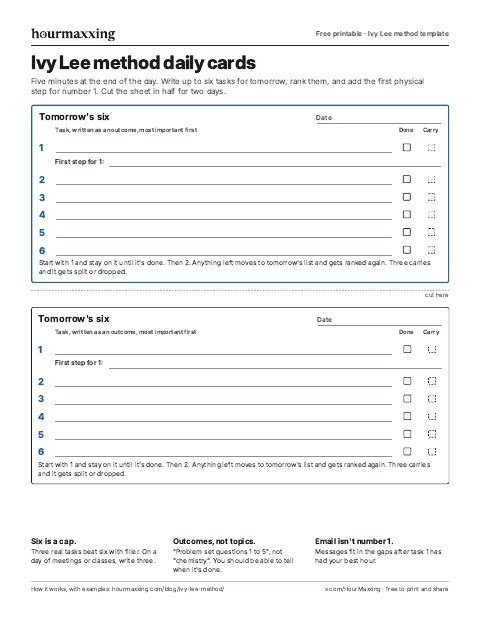
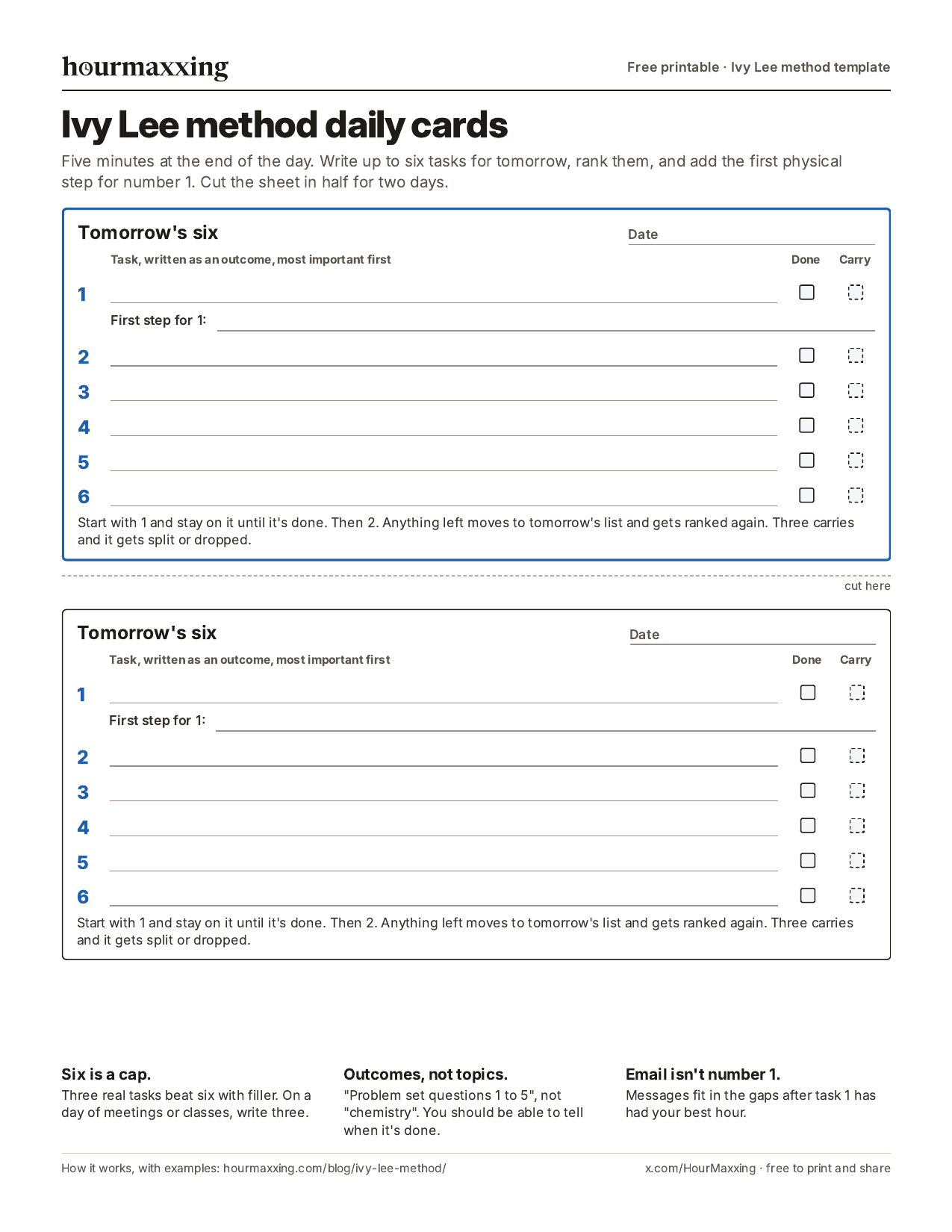
Page 1 is two daily cards. Cut the sheet in half and you have two days. Each card has a date, six ranked lines with a done box and a carry-over box, a first step line under task one, and the rules in small print at the bottom.
Page 2 is a week of Ivy Lee lists. Five columns, Monday to Friday, six ranked lines each, with a Friday check: which tasks got carried over three times, and what you’ll do with them.
There’s also a phone image of page 1. For Excel, Google Sheets or Notion, there’s a spreadsheet version (CSV) with one row per task (date, rank, task, first step, done, carried over) and a filled-in example day to delete. In Google Sheets use File, then Import. In Notion, import the CSV and filter by date. If you’d rather keep it in a note, paste this in as a daily template:
- Date: tomorrow’s date.
- 1. The most important task, written as an outcome.
- First step for 1: one physical action.
- 2. to 6. The rest, in order. Fewer is fine.
- Carried over from yesterday: any task on its second or third day.
- Three strikes: split it, or move it to the backlog.
Why six? (and when to use three)
There’s nothing special about six. It’s the number in the most-told version of the story, and other versions use five or no limit at all. What matters is a small hard cap, so that writing the list forces you to leave things off.
Use fewer when:
- Your day is mostly meetings, classes or shifts. If you have two free hours, six tasks is a guilt list. Write three.
- You never get past item two. That’s your real number. Cut to two or three and finish them.
- The tasks are big. One “write the chapter draft” can be a whole day. Rank it first and let the rest be small.
Our brain dump guide uses three for exactly these reasons. The Ivy Lee list is the slightly bigger, strictly ranked version for days that have more open time. For days chopped up by meetings, the 1-3-5 rule sorts tasks by size instead, so the small ones fit in the gaps.
Ivy Lee method vs other methods
| Method | What it decides | Use it with Ivy Lee? |
|---|---|---|
| Eisenhower matrix | Which tasks matter at all (urgent vs important), usually weekly | Yes. Sort the week with the matrix, pull each day’s six mostly from the important boxes. |
| Brain dump | Gets everything out of your head and into one list | Yes. Dump first, then pick tomorrow’s six from the dump. |
| Time blocking | When each task happens on the calendar | Yes. Block items one and two in your best hours, work the rest in order in the gaps. |
| Eat the frog | Do your hardest important task first | Mostly the same idea. If the frog is the most important task, it’s item one. |
| MIT method | One to three most important tasks, done first | A shorter cousin. Your top one to three Ivy Lee items are your MITs. |
| ABCDE method | Letters every task by consequences (A must, B should, C nice, D delegate, E drop) | Yes. Letter the day’s list, and your As, in order, fill the top of the six. |
| 1-3-5 rule | One big, three medium, five small tasks a day | An alternative. 1-3-5 mixes sizes, Ivy Lee ranks by importance. Pick one. |
| Pomodoro technique | How you stay on a task | Yes. Run Pomodoros on item one until it’s done. |
| Weekly review | The week’s priorities and what slipped | Yes. The review picks the week’s one to three priorities, and they become item one on their days. |
Ivy Lee method for time blocking
This is the combination we’d recommend for most people with some control over their calendar. At the end of the day, write the six and rank them. Then open tomorrow’s calendar and put items one and two into blocks, ideally the first focused hours of the day. The ranking decides what gets protected, and the blocks stop the morning from being eaten by meetings. Items three to six stay unscheduled and get worked in order when you have a gap.
The Ivy Lee method with ADHD (or any brain that hates strict order)
Strict order is the part most likely to break. A few adjustments that keep the point of the method:
- Make item one small enough to start. If item one is huge and dreaded, you’ll stall on it all morning. Split it until the first chunk takes under 25 minutes, which is one round on our Pomodoro timer. Our task paralysis guide has more on getting started when you freeze.
- Allow one swap. If item one is really stuck, you get one swap with item two, written down. Not a free-for-all. If both are stuck, do anything else on the list rather than scroll. That’s structured procrastination, and it still clears tasks.
- Keep the list where you’ll see it. A sticky note on the laptop or the lock screen beats an app you have to open. Out of sight tends to mean out of mind.
- Do the list at a fixed cue. End-of-day planning is easy to skip. Attach it to closing the laptop or packing your bag, and accept that some days it’ll be three lines written on the bus.
- Do it with someone. Write your six while a friend writes theirs, on a call or in the library. A body doubling session works for this too.
Common Ivy Lee method mistakes
- Writing the list in the morning. You can, but the evening version is the point: decide before tomorrow’s noise starts.
- Padding to six. Six is a cap. Three real tasks beat six where three are filler.
- Topics instead of tasks. “Marketing” can’t be finished. “Send the draft newsletter to Jo” can.
- Doing number four first because it’s easy. That’s the habit the method exists to break. Easy tasks go in gaps after item one has had its turn.
- Carrying the same task forever. Three strikes, then split it or drop it.
- Turning it into an app project. A notebook page or the printable is enough. If you spend 20 minutes setting up a Notion template, you’ve procrastinated on tomorrow’s list.
Sources
- Clear, J. The Ivy Lee method: The daily routine for peak productivity. https://jamesclear.com/ivy-lee. Read: the five steps; the 1918 date citing Cutlip, The Unseen Power, pp. 118 to 119; “the earliest reference I have tracked down for the story is from the 1960s”.
- Cutlip, S. M. (1994). The Unseen Power: Public Relations, a History. Lawrence Erlbaum Associates. Cited via Clear for the 1918 date.
- Wikipedia. Talk:Ivy Lee/Archives/2014. https://en.wikipedia.org/wiki/Talk:Ivy_Lee/Archives/2014. Read: the version in Mackenzie, R. A., The Time Trap (3rd ed., 1997), with no task limit; earlier retelling in LeBoeuf, M. (1979), Working Smart.
- Lehigh Valley Press (2014, July 17). This week in Bethlehem history: Ivy Lee, father of public relations. https://www.lvpnews.com/20140717/this-week-in-bethlehem-history-ivy-lee-father-of-public-relations/. Read: the 1914, five-task, two-week version.
- Masicampo, E. J., & Baumeister, R. F. (2011). Consider it done! Plan making can eliminate the cognitive effects of unfulfilled goals. Journal of Personality and Social Psychology, 101(4), 667-683. https://doi.org/10.1037/a0024192.
- Scullin, M. K., Krueger, M. L., Ballard, H. K., Pruett, N., & Bliwise, D. L. (2018). The effects of bedtime writing on difficulty falling asleep: A polysomnographic study comparing to-do lists and completed activity lists. Journal of Experimental Psychology: General, 147(1), 139-146. https://doi.org/10.1037/xge0000374. Read: 57 adults aged 18 to 30, five minutes of writing; to-do list group fell asleep faster; more specific lists, faster sleep onset.
- Leroy, S. (2009). Why is it so hard to do my work? The challenge of attention residue when switching between work tasks. Organizational Behavior and Human Decision Processes, 109(2), 168-181. https://doi.org/10.1016/j.obhdp.2009.04.002.
- Rubinstein, J. S., Meyer, D. E., & Evans, J. E. (2001). Executive control of cognitive processes in task switching. Journal of Experimental Psychology: Human Perception and Performance, 27(4), 763-797. https://doi.org/10.1037/0096-1523.27.4.763.
- Zhu, M., Yang, Y., & Hsee, C. K. (2018). The mere urgency effect. Journal of Consumer Research, 45(3), 673-690. https://doi.org/10.1093/jcr/ucy008.
- Buehler, R., Griffin, D., & Ross, M. (1994). Exploring the “planning fallacy”: Why people underestimate their task completion times. Journal of Personality and Social Psychology, 67(3), 366-381. https://doi.org/10.1037/0022-3514.67.3.366.
Want one more of these each week?
One technique a week, the study behind it, and a low-energy version. Free, about a 3-minute read, unsubscribe anytime.
We use your address only to send the email, and you can unsubscribe in one click.
FAQ
What is the Ivy Lee method?
The Ivy Lee method is a daily to-do list routine. At the end of each workday you write down the six most important things to do tomorrow, rank them in order of importance, and the next day you work on number one until it's done before starting number two. Anything unfinished moves to the next day's list of six. It's named after Ivy Lee, a public relations pioneer who is said to have taught it to the executives of Bethlehem Steel.
What are the steps of the Ivy Lee method?
Five steps. 1) At the end of the day, write down no more than six things you need to do tomorrow. 2) Rank them by real importance. 3) Tomorrow, start with number one and stay on it until it's finished. 4) Work down the list the same way, and at the end of the day move anything unfinished onto a new list of six. 5) Repeat every working day. Our two additions: write a first physical step next to item one, and write each task as a finished outcome, not a topic.
Is the Ivy Lee method story true?
Partly, as far as anyone can tell. Ivy Lee was real and did work for Charles M. Schwab of Bethlehem Steel, and the public relations historian Scott Cutlip dates the meeting to 1918. But no original document of the method has been found, and the retellings disagree: some say six tasks and three months, others five tasks and two weeks, and an older version in Alec Mackenzie's The Time Trap has no task limit at all. The $25,000 check is part of every version. Treat it as a good story, not as evidence that the method works.
Does the Ivy Lee method actually work?
Nobody has run a trial of the Ivy Lee method as a package, as far as we could find. Its parts have decent support: making a specific plan for unfinished tasks reduces how much they nag at you (Masicampo and Baumeister, 2011), writing a specific to-do list before bed helped people fall asleep faster in a sleep-lab study (Scullin and colleagues, 2018), and switching away from an unfinished task leaves attention residue that hurts the next one (Leroy, 2009). Ranking by importance also pushes back against the pull of urgent but unimportant tasks.
Why six tasks in the Ivy Lee method?
There's no study behind the number six. It's simply what the most popular version of the story says, and other versions say five or give no limit. The point is a hard cap that forces you to choose. Six is usually too many for a day full of meetings or classes, so write six and expect to finish the top two or three. If you never get past item two, cut the list to three.
What if I don't finish all six tasks?
That's normal and part of the method. Unfinished tasks move to the top of tomorrow's candidates, and you re-rank them against whatever is new. If the same task gets carried over three days running, it's either too big (split it and write only the first chunk) or not as important as you thought (drop it or park it in a backlog).
Ivy Lee method vs Eisenhower matrix: which is better?
They do different jobs and work well together. The Eisenhower matrix sorts a whole week's list by urgent and important, so it's good for deciding what deserves attention at all. The Ivy Lee method turns that into tomorrow's six, ranked, and tells you to work them one at a time. A simple combination: run the matrix once a week and pull each day's Ivy Lee list mostly from the important boxes.
Can I use the Ivy Lee method with time blocking?
Yes. Write tonight's six, rank them, then give items one and two a block on tomorrow's calendar, ideally early and in your best focus hours. The ranking decides what gets the good hours, and the blocks protect them from meetings. Leave the rest of the list unscheduled and work it in order when gaps appear.
Is there a free Ivy Lee method template?
Yes. We made a free two-page Ivy Lee method template PDF, no email needed: hourmaxxing.com/printables/ivy-lee-method-template.pdf. Page 1 has two cut-out daily cards with six ranked lines, a first step for item one and a carry-over tick. Page 2 is a five-day week of Ivy Lee lists on one sheet. There's also a CSV version for Excel, Google Sheets or Notion, and a copyable text version on the guide page.
New here? Start with the reading order → Rather use paper? Grab a free printable.