Short answer: a weekly review is a 30-minute checklist you run once a week. Look back at what happened, clear loose ends out of your head and your inboxes, then pick one to three priorities for next week and give each a time. The name comes from David Allen’s GTD weekly review. There’s a free weekly review checklist template (PDF) further down.
It’s Sunday, 9:40pm. You have a vague sense that next week is going to be a lot, a group chat you haven’t answered since Thursday, and a tab open called “productivity system 2026 ultimate setup” that you’ll never read. Monday is going to arrive either way. The question is whether it arrives with a plan.
A weekly review is the 30 minutes that turns that vague dread into a short list with times on it. You look back at the week, empty the loose ends out of your head and your inboxes, and pick the one to three things that would make next week a good one. This guide gives you a weekly review checklist, the weekly review questions worth keeping, how David Allen’s GTD weekly review works, and what the research says about why reviewing helps.
There’s a free weekly review template further down, as a printable PDF, a spreadsheet and text you can paste into Notion or your notes.
TL;DR: Same slot every week, about 30 minutes. Look back (10 min): three wins, what slipped and one reason why, and one estimate checked against reality. Clear the decks (10 min): empty your head, collect the loose notes and flagged emails, chase what you’re waiting on, drop three dead items. Plan (10 min): look at the next two weeks of calendar, pick one to three priorities and give each a day and a time, and write Monday’s first move. Bad week? Do the 10-minute version: wins, priorities, first move.
What is a weekly review?
A weekly review is a short, scheduled session where you step back from the daily list and check the whole picture: what happened last week, what’s still open, and what next week needs. The name and the habit come from David Allen’s Getting Things Done (2001), where the weekly review is the step that keeps every other list honest. Allen’s own checklist calls it “the one factor upon which your success” with the system “hinges”.
You don’t have to run GTD to get the benefit. Most weekly review templates share the same three moves, in this order:
- Look back. What got done, what didn’t, and why.
- Clear the decks. Get the open loops out of your head, your notes app and your inbox, and onto one list.
- Look ahead. Check the calendar, pick a few priorities, and give them actual time.
The order matters. Planning first skips the part that makes the plan better: noticing that the “one hour” task took three, or that the same priority has slipped for three weeks.
Weekly review vs weekly planning
Weekly planning is the third step on its own: deciding what goes where next week. A weekly review wraps it in the look back and the clear-out. If you already plan your week in a time-blocked calendar, the review is the 20 minutes you add in front of that planning.
The weekly review checklist (30 minutes, three parts)
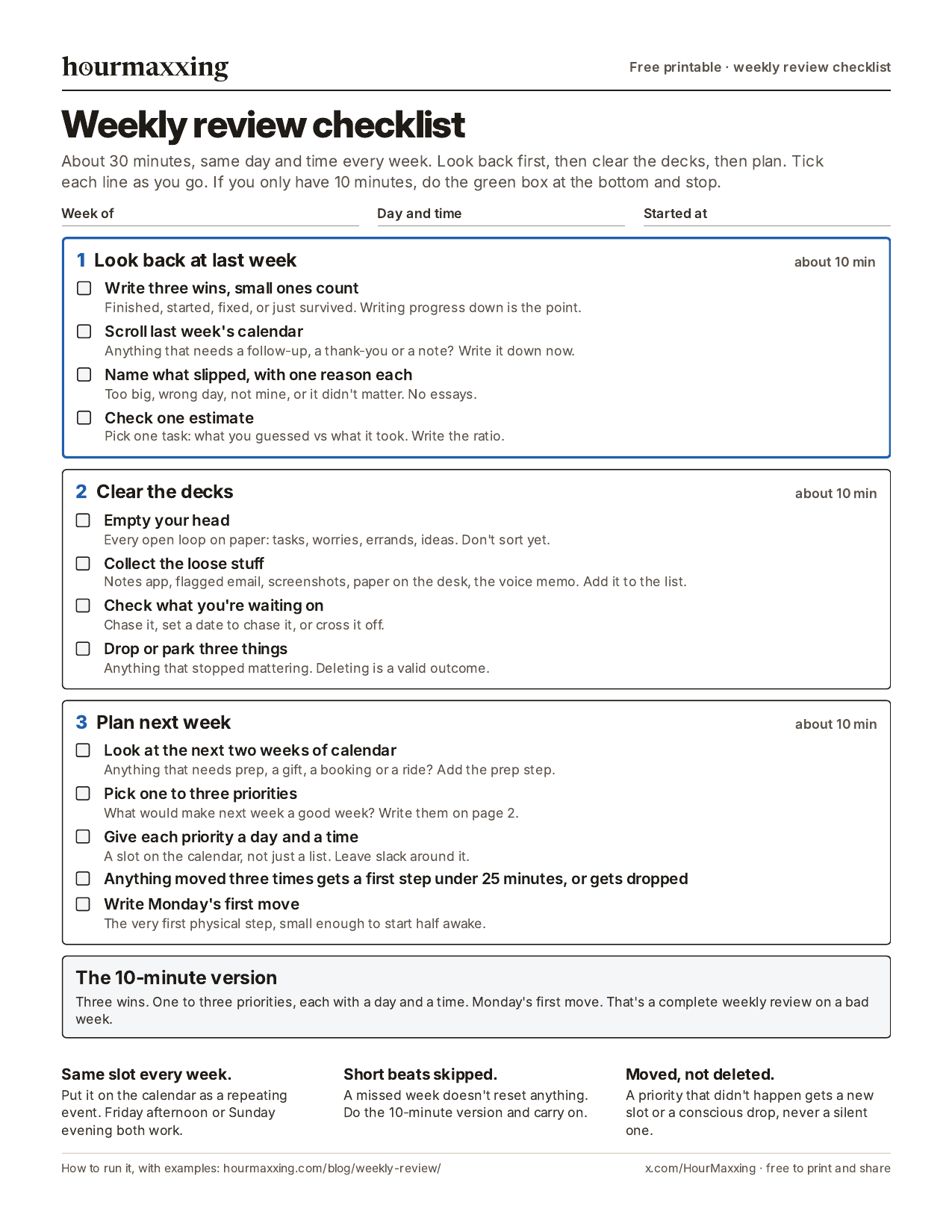
This is the checklist on page 1 of the printable. Set a timer for each part if you tend to overdo the first one.
1. Look back at last week (about 10 minutes)
- Write three wins, small ones count. Finished, started, fixed, or survived. “Replied to the landlord” is a win.
- Scroll last week’s calendar. Anything that needs a follow-up, a thank-you, a note or a receipt? Write it down now.
- Name what slipped, with one reason each. Too big, wrong day, not really mine, or it didn’t matter. One word is enough.
- Check one estimate. Pick a task and compare what you guessed with what it took. If “one hour” keeps meaning two and a half, that ratio is your planning multiplier for next week. (The planning fallacy is why the guess is almost always short.) If you can’t tell where the week went at all, run a time audit once: a few days of half-hour logs give you the real numbers.
2. Clear the decks (about 10 minutes)
- Empty your head. Every open loop onto paper: tasks, worries, errands, half ideas. Don’t sort yet. Our brain dump guide has a sorting method for when the list gets long.
- Collect the loose stuff. Your notes app, flagged emails, screenshots of things you meant to do, paper on the desk, the voice memo from the car. Add anything actionable to the list.
- Check what you’re waiting on. Chase it, write a date to chase it, or cross it off. If you keep a personal kanban board, this is when you clear the Done column and refill Ready.
- Drop or park three things. Something on your list has stopped mattering. Deleting it is a real outcome.
3. Plan next week (about 10 minutes)
- Look at the next two weeks of calendar. Two weeks, because next Thursday’s birthday needs a gift ordered this Monday. Add the prep steps.
- Pick one to three priorities. Ask: what would make next week a good week? If you need help choosing, run the list through the Eisenhower matrix and take your priorities from box 2.
- Give each priority a day and a time. A slot on the calendar, with some slack around it. A priority without a slot is a wish. An ideal week shows where those slots usually are.
- Anything moved three times gets a first step under 25 minutes, or gets dropped. Something that keeps slipping is either too big to start or not actually wanted.
- Write Monday’s first move. The very first physical step, small enough to do half awake: “open the problem set and do question 1”, not “chemistry”. For the rest of the week, the Ivy Lee method carries the same idea into each evening: six tasks for tomorrow, ranked, with your weekly priorities at the top on their days. A shutdown ritual gives that evening list a fixed ten minutes at the end of each workday.
The 10-minute weekly review (for bad weeks)
Three wins. One to three priorities, each with a day and a time. Monday’s first move. That’s a complete weekly review on a week where you have no energy for more, and doing it keeps the habit alive.
A free weekly review template (PDF, spreadsheet and copyable)
We made a two-page printable: download the weekly review template (PDF). It’s free, and there’s no email form.
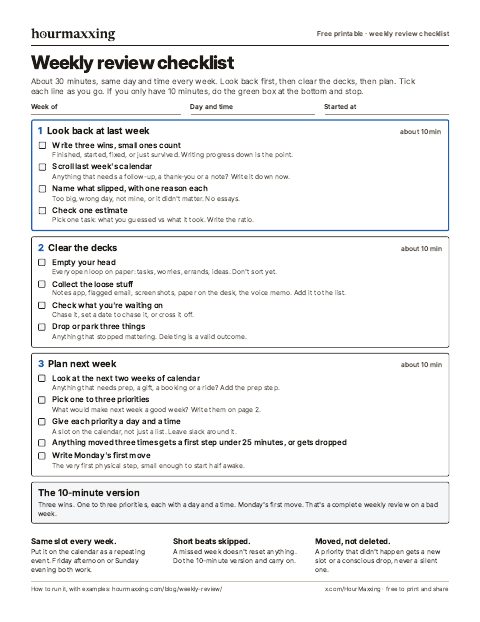
Page 1 is the weekly review checklist. The three parts above as tick boxes, with a line for the week, the day and time you do it, and the 10-minute version in a box at the bottom.
Page 2 is the weekly review questions sheet. Three wins, six questions with room to write, a priorities table with a day, a time and a first step under 25 minutes for each, and an if-then line for whatever might get in the way. Print a stack and keep the old ones in a folder for the monthly read-back.
There’s also a phone image of page 1. For Excel, Google Sheets or Notion, there’s a spreadsheet version (CSV) with one row per week and one column per question, plus a filled-in example row to delete. In Google Sheets use File, then Import. In Notion, import the CSV and it becomes a database you can add a row to every week. If you’d rather keep it in a note (Notes, Notion, Obsidian or Google Docs), paste these headings into a weekly template:
- Week of: the date.
- Three wins: small ones count.
- What slipped, and one reason each: too big, wrong day, not mine, didn’t matter.
- One estimate vs reality: guessed, took, ratio.
- Open loops: head emptied, notes and inbox collected, waiting-on chased.
- Dropped or parked: three things.
- Next two weeks: anything that needs prep.
- Priorities (1 to 3): each with a day, a time and a first step under 25 minutes.
- If this gets in the way, then I will: one line.
- Monday’s first move: one physical step.
Already using our ADHD weekly planner? Its page 2 is a 15-minute weekly reset built on the same idea, tied to the planner’s energy ratings. Use that one if you plan on the weekly sheet, and this one if you want the full review with questions.
Weekly review questions worth asking
Lists of “50 weekly review questions” are fun to read and useless to fill in. Answering eight questions every Sunday gets old by week three. Pick four to six from this list, keep them the same each week so the answers are comparable, and answer each in a line or two. If you keep a journal, the same questions work as weekly review journal prompts.
Looking back
- What went well, and why?
- What took longer than I planned, and by how much?
- What gave me energy this week, and what drained it?
Learning from it
- What did I keep putting off, and what was the real reason? (If the answer is a feeling, like dread or boredom, see how to stop procrastinating.)
- What will I do differently next week?
- What can I stop doing, hand back or say no to?
Looking ahead
- What one to three things would make next week a good week?
- When exactly will I do each one, and what’s the first step?
- What could get in the way, and what will I do if it happens?
The last question is an if-then plan (“if the Tuesday slot gets eaten by a meeting, then I move it to Wednesday 8am”). Those plans have some of the best evidence in this whole area, which is covered below.
Once a month, read your last four answers together. A drain or an excuse that shows up four weeks in a row is the pattern worth fixing.
The GTD weekly review, explained
David Allen’s official GTD weekly review checklist has 11 steps in three phases:
| Phase | Steps |
|---|---|
| Get clear | Collect loose papers and materials. Get your inbox to zero. Empty your head. |
| Get current | Review next actions lists. Review the past calendar. Review the upcoming calendar. Review the waiting-for list. Review project (and larger outcome) lists, making sure every project has a next action. Review any relevant checklists. |
| Get creative | Review the someday/maybe list. Be creative and courageous: add any new ideas. |
Allen suggests early Friday afternoon, because the review “will invariably surface small actions” you can still finish while people are at work. For new users he recommends putting “do weekly review” in the calendar for the next four Fridays, and making your own customized checklist over time.
Our version is a cut-down GTD review with two additions. It drops the full project-list sweep, which is where most people’s weekly reviews stall at the 70-minute mark, and adds a look-back with questions (what slipped and why, one estimate checked) because that’s the part with the research behind it. If you run full GTD with project lists, use Allen’s checklist and add our questions at the end.
When to do your weekly review: Friday or Sunday?
Consistency beats the perfect day. Pick a slot that’s usually calm and put it in your calendar as a repeating event.
- Friday afternoon closes loops while people can still answer your emails, and lets you start the weekend with nothing open in your head. It’s Allen’s pick.
- Sunday evening puts the plan right before Monday, while the week ahead still feels real. It’s the more popular choice for students.
There’s a hint in our own data about why Sunday feels natural. In our analysis of when people look up procrastination and other productivity topics, ten years of English Wikipedia views for 22 topics, Saturday is the quietest day for 21 of the 22. Reading recovers part of the way on Sunday, and Monday or Tuesday is the busiest day for 19 of them. That’s reading behaviour, so it can’t show that a Sunday review works better. It does suggest a lot of people already turn toward the week on Sunday.
Monday has its own pull. In Dai, Milkman and Riis’s (2014) study of 11,912 students at a university gym, the chance of a visit was 33.4% higher at the start of a week than on a typical day. A Sunday review that ends with Monday’s first move puts your priorities right where that start-of-week bump lands.
Does a weekly review actually work?
Nobody has run a trial of “the weekly review” as a package, as far as we could find. The pieces it’s built from have good evidence, though.
Checking progress helps you reach goals, especially on paper. Benjamin Harkin and colleagues (2016) pooled 138 experiments with 19,951 people in which one group was prompted to monitor their progress toward a goal. Monitoring improved goal attainment (d = 0.40, a small-to-medium effect), and the effect was larger when progress was physically recorded or reported to others. The look-back half of a weekly review, written down, is exactly this.
Reflecting on what you did makes you better at it. In a field experiment at Wipro’s call centre in India, Giada Di Stefano, Francesca Gino, Gary Pisano and Bradley Staats had new trainees spend the last 15 minutes of each day writing about what they’d learned. They scored 22.8% higher on the final training test than trainees who used those 15 minutes to keep practising. That was a daily reflection during training, not a weekly one, so it backs the “what will I do differently” question more than it measures weekly reviews.
Making a plan quiets the open loops. E. J. Masicampo and Roy Baumeister (2011) found that unfinished goals kept intruding on people’s thoughts during unrelated tasks, and that making a specific plan for the goal removed that interference, even though the goal wasn’t finished. That’s the clear-the-decks step and the “day and a time” rule.
If-then plans work. Peter Gollwitzer and Paschal Sheeran’s (2006) meta-analysis of 94 tests found that plans in the form “if situation X, then I’ll do Y” had a medium-to-large effect on reaching goals (d = 0.65). The last question on the sheet is one of those.
Noticing progress keeps you motivated. Teresa Amabile and Steven Kramer’s diary study of 238 knowledge workers (nearly 12,000 daily entries) found that making progress in meaningful work was the single biggest boost to people’s emotions and motivation on a given day. That’s a correlational diary study, but it’s a good reason to start the review with three wins rather than with what went wrong.
Our take: the review works because it forces three behaviours most weeks skip, writing down what actually happened, closing open loops with a plan, and giving priorities a time before the week fills up.
A weekly review example
A student, Sunday 7pm, 25 minutes:
- Wins: submitted the lab report, went to the gym twice, finally cleared the chair of laundry.
- Slipped: the chemistry problem set (reason: too big, never split it). History reading (reason: wrong day, Friday night was never going to happen).
- Estimate check: the internship application, guessed one hour, took three. Multiplier: about 3.
- Cleared: six screenshots turned into two tasks, emailed the TA about the grade, deleted “learn Blender” from this month.
- Priorities: chemistry problem set (Tuesday 4pm, first step: do question 1), history essay outline (Thursday 10am), call about the dorm heater (Wednesday 12:30).
- If-then: if the Tuesday slot gets eaten by the group project, then problem set moves to Wednesday 9am.
- Monday’s first move: open the problem set PDF on the bus.
At work, Friday 3pm, 30 minutes:
- Wins: shipped the pricing page fix, unblocked the design review, inbox under 20.
- Slipped: the quarterly report draft, for the third week (reason: too big). It gets a first step: “outline the five sections, 20 minutes”.
- Waiting on: legal sign-off (chase Tuesday), the vendor quote (crossed off, it arrived).
- Priorities: report outline (Monday 9am), interview prep (Wednesday 2pm), 1:1 agenda (Thursday 10am).
- Dropped: the “Q3 process improvements” doc nobody has opened since July.
Weekly reviews with ADHD (or any brain that hates routines)
The hard part is usually starting it. A 45-minute ritual with candles and a fresh notebook is something you’ll do twice. What tends to help:
- Shrink it until it’s easy. The 10-minute version every week beats the full one once a month.
- Tie it to something you already do. Sunday tea, the Friday commute home, the laundry cycle. A fixed cue is how habits stick.
- Use the paper sheet. A printed checklist with boxes to tick is harder to drift away from than a blank note.
- Do it with someone. A friend on a call doing their own review, a study group, or a body doubling session.
- Start with wins. If the first thing you see is everything that slipped, you’ll avoid the review next week. That’s the order on the template.
Common weekly review mistakes
- Building the system instead of doing the review. A gorgeous Notion dashboard with 14 linked databases, and no review since August. Paper and ten minutes is fine.
- Reviewing every project every week. Fine if you run full GTD. For most people it’s where the review dies. Review priorities, not everything.
- Skipping the look-back. Planning without looking back means repeating the same estimate mistakes forever.
- Ten priorities. That’s a to-do list. One to three, each with a time.
- Turning it into a guilt session. “What slipped” gets one reason, not a trial. Then move on.
- No fixed slot. “Sometime this weekend” means never. Put a repeating event in the calendar.
Sources
- Allen, D. (2001; revised 2015). Getting Things Done: The Art of Stress-Free Productivity. Viking / Penguin.
- David Allen Company. GTD Weekly Review checklist (2014, 2015). https://gettingthingsdone.com/wp-content/uploads/2016/04/GTD-WeeklyReview.pdf. Read: 11 steps in three phases, get clear, get current, get creative. And The Weekly Review, by David Allen (2008). https://gettingthingsdone.com/wp-content/uploads/2014/10/Weekly_review.pdf. Read: “early Friday afternoon”, four Fridays in the calendar, customized checklist.
- Harkin, B., Webb, T. L., Chang, B. P. I., Prestwich, A., Conner, M., Kellar, I., Benn, Y., & Sheeran, P. (2016). Does monitoring goal progress promote goal attainment? A meta-analysis of the experimental evidence. Psychological Bulletin, 142(2), 198-229. https://doi.org/10.1037/bul0000025. Read: 138 studies, N = 19,951; goal attainment d = 0.40; larger effects when progress was physically recorded or reported.
- Di Stefano, G., Gino, F., Pisano, G. P., & Staats, B. R. (2014). Learning by thinking: How reflection aids performance. Harvard Business School Working Paper 14-093 (later titled “Making experience count: The role of reflection in individual learning”). Summary read: Nobel, C. (2014, May 5). Reflecting on work improves job performance. HBS Working Knowledge. https://www.library.hbs.edu/working-knowledge/reflecting-on-work-improves-job-performance. Wipro field study, 15 minutes of end-of-day reflection, 22.8% higher final test score.
- Masicampo, E. J., & Baumeister, R. F. (2011). Consider it done! Plan making can eliminate the cognitive effects of unfulfilled goals. Journal of Personality and Social Psychology, 101(4), 667-683. https://doi.org/10.1037/a0024192.
- Gollwitzer, P. M., & Sheeran, P. (2006). Implementation intentions and goal achievement: A meta-analysis of effects and processes. Advances in Experimental Social Psychology, 38, 69-119. https://doi.org/10.1016/S0065-2601(06)38002-1. 94 independent tests, d = 0.65.
- Amabile, T. M., & Kramer, S. J. (2011). The power of small wins. Harvard Business Review, 89(5). https://hbr.org/2011/05/the-power-of-small-wins. Read: 238 people on 26 project teams in seven companies, nearly 12,000 diary entries.
- Dai, H., Milkman, K. L., & Riis, J. (2014). The fresh start effect: Temporal landmarks motivate aspirational behavior. Management Science, 60(10), 2563-2582. https://doi.org/10.1287/mnsc.2014.1901.
- HourMaxxing (2026). When people look up procrastination: ten years of Wikipedia views for 22 productivity topics. https://hourmaxxing.com/research/when-people-look-up-procrastination/. Saturday quietest for 21 of 22 topics; Monday or Tuesday busiest for 19 of 22.
Want one more of these each week?
One technique a week, the study behind it, and a low-energy version. Free, about a 3-minute read, unsubscribe anytime.
We use your address only to send the email, and you can unsubscribe in one click.
FAQ
What is a weekly review?
A weekly review is a short, scheduled session, usually 15 to 45 minutes, where you look back at the past week, clear out the loose ends in your head and inboxes, and plan the next week. It comes from David Allen's Getting Things Done method, where it's the step that keeps the rest of the system trustworthy. You don't need GTD to use one: the core is looking back, clearing the decks and picking one to three priorities with a day and a time.
How do you do a weekly review?
Pick the same 30-minute slot every week and work through three parts. Look back for about 10 minutes: three wins, what slipped and one reason why, and one time estimate checked against what really happened. Clear the decks for about 10 minutes: empty your head onto a list, collect loose notes and flagged emails, chase anything you're waiting on, and drop a few dead items. Plan for about 10 minutes: check the next two weeks of calendar, pick one to three priorities, give each a day and a time, and write down Monday's first move. On a bad week, do only the wins, the priorities and the first move.
What questions should I ask in a weekly review?
Good weekly review questions are short and the same every week, so you can compare answers. Our core set: What went well, and why? What took longer than I planned? What gave me energy, and what drained it? What did I keep putting off, and what was the real reason? What will I do differently next week? What can I stop doing or say no to? What one to three things would make next week a good week, and when will I do each one? What could get in the way, and what will I do if it happens? Pick four to six and answer each in a line or two.
How long should a weekly review take?
About 30 minutes is a good target: roughly 10 minutes looking back, 10 clearing the decks and 10 planning the week. David Allen's full GTD weekly review often takes longer, an hour or more, because it covers every project list. On a bad week, a 10-minute version (three wins, one to three priorities with a day and a time, and Monday's first move) is far better than skipping.
What is the GTD weekly review?
The GTD weekly review is David Allen's 11-step checklist in three phases. Get clear: collect loose papers, get your inbox to zero, empty your head. Get current: review next action lists, the past calendar, the upcoming calendar, the waiting-for list, project lists and any relevant checklists. Get creative: review the someday/maybe list and add any new ideas. Allen calls it the critical success factor for GTD and suggests early Friday afternoon.
Is it better to do a weekly review on Friday or Sunday?
Either works, and consistency matters more than the day. Friday afternoon lets you close loops while people are still at work, which is why David Allen suggests it. Sunday evening puts the plan right before Monday. In our analysis of ten years of Wikipedia views for 22 productivity topics, reading dips on Saturday and recovers part of the way on Sunday, and Monday or Tuesday is the busiest day for 19 of the 22 topics, so Sunday is when a lot of people already turn toward the week.
Is there a free weekly review template?
Yes. We made a free two-page weekly review template PDF, no email needed: hourmaxxing.com/printables/weekly-review-template.pdf. Page 1 is the 30-minute weekly review checklist in three parts with a 10-minute version. Page 2 has the weekly review questions with room to write, three wins, one to three priorities with a day, a time and a first step, and an if-then plan. There's also a CSV version for Excel, Google Sheets or Notion, with one row per week, and a copyable text version on this page for Notes, Notion or Obsidian.
What is the difference between a weekly review and weekly planning?
Weekly planning looks forward: what goes where next week. A weekly review looks back first (what happened, what slipped and why), clears the open loops, and only then plans. The looking-back part is what makes the next plan better, because it shows you how long things really took and which priorities keep slipping.
What if I miss my weekly review?
Do the 10-minute version as soon as you notice, and carry on. A missed week doesn't reset anything. If you miss it two weeks running, the slot is probably wrong: move it to a time that's already calm, attach it to something you do anyway (Sunday tea, the Friday commute home), and shrink it until it's easy to start.
New here? Start with the reading order → Rather use paper? Grab a free printable.