Short answer: the 1-3-5 rule is a to-do list with a fixed shape: for tomorrow, pick one big task, three medium ones and five small ones, and let everything else wait on a separate list. That’s the whole method (the to-do list one, not the chord rule from guitar class or the parabola trick from algebra). There’s a free 1-3-5 rule PDF template further down. Picture a list with 23 lines on it, from a report due Friday to “fix printer??”. The rule keeps nine of them for tomorrow, and the cutting is the part that does the work.
It sounds too simple to need a guide, but people get stuck on the sizing. What counts as “big”? Do nine tasks fit a day with four meetings? Where do the other 14 go? Below: real examples, a quick time check, versions for chopped-up days and ADHD, the research, and a free 1-3-5 rule template.
What is the 1-3-5 rule?
The 1-3-5 rule is a daily to-do list with a fixed shape. You assume that in one day you can finish:
- 1 big task, the one that would make the day count if nothing else got done.
- 3 medium tasks, real work that moves things forward but doesn’t need your whole morning.
- 5 small tasks, the quick stuff that keeps life running: a booking, a form, a two-line reply.
You choose those nine the evening before, from a longer master list, and everything else stays on the master list until a future day picks it.
Where the 1-3-5 rule comes from
The rule is known through Alex Cavoulacos, a co-founder of the career site The Muse. In her Muse article “Why You Never Finish Your To-Do Lists at Work”, she tells readers to “assume that you can only accomplish one big thing, three medium things, and five small things”, to define tomorrow’s 1-3-5 before leaving work, and to revise it down if you spend much of your day in meetings. She adds one more detail most summaries skip: if your job brings lots of unexpected tasks, leave one medium and two small slots blank for them.
The Muse editors later published a standalone explainer with a printable, crediting her with sharing the method. The New Rules of Work (2017), the book she wrote with Kathryn Minshew, goes a step further and says the rule is one “which Alex developed”. We couldn’t find an older source for it. Unlike some productivity methods, there’s no famous origin story to fact-check here, just a sensible rule from someone who ran a busy company.
How to use the 1-3-5 rule, step by step
1. Keep one master list
The 1-3-5 list only works if the other 14 things have somewhere to go. Cavoulacos and Minshew suggest two lists: one big “kitchen sink” list of everything, and the short daily one. If you don’t have a master list yet, do a brain dump first. It takes about five minutes and gives you the pile to pick from.
2. Give each candidate a size and a minutes guess
This is the step that decides whether the method works for you. “Big” and “medium” mean nothing until you put minutes on them. Here are the sizes we’d start with (our suggestion, not part of the original rule):
- Big: 90 minutes to 3 hours of focused work. Draft the report, write 800 words of the essay, build the slide deck.
- Medium: 30 to 60 minutes. Review a document, read a chapter, prep a meeting agenda.
- Small: 15 minutes or less. Book an appointment, pay a bill, send a file, reply to one email.
If a “big” task would take more than about three hours, it’s a project. Put the first three-hour chunk on the list (“outline and draft section 1”), not the whole thing.
When you guess the minutes, list the steps in your head first. “Prep the 1:1 agenda” sounds like 10 minutes. “Read last week’s notes, check the tracker, write four questions, send it” is closer to 40. That small habit helps with a known estimating bias (see the research section below).
3. Pick one big, three medium and five small for tomorrow
Do it at the end of the day, before you close the laptop or leave the library, while you still know where things stand. Pick the big task first, since it’s the one that matters most. Then the medium tasks, then the small ones.
Ask of the big task: if this is the only thing that gets done tomorrow, will the day still have been worth it? If not, you picked the wrong one.
4. Check that it fits your free time
Add up the minutes. Then look at tomorrow’s calendar and subtract meetings, classes, shifts, commutes and lunch. Whatever is left is your real budget.
With our sizes, a full 1-3-5 list is somewhere between about 3 and 7 hours of work. That fits a day with five or six free hours. It does not fit a day with four hours of meetings, and a list that can’t fit is a guilt list. If the total is over budget, use a smaller shape (see “Smaller versions” below) or swap a medium task for a small one. Leave some slack, because something will come up.
5. Start with the big task, then fill the gaps
Tomorrow, give the big task your best focus hours, ideally first thing or right after your first meeting. Fit the medium tasks into the next longest gaps and save the small ones for the 10 to 20 minute slivers between calls or classes. That’s where the rule earns its keep: small tasks have a home that isn’t “before I start the real work”.
6. Move what’s left back to the master list
At the end of the day, anything unfinished goes back to the master list and competes with everything else for tomorrow’s nine. It doesn’t get a guaranteed spot. If the same big task keeps sliding, it’s probably two tasks pretending to be one. Split it and put only the first piece on the list.
1-3-5 rule examples
At work, end of Monday:
| Size | Task | Minutes |
|---|---|---|
| Big | Draft the Q4 budget summary (first step: copy last quarter’s numbers into the new doc) | 150 |
| Medium | Review Sam’s pull request | 45 |
| Medium | Prep Thursday’s 1:1 agenda | 40 |
| Medium | Reply to the vendor about the contract change | 30 |
| Small | Book the meeting room | 10 |
| Small | Submit the expense report | 10 |
| Small | Update the project tracker | 10 |
| Small | Send the slides to Jo | 5 |
| Small | Renew the parking pass | 10 |
| Total | 310 (about 5 hours) |
Total: about 5 hours. Tuesday has a 30-minute standup and a 1-hour call, so it fits with some room left over. Email isn’t on the list. It happens in the gaps.
A student, Sunday night:
- Big: Write the first 800 words of the history essay (first step: paste the three quotes into the doc).
- Medium: Problem set questions 1 to 5. Read pages 40 to 62 for seminar. Email the TA about the lab grade.
- Small: Return the library book. Print the lab sheet. Pay the phone bill. Book the dentist. Answer the group chat about Friday.
Monday has four hours of class. So the essay goes in the free morning block, the reading goes on the bus, and the small tasks fit between classes. If you’re studying for exams rather than writing, our guide to focusing while studying covers how to run those sessions.
A day off with errands:
- Big: Deep clean the kitchen.
- Medium: Groceries for the week. One load of laundry, all the way to folded. Call the landlord about the heater.
- Small: Pay the phone bill, water the plants, take the recycling out, order the birthday present, text back about Saturday.
On a day with no structure, the shape does the job a calendar would. Without it, days off tend to dissolve into a lot of small tasks and no big one.
Smaller versions: 1-2-3, 1-1-3 and blank slots
Nine tasks is a full day. Plenty of days aren’t full days. Cavoulacos herself says to revise the list down if you’re in meetings a lot. Some shapes we’d use:
| Your day | Shape | Why |
|---|---|---|
| Five or more free hours | 1-3-5 | The original. |
| Half the day in meetings or class | 1-2-3 | Still one real thing, fewer extras. |
| Back-to-back meetings, or a low-energy day | 1-1-3 | One big task (or a small “big” one), and a few quick wins. |
| Lots of surprise requests | 1-3-5 with 1 medium and 2 small blank | Cavoulacos’s own suggestion: plan for the interruptions instead of pretending they won’t come. |
| You know the big task will eat the day | 1-0-3 | The big task plus three small things you can’t let slip. |
The numbers aren’t sacred. The point is a fixed cap with a mix of sizes, decided before the day starts.
Does the 1-3-5 rule work? What the research says
Nobody has tested the 1-3-5 rule as a method, as far as we could find. What we can check is what it makes you do.
People underestimate their tasks, and splitting them helps. Roger Buehler, Dale Griffin and Michael Ross (1994) found that people routinely predict they’ll finish tasks sooner than they do, even when they remember similar tasks running late. They called it the planning fallacy. Justin Kruger and Matt Evans (2004) then asked people to estimate tasks like holiday shopping, getting ready for a date and formatting a document. When people were prompted to list the steps first, their estimates got longer, and in the experiments where actual time was measured, less biased. The more steps a task had, the bigger the effect. That’s why step 2 above has you list the steps before guessing the minutes, and why a big task gets capped at about three hours.
A concrete plan quiets unfinished tasks. E. J. Masicampo and Roy Baumeister (2011) found that unfinished goals kept intruding on people’s thoughts during unrelated tasks, and that making a specific plan for them removed the interference, even though the goals weren’t done yet. The evening 1-3-5 list is a plan for tomorrow. The master list is a plan for everything else: it’s written down, and it’ll be picked from again.
Deciding when and how makes follow-through more likely. Peter Gollwitzer and Paschal Sheeran (2006) pooled 94 tests of “implementation intentions”, plans that say when, where and how you’ll act, and found a medium-to-large effect on reaching goals (d = 0.65). Writing the big task’s first step and slotting it into a specific time is that kind of plan.
Deciding ahead pushes back against fake urgency. In experiments by Meng Zhu, Yang Yang and Christopher Hsee (2018), people often chose tasks with a short deadline over tasks with a bigger payoff, even when the deadline didn’t matter. Picking the big task the night before, when nothing is pinging you, is a simple guard against the day filling up with whatever is loudest. Our Eisenhower matrix guide covers that study in more detail.
Fewer switches, less leftover attention. Sophie Leroy (2009) found that switching away from an unfinished task leaves “attention residue” that hurts performance on the next one. Batching the five small tasks into gaps, instead of sprinkling them through the big task, keeps the big task’s block clean.
Our take: the 1-3-5 rule works for the boring reason that it forces you to choose, size and schedule before the day starts. The sizing is the part most people skip, and it’s the part with the best evidence behind it.
A free 1-3-5 rule template (PDF, spreadsheet and copyable)
We made a two-page printable: download the 1-3-5 rule template (PDF). It’s free, and there’s no email form.
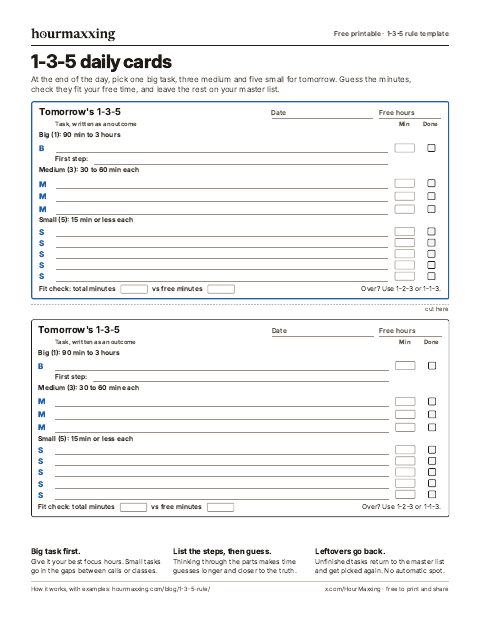
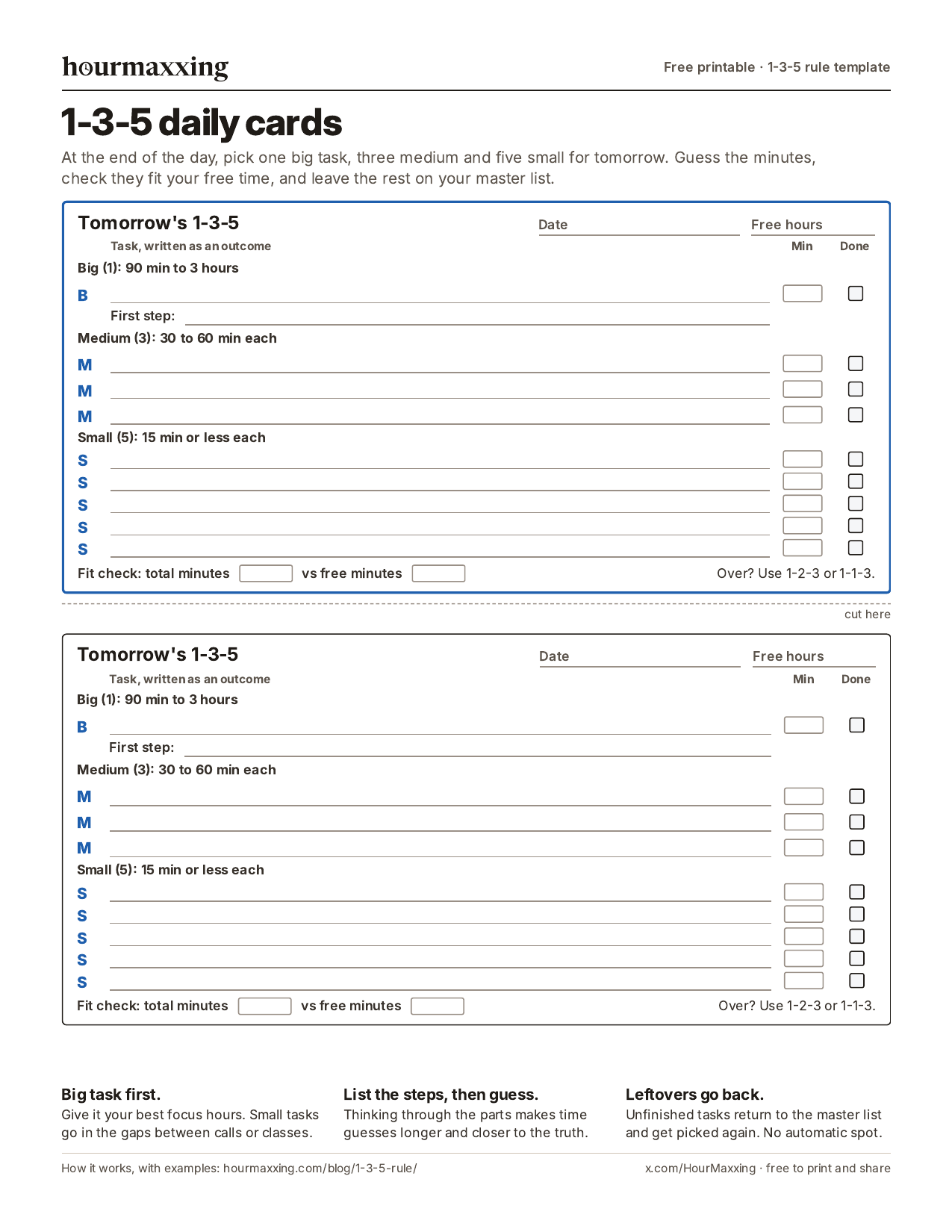
Page 1 is two daily cards. Cut the sheet in half and you have two days. Each card has one big line with a first step, three medium lines and five small lines, a minutes box beside every task, done boxes, and a fit check at the bottom: total minutes against free hours.
Page 2 is the sizing sheet. List up to 15 candidates from your master list, circle B, M or S, guess the minutes, then copy the winners onto a card. It also has the smaller shapes (1-2-3, 1-1-3, blank slots) for days that aren’t full days.
There’s also a phone image of page 1. For Excel, Google Sheets or Notion, there’s a spreadsheet version (CSV) with one row per task (date, size, task, minutes, first step, done) and a filled-in example day to delete. In Google Sheets use File, then Import. In Notion, import the CSV and group by size. If you’d rather keep it in a note, paste this in as a daily template:
- Date and free hours: tomorrow’s date, and how many hours are actually free.
- Big (1): one task, 90 minutes to 3 hours. First step: one physical action.
- Medium (3): 30 to 60 minutes each.
- Small (5): 15 minutes or less each.
- Fit check: total minutes, compared with free hours. Over? Use 1-2-3 or 1-1-3.
- Blank slots: leave one medium and two small empty if surprises are likely.
1-3-5 rule vs the Ivy Lee method and other methods
| Method | What it decides | Use it with 1-3-5? |
|---|---|---|
| Ivy Lee method | Up to six tasks, ranked by importance, done strictly in order | An alternative. Ivy Lee suits days with long open stretches. 1-3-5 suits days chopped into pieces. Pick one. |
| Brain dump | Gets everything out of your head into one list | Yes. The dump becomes your master list, and the 1-3-5 picks from it. |
| Eisenhower matrix | Which tasks matter at all (urgent vs important), usually weekly | Yes. Sort the week with the matrix and pull the big task from the important boxes. |
| Time blocking | When each task happens | Yes. Block the big task, and leave medium and small tasks for the gaps. |
| Eat the frog | Do your hardest important task first | Close. The big task is usually the frog. |
| Personal kanban board | How many tasks you have open at once (a WIP limit, usually three) | Yes. The 1-3-5 picks fill the Ready column, and Doing stays capped. |
| Pomodoro technique | How you stay on a task | Yes. Run timed rounds on the big task. |
| Weekly review | The week’s priorities and what slipped | Yes. Each weekly priority becomes the big task on its day. |
1-3-5 vs Ivy Lee, in one line each
The Ivy Lee method asks “what matters most, in order?” The 1-3-5 rule asks “what fits today, by size?” If you keep doing the easy task first and never reach the important one, Ivy Lee’s strict order is the stronger medicine. If your day is interruptions with a few gaps in between, the 1-3-5 mix gives those gaps something useful to do. On days when even nine feels like too many, the most important task (MIT) method shrinks it to one to three.
The 1-3-5 rule with ADHD (or any brain that resists lists)
The size mix is friendlier than a strict ranked list for a lot of ADHD brains. Small tasks offer a way in when the big one feels impossible. A few adjustments help:
- Shrink the big task until you can start it. If the big task is huge and dreaded, you’ll orbit it all morning. Write the first chunk that takes 25 minutes or less, plus its first physical step. Our task paralysis guide has more on getting started when you freeze.
- Allow a warm-up. One or two small tasks before the big one is fine, if you pick them in advance. Five small tasks before it is the old trap.
- Use smaller shapes on bad days. 1-1-3 is still a list that works. A full 1-3-5 you abandon by 11am is not.
- Double your minutes guesses for the first week. Then compare with what really happened. Our time blindness guide explains why estimates tend to run short and how to find your own multiplier.
- Keep it on paper and in sight. A card next to the keyboard or a photo on the lock screen beats an app you have to remember to open.
- Plan it with someone. Write your nine while a friend writes theirs. A body doubling session works for this too.
We are not clinicians, and nothing here is treatment advice. If lists never stick no matter how you shape them, that’s worth raising with a doctor.
Common 1-3-5 rule mistakes
- Skipping the master list. Without it, the 14 unpicked tasks keep nagging at you and sneak back onto the daily list.
- Calling a project a big task. “Write the thesis” is not a day. “Draft section 2” is.
- Filling all nine slots on a meeting day. Check the total against your free hours, and use a smaller shape.
- Doing the five small tasks first, every day. They feel productive, and then it’s 3pm. Big task first, small tasks in the gaps.
- Treating unfinished tasks as failures. They go back to the master list. That’s the system working as designed.
- Building the perfect app setup. A card or a sticky note is enough. If the template takes longer to set up than tomorrow’s list, that’s procrastination with extra steps.
Sources
- Cavoulacos, A. Why you never finish your to-do lists at work (and how to change that). The Muse. https://www.themuse.com/advice/why-you-never-finish-your-todo-lists-at-work-and-how-to-change-that. Read: “assume that you can only accomplish one big thing, three medium things, and five small things”; define tomorrow’s 1-3-5 before leaving work; revise down for meeting-heavy days; leave one medium and two small tasks blank for unexpected requests.
- The Muse Editors. A better to-do list: The 1-3-5 rule. The Muse. https://www.themuse.com/advice/a-better-todo-list-the-135-rule. Read: the standalone explainer and printable, crediting Cavoulacos with sharing the method.
- Minshew, K., & Cavoulacos, A. (2017). The New Rules of Work: The Modern Playbook for Navigating Your Career. Crown Business. Excerpt read at https://startupnation.com/books/new-rules-work-book-excerpt/: “the 1-3-5 Rule, which Alex developed”; one “kitchen sink” master list plus a short daily list.
- Buehler, R., Griffin, D., & Ross, M. (1994). Exploring the “planning fallacy”: Why people underestimate their task completion times. Journal of Personality and Social Psychology, 67(3), 366-381. https://doi.org/10.1037/0022-3514.67.3.366.
- Kruger, J., & Evans, M. (2004). If you don’t want to be late, enumerate: Unpacking reduces the planning fallacy. Journal of Experimental Social Psychology, 40(5), 586-598. https://doi.org/10.1016/j.jesp.2003.11.001. Read: five experiments; prompting people to list a task’s parts produced longer and, where measured, less biased estimates, more so for tasks with more parts.
- Masicampo, E. J., & Baumeister, R. F. (2011). Consider it done! Plan making can eliminate the cognitive effects of unfulfilled goals. Journal of Personality and Social Psychology, 101(4), 667-683. https://doi.org/10.1037/a0024192.
- Gollwitzer, P. M., & Sheeran, P. (2006). Implementation intentions and goal achievement: A meta-analysis of effects and processes. Advances in Experimental Social Psychology, 38, 69-119. https://doi.org/10.1016/S0065-2601(06)38002-1. Read: 94 independent tests, 8,461 participants, d = 0.65.
- Zhu, M., Yang, Y., & Hsee, C. K. (2018). The mere urgency effect. Journal of Consumer Research, 45(3), 673-690. https://doi.org/10.1093/jcr/ucy008.
- Leroy, S. (2009). Why is it so hard to do my work? The challenge of attention residue when switching between work tasks. Organizational Behavior and Human Decision Processes, 109(2), 168-181. https://doi.org/10.1016/j.obhdp.2009.04.002.
Want one more of these each week?
One technique a week, the study behind it, and a low-energy version. Free, about a 3-minute read, unsubscribe anytime.
We use your address only to send the email, and you can unsubscribe in one click.
FAQ
What is the 1-3-5 rule?
The 1-3-5 rule is a way to build a daily to-do list. You assume you can get one big thing, three medium things and five small things done in a day, so you pick those nine tasks the evening before and leave everything else on a separate master list. It was popularized by Alex Cavoulacos, a co-founder of The Muse. It has nothing to do with the 1-3-5 chord rule in music or the 1-3-5 trick for graphing parabolas.
How do you use the 1-3-5 rule?
Keep one master list of everything. At the end of the day, give each candidate task a rough size (big, medium or small) and a minutes guess. Pick one big task, three medium and five small for tomorrow, and check that their minutes fit the free time you actually have. Tomorrow, start with the big one, fit the medium and small tasks around it, and move anything unfinished back to the master list to be picked again. Our suggested sizes: big is 90 minutes to 3 hours, medium is 30 to 60 minutes, small is 15 minutes or less.
What is an example of a 1-3-5 list?
A work example: big, draft the Q4 budget summary. Medium: review a pull request, prep Thursday's 1:1 agenda, reply to the vendor about the contract. Small: book the meeting room, submit the expense report, update the tracker, send the slides to Jo, renew the parking pass. A student example: big, write the first 800 words of the essay. Medium: problem set questions 1 to 5, read pages 40 to 62, email the TA. Small: return the library book, print the lab sheet, pay the phone bill, book the dentist, reply to the group chat about Friday.
Who created the 1-3-5 rule?
The rule is known through Alex Cavoulacos, a co-founder of the career site The Muse. She set it out in a Muse article called Why You Never Finish Your To-Do Lists at Work, and the 2017 book she wrote with Kathryn Minshew, The New Rules of Work, says she developed it. The Muse later published a standalone explainer and a printable. We couldn't find an older source.
Does the 1-3-5 rule work?
Nobody has tested the 1-3-5 rule itself in a study, as far as we could find. Its parts line up with decent research: people underestimate how long tasks take (the planning fallacy), and splitting a task into its pieces makes estimates longer and more realistic (Kruger and Evans, 2004). Making a concrete plan for unfinished goals stops them from nagging at you (Masicampo and Baumeister, 2011), and deciding when and how you'll act has a medium-to-large effect on following through (Gollwitzer and Sheeran, 2006, 94 tests). A fixed cap of nine also forces a choice that an open-ended list never does.
Is the 1-3-5 rule good for ADHD?
It can be, with a few changes. The mix of sizes helps, because the five small tasks give you quick wins and a way to get moving when the big task feels impossible. What tends to break is the big task, so shrink it until the first chunk takes 25 minutes or less, write its first physical step, and allow one or two small tasks before you start it. On bad days drop to 1-1-3. Keep the list on paper where you'll see it, and leave slots blank if your days get interrupted. We are not clinicians, and this is not treatment advice.
1-3-5 rule vs the Ivy Lee method: which is better?
They solve slightly different problems. The Ivy Lee method ranks up to six tasks by importance and has you do them strictly in order, which suits days with long open stretches. The 1-3-5 rule sorts nine tasks by size and lets you fit the small ones into gaps, which suits days broken up by meetings, classes or messages. If your day has one big block of free time, try Ivy Lee. If it's chopped into pieces, try 1-3-5. Use one at a time.
Is there a free 1-3-5 rule template?
Yes. We made a free two-page 1-3-5 template PDF, no email needed: hourmaxxing.com/printables/1-3-5-to-do-list-template.pdf. Page 1 has two cut-out daily cards with one big, three medium and five small lines, a minutes box per task, a first step for the big task and a check that the total fits your free hours. Page 2 is a sizing sheet for sorting candidates, plus the smaller versions for meeting days and bad days. There's also a CSV version for Excel, Google Sheets or Notion, and a copyable text version on this page.
New here? Start with the reading order → Rather use paper? Grab a free printable.